
Manual iPaaS migrations run six to twelve months. That's not an exaggeration teams use to justify staying put; it's what it actually takes to hand-translate a workflow platform's proprietary recipe format into another proprietary recipe format, one connector and one edge case at a time. Teams stay on integration platforms they've already outgrown because the migration cost is worse than the platform's flaws. That calculation is real, and it's the reason a lot of technical debt in the integration layer never gets paid down.
AI coding assistants can now read that same proprietary format and rewrite it into a different one in minutes instead of months. That's a genuine result. It is also solving the wrong half of the problem.
Migrating faster doesn't change what you're migrating into. If the destination is still a proprietary format that only an AI (or a very patient engineer) can parse, you haven't fixed the six-to-twelve-month problem. You've just pre-paid for the next one.
The speed claim is real, and it's not the interesting part
Hand-converting a legacy workflow platform's export format into a new vendor's recipe schema is exactly the kind of task AI coding assistants are good at: bounded, pattern-heavy, mechanical translation with a clear source and a clear target. A tool that parses that export and reconstructs the logic on the other end compresses a migration timeline for real. Most workflows in a real integration estate are structured and documented enough to convert cleanly on a first pass. The edge cases that need a human rebuild are the minority.
None of that is in dispute. Teams that have been stuck on a platform for years because the switching cost was too high now have a faster way to switch. That's worth taking seriously.
But compressing the migration timeline answers a narrower question than it looks like it does. It answers "how fast can I get from platform A's format to platform B's format." It doesn't touch the question that actually determines whether you do this again in three years: what shape is the logic in once it lands.
Reconstructing logic and owning logic are different outcomes
Here's what AI-assisted conversion actually demonstrates, whether or not the marketing says it out loud: your integration logic was already expressible as plain, parseable text. An AI model read a workflow export, understood the routing, the transforms, the error handling, and rebuilt it correctly enough to work. That's only possible because the logic itself is not fundamentally visual or platform-specific. It's structured logic that happens to be trapped inside a proprietary JSON or recipe schema.
Once you've seen an AI do that, the natural next question isn't "which vendor migrates fastest." It's why the logic had to be locked in a format that needed reverse-engineering at all.
If an AI can parse your integration logic into text on demand, that logic should have been living as text all along.
The alternative to "trap it, then hire an AI to un-trap it every few years" is not complicated. It's the same practice already applied to every other piece of production software: the logic lives as a real file, in a real repository, under real version control, from day one. Nobody needs an AI assistant to reverse-engineer your application code before a platform migration, because your application code was never encoded into a proprietary format in the first place. It was always just code, sitting in Git, where any tool, human or AI, can read and write it directly.
The AI didn't just migrate a workflow. It proved the workflow was text-shaped the whole time and someone chose to hide that.
A faster migration into the same model is still a rental
The deeper issue with using AI purely to accelerate conversion into a new proprietary format is what happens after the migration completes. The logic is now encoded in a different vendor's schema, readable by that vendor's editor and, going forward, by an AI assistant that has to parse it again next time. The governance layer for that logic is whatever gateway or audit log the new platform ships. None of that is owned in the sense that matters. It isn't diffable in your own version control. It doesn't go through the same review process your engineers already use for everything else they ship.
| Faster migration, same format model | Land in Git-native text | |
|---|---|---|
| Logic after migration | Proprietary recipe/JSON, vendor-specific | Real files in your own repo |
| Change review | Vendor's built-in audit trail, if any | Diff + pull request through GitHub/GitLab, same as application code |
| Next migration | Needs another AI-assisted (or manual) reverse-engineering pass | Already portable; any tool that reads text can work with it |
| Who can read it without the vendor's tool | Nobody | Any engineer, any AI assistant, any editor |
A workflow that's easy to convert out of one black box and into another black box is still, on the day the migration finishes, sitting in a black box. The clock on the next multi-month migration starts again the moment you land.
What it actually means to land somewhere durable
Landing in a durable format isn't a vague aspiration. It's three concrete, checkable properties, and an AI-assisted migration into a new proprietary schema satisfies none of them by default.
- The logic is a file in your repository, not a row in a vendor's database. Real Git versioning, with in-platform branching against the GitHub or GitLab your team already uses. Change history, blame, and rollback work exactly the way they do for the rest of your production code, because the workflow is treated as the same kind of artifact.
- Every execution emits a trace you own. OpenTelemetry on every tier, not a proprietary dashboard that's the only place execution history exists. When something breaks post-migration, whoever's on call debugs it with the same tools they use for the rest of production, not a separate login for the integration layer specifically.
- The bill doesn't reset the clock on your next migration decision. Cost tied to capability, not execution volume, means a workflow that gets promoted to production and starts carrying real traffic doesn't turn into a forecasting problem that forces a re-evaluation on its own schedule, separate from whether the platform itself still fits.
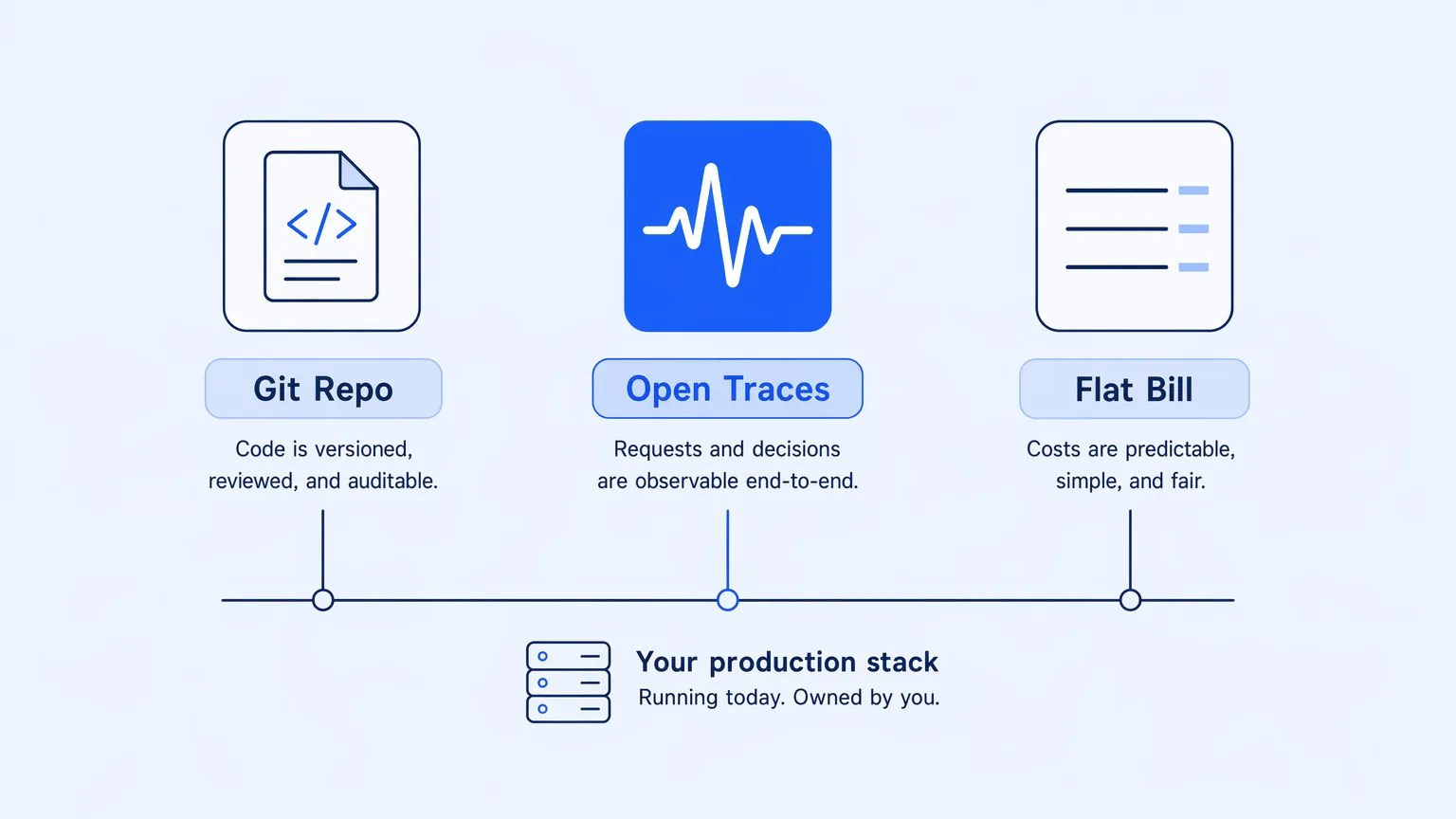
Compare that to "AI reconstructed my workflow into a new recipe format" and the difference isn't subtle. One gives you a workflow a vendor's tool can open. The other gives you a workflow any tool, including the next AI coding assistant that comes along, can read and modify directly, continuously, without a conversion step.
Where migrating fast into a familiar format is still the right call
Not every integration justifies insisting on Git-native ownership before you move it. A disposable notification hook or a one-off sync that nobody would notice failing for an afternoon doesn't need diffable version control any more than it needed it on the old platform. If a team is migrating a large batch of genuinely low-stakes automations and speed is the only variable that matters, an AI-assisted bulk conversion into whatever destination format is fastest to stand up is a reasonable trade.
The distinction worth making during the migration, not after, is which workflows in the estate are disposable and which are load-bearing. The load-bearing ones are exactly the ones worth landing somewhere you won't have to migrate off of again in three years.
Land where the format itself stops being the problem
A migration project already forces the assessment, the parallel run, and the cutover decision. If you're already spending the effort to move, spend it landing somewhere that doesn't need this exercise repeated.
Koodisi's Git-Enabled workflows are real files in your own repository from the moment they're created, branched in-platform and reviewed through the GitHub or GitLab flow your team already runs. Every execution emits an OpenTelemetry trace exportable to the observability stack you already use. The Professional tier removes execution-based overages entirely, so a workflow's promotion to production doesn't become the reason the next migration conversation starts early.
If you're mid-migration off a legacy platform right now, the question worth asking before cutover isn't just how fast the new format converts. It's whether the format on the other end is one your own engineers, and your own tools, can read and write directly, indefinitely, without needing an AI to translate it again the next time the platform stops fitting.