
You've shipped an API. You've also bought a seat on some integration platform. Both connect systems. Both move data. And at some point someone on your team — maybe you — said "wait, why do we have both of these?" and nobody gave a satisfying answer.
The reason the question lingers is that most explanations treat it as a vocabulary problem: here's what an API is, here's what iPaaS means, now go make better purchasing decisions. That misses the real question, which isn't taxonomic. It's about where integration logic lives, who owns it when it breaks, and what actually happens to both approaches once real production load arrives.
APIs and iPaaS are not competing answers to the same question — they sit at different layers of your stack, and the decision to use one, the other, or both depends entirely on which layer you're trying to govern.
Quick answer
- An API is a contract that exposes one system: send this request, get that response. The team that owns the system owns the API.
- API management is the layer that publishes, secures, versions, and monitors APIs: authentication, rate limits, developer portals, and usage analytics.
- iPaaS (integration platform as a service) connects many systems. It consumes their APIs, and other interfaces, to move data and run workflows between them.
- In short: an API exposes one system, API management governs access to it, and iPaaS coordinates the work that spans several systems.
API vs API management vs iPaaS at a glance
| API | API management | iPaaS | |
|---|---|---|---|
| What it does | Exposes one system's capabilities to other software | Publishes, secures, versions, and monitors APIs | Connects multiple systems and orchestrates data and workflows between them |
| Who owns it | The team that owns the underlying system | A platform or API team | Whoever owns the cross-system business process |
| Unit of work | A single request and response | Access to a set of APIs | A multi-step workflow across systems |
| Typical question | "How do other systems talk to ours?" | "How do we expose this safely to other teams and partners?" | "How do we keep five systems in sync without custom code for every pair?" |
| Example | A "create customer" endpoint | Rate limits, keys, and a portal for that endpoint | When a deal closes in the CRM, create the customer in the ERP, provision access, and notify the team |
What an API actually gives you (and what it doesn't)
An API is a contract. You publish a set of endpoints, you define the request and response shapes, you authenticate callers, and you let other systems talk to yours on those terms. The contract is yours to version, yours to deprecate, yours to monitor.
That's genuinely powerful. When you own the API, you own the interface. You control how your system is consumed. Rate limits, authentication, schema evolution — all live in your house.
What an API does not give you is orchestration. An API tells callers what they can ask; it doesn't coordinate the sequence of things that need to happen after they ask. If a new user signing up needs to provision a record in your billing system, enqueue a welcome email, sync to your CRM, and kick off a compliance check — that sequence, with its retries, error handling, and ordering guarantees, doesn't live in any individual API. It lives somewhere in the middle.
The API defines the edges of your system. Everything between those edges — the routing, the transformation, the retry logic, the sequencing — has to live somewhere else.
Where it actually lives in most mid-market stacks: a mix of Lambda functions, cron jobs, webhook handlers in your application code, and some integration tooling that nobody fully owns. The API contract is clean. The space behind it is archaeology.
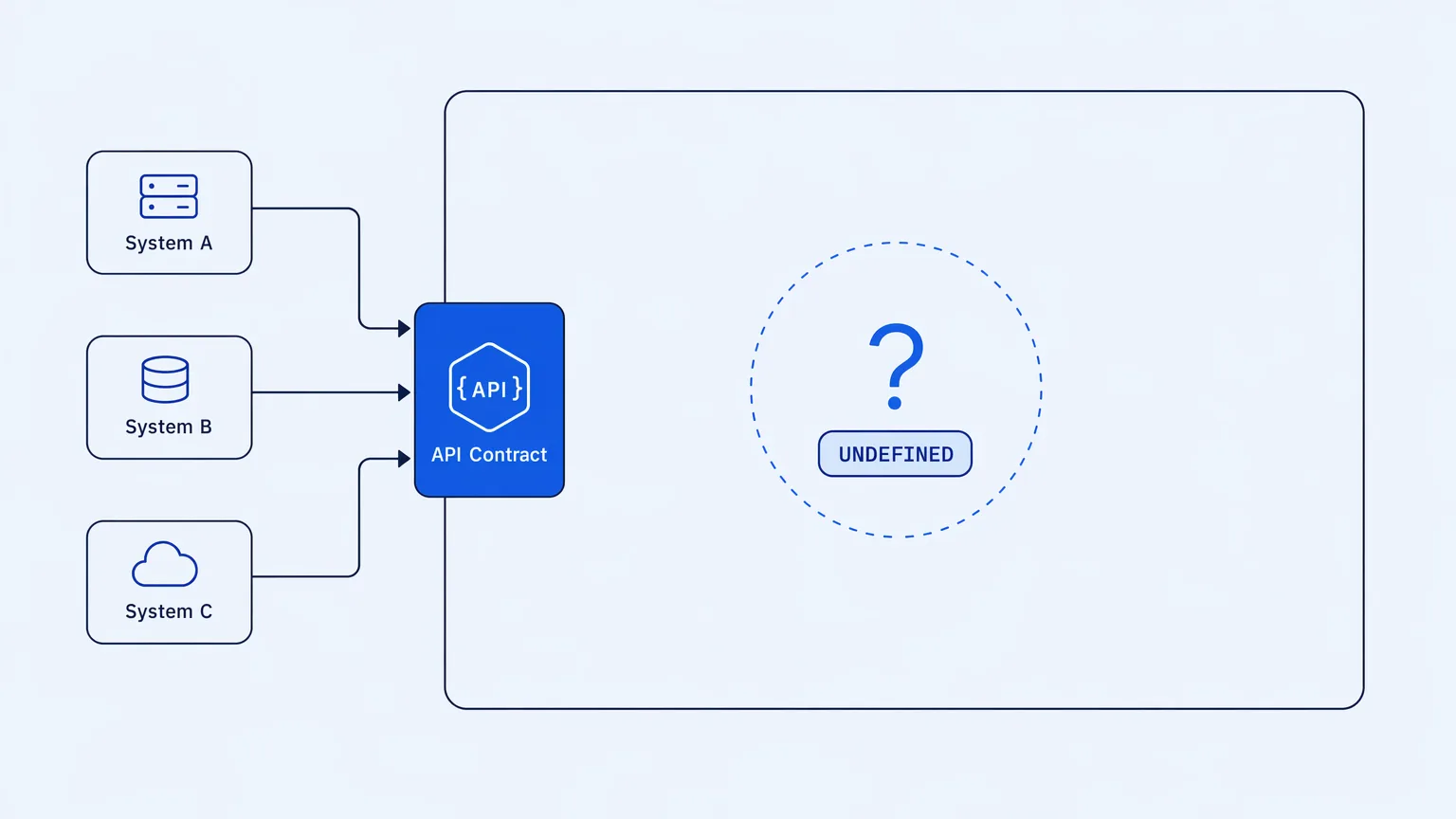
An API is a clean contract at the boundary of a system; it cannot govern what happens when multiple systems need to cooperate.
What iPaaS actually gives you (and where it gets uncomfortable)
An iPaaS — an Integration Platform as a Service — is the place where cross-system orchestration lives. It's the answer to "who coordinates the sequence?" It holds the workflow logic that says: when event A arrives from system 1, transform it, call system 2, wait for confirmation, call system 3, and if any step fails, retry it twice before routing to a dead-letter queue.
Done well, this is a significant operational win. You get a single place where integration logic is visible, testable, and (with better platforms) versioned. You remove the class of problems that come from integration logic scattered across application code, Lambda scripts, and tribal knowledge.
Where iPaaS gets uncomfortable is in three predictable places.
First, pricing. A large class of integration platforms charge per execution — per task, per recipe run, per action step. That model seems fine when you're handling thousands of events a month. It gets uncomfortable the first time a customer floods your webhook, a loop runs more iterations than expected, or you promote a workflow to production and traffic scales by 10x. The bill moves when your traffic moves, which means your integration costs are unpredictable at exactly the moment they matter most.
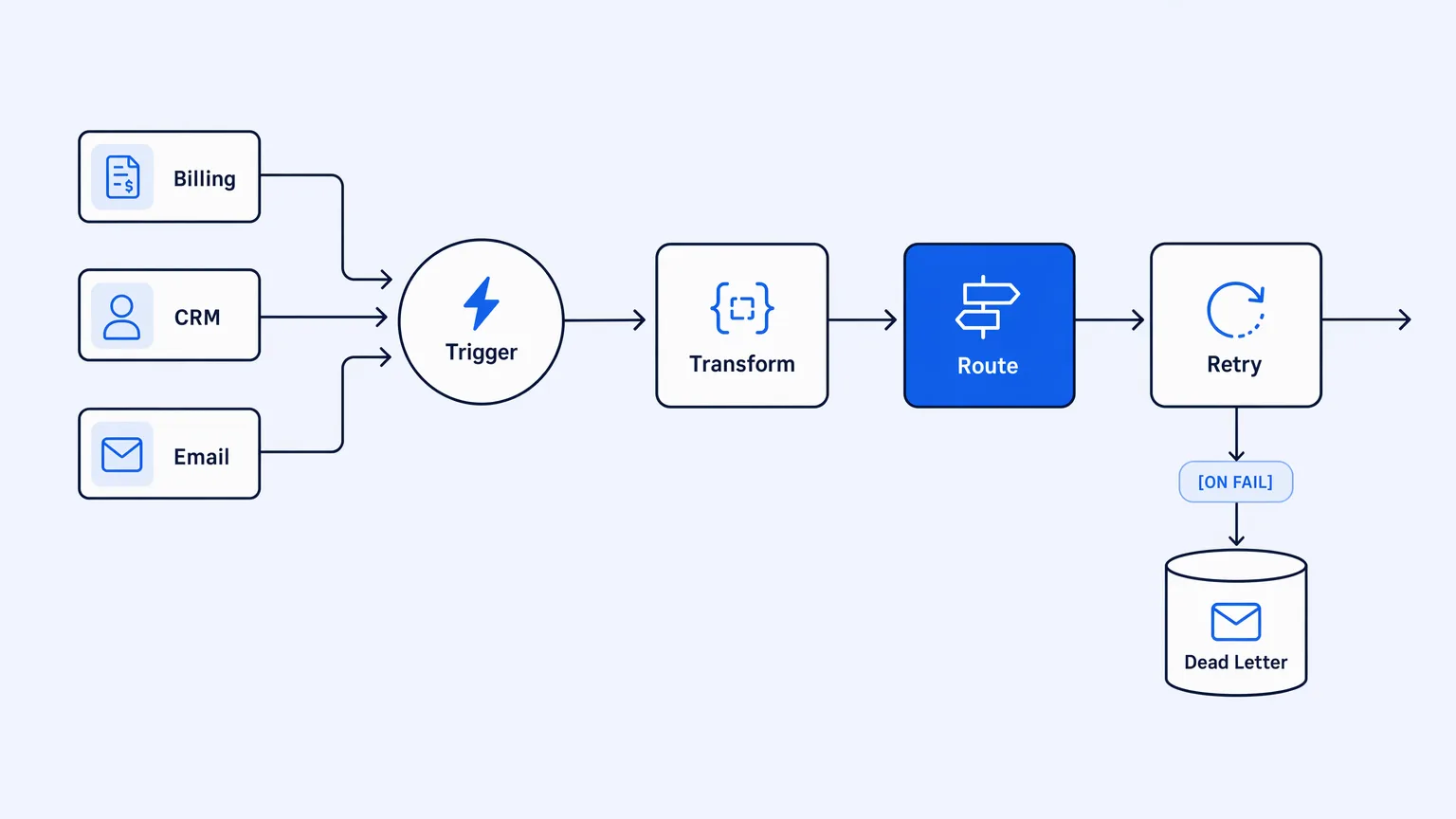
Second, observability. Many platforms log execution state inside their own UI, behind their own query interface. When something goes wrong at 2 AM, your SRE team can't pull a span into your existing observability stack — they have to context-switch into the integration vendor's console, with whatever visibility that vendor decided to give you. That's a structural blind spot that application monitoring can't compensate for.
Third, version control. The integration logic that now runs your onboarding, your billing events, and your AI pipelines is production software. It should be treated like production software — reviewed, versioned, rollable-back. Most platforms store workflows in their own database rather than your Git repo. That means changes don't go through your engineering workflow. They don't show up in your diff history. And when something breaks, reconstructing what changed and when is its own investigation.
iPaaS solves the orchestration gap that APIs leave open, but not all platforms give you the ownership properties you'd demand from any other production system.
The question that actually matters: who owns the contract when it breaks?
The API vs iPaaS framing is a useful first cut, but the sharper question is about ownership. When something breaks in production — a transformation silently corrupts a record, a retry loop double-charges a customer, a workflow deploys a change nobody reviewed — where does the accountability land?
With an API, the answer is reasonably clear. The owner of the service owns the contract. Version mismatches are a versioning problem. Security issues are an authentication problem. Both are yours to fix, in your codebase, through your deployment process.
With iPaaS, it depends entirely on how that platform treats your artifacts. If your workflow logic lives in a vendor database, every change is a vendor-UI operation. If execution traces live in a vendor console, incident response requires vendor access. If billing spikes when traffic spikes, financial exposure is a function of your traffic pattern, not your purchasing decision.
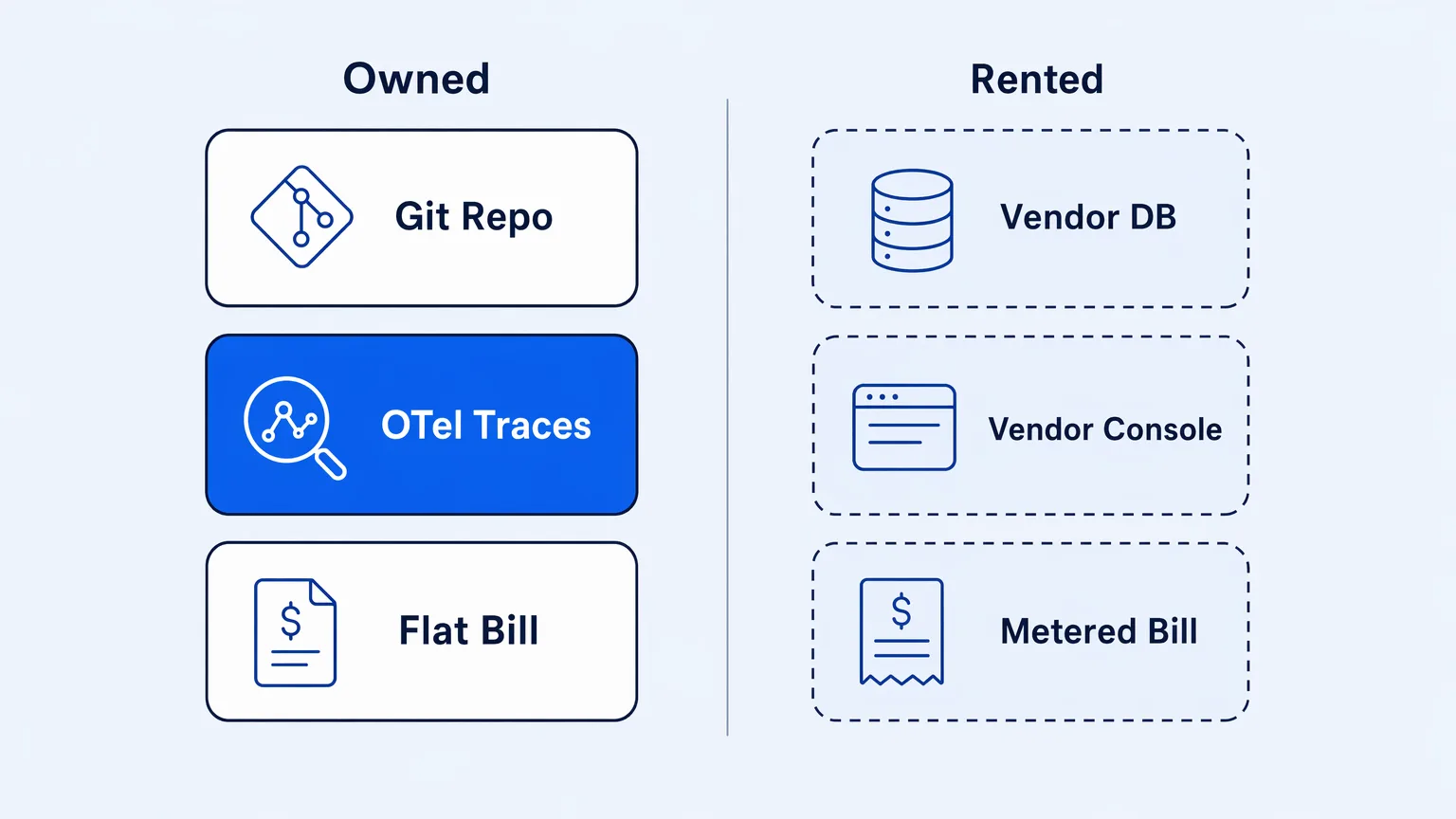
The teams that end up least surprised by their integration layer are the ones that treat integration logic with the same ownership expectations they'd apply to application code: the logic should be in their repo, the traces should land in their observability stack, and the bill should not move with traffic.
That's not universally available from iPaaS vendors. But it's the right bar to set — and platforms that hit it make the "API vs iPaaS" question far less consequential, because they close the gap that makes iPaaS uncomfortable in the first place.
Why APIs and iPaaS get confused
Two reasons. First, many iPaaS vendors also sell API management, sometimes as one product. MuleSoft's Anypoint Platform, for example, combines API management and integration, so the line between the two blurs in the marketing. Second, an iPaaS consumes APIs constantly: most connectors are pre-built wrappers around a system's API. It's easy to assume an "integration platform" and an "API platform" are the same thing under different names.
They aren't. You can have excellent API management and no cross-system integration at all, such as a company that publishes a well-documented, rate-limited API for its product and nothing else. You can also run an iPaaS without managing a single API of your own, connecting SaaS apps through the APIs they already provide.
When to use an API, when to use iPaaS, and when to use both
This is the part most comparisons spend too long on, usually in the form of a decision tree that doesn't survive contact with a real system. A simpler framing:
Use an API when you're building a surface that external systems will call. Your product exposes capabilities. Those capabilities need authentication, versioning, rate limiting, and documented contracts. An API is the right abstraction.
Use an iPaaS when you're coordinating across systems you don't fully own. You're the consumer of other people's APIs, not just the producer of your own. The workflow — the sequence, the transformation, the retry logic, the error handling — needs to live somewhere visible and governed. That somewhere is an integration platform.
Most engineering teams at any meaningful scale need both. The API governs the boundary. The iPaaS governs the space between boundaries. The mistake is assuming one substitutes for the other. A well-designed API doesn't eliminate the need for orchestration, and an integration platform doesn't replace the need to publish clean interfaces. They work at different layers.
You need API management if...
- You're exposing your own product's data or functions to partners, customers, or internal teams who will build against it.
- You need to control who can call what and how often, and track usage for security, reliability, or billing.
- Developer experience matters: other teams need a documented, versioned interface they can rely on.
You need an iPaaS if...
- Data has to move between systems you didn't build, such as CRM to ERP, HR system to ITSM, or ecommerce to warehouse management.
- A business process spans several tools and relies on manual re-entry, CSV exports, or brittle scripts today.
- You want operations and business teams to maintain those workflows without an engineering ticket for every change.
You need both if...
- You orchestrate workflows internally and also expose capabilities to partners or customers, a common pattern for platforms with a developer ecosystem.
- You want to govern access to the systems your workflows touch, not just the workflows: which workflow called which system, with what permissions, at what rate.
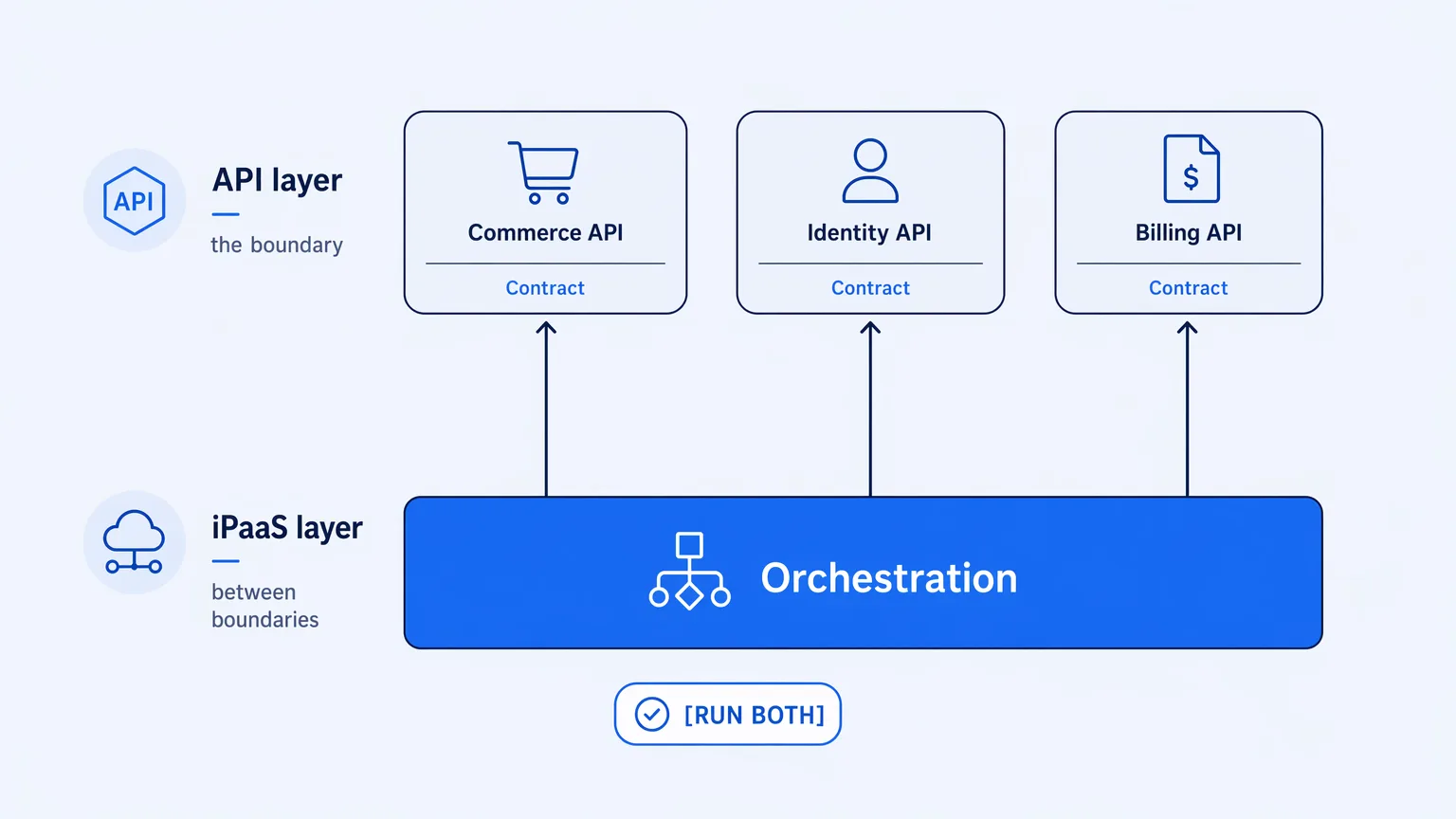
The production-grade version of this answer adds one more requirement: both should be owned artifacts. Your APIs live in your codebase. Your integration logic should too — in Git, versioned, reviewed, observable through your existing stack, with a bill that doesn't spike when your traffic does.
Koodisi is an enterprise integration platform built for teams running at this standard: no-code workflows with Git-native version control and pull-request review, a built-in API Manager for publishing and securing APIs under the same access model, metrics and traces emitted as OpenTelemetry, and a flat enterprise license rather than per-task billing. If your current integration layer doesn't pass the ownership test, book a Koodisi demo to see what production-grade orchestration looks like when it's treated as software rather than a vendor-side recipe.
Frequently asked questions
iPaaS vs. API management: what's the difference?
API management governs access to APIs you already have — rate limiting, auth, versioning, developer portals. iPaaS orchestrates data and workflows across systems, including ones with no API at all. They solve adjacent but distinct problems: API management controls who can call your APIs and how; iPaaS decides what happens across multiple systems when something changes. Mature platforms increasingly bundle both, but the capabilities aren't interchangeable — a strong API gateway doesn't replace workflow orchestration, and vice versa.
iPaaS vs. PaaS: what's the difference?
PaaS (Platform as a Service — Heroku, Vercel, Azure App Service) is where you deploy and run custom application code. iPaaS is where you connect and orchestrate data between existing systems without writing and hosting a full application. If you're building new functionality from scratch, that's a PaaS problem. If you're moving data or triggering actions between systems you already run — Salesforce to NetSuite, ServiceNow to Slack — that's what iPaaS is built for. Some teams use PaaS to build custom integration logic instead of using an iPaaS; that trades platform lock-in for engineering overhead every integration platform is specifically built to remove.
Is iPaaS a type of API management?
No. They're complementary but distinct. API management governs access to the APIs a system exposes. iPaaS connects multiple systems' interfaces to move data and automate workflows between them. Some vendors sell both on one platform, but the capabilities are different.
Can I use an iPaaS without API management?
Yes. Most iPaaS use cases consume APIs that SaaS platforms such as Salesforce, Workday, or ServiceNow already provide, so you don't need to publish or manage APIs of your own. API management becomes relevant when you expose your own systems to others.
iPaaS vs custom API development: which should I choose?
Custom code gives you full control over each integration, but every one becomes software your team has to build, monitor, and maintain. An iPaaS gives you connectors, mapping, retries, and monitoring out of the box, so the effort goes into the business logic rather than the plumbing. Teams usually keep custom APIs for their own product surface and use an iPaaS for the connections between systems. For the bigger picture, see what iPaaS is and how API integration works.
What's an example of a company that needs both?
A SaaS company with a public API for customers and partners needs API management. The same company also needs its CRM, billing, and support systems to stay in sync, which is an iPaaS job. Running both on one platform means one governance model covers external API access and internal workflows.