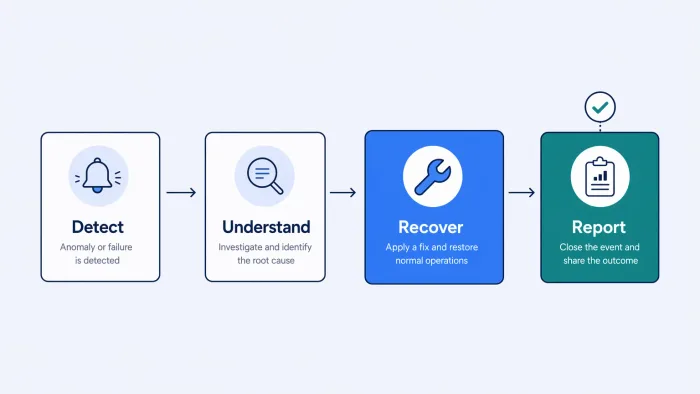
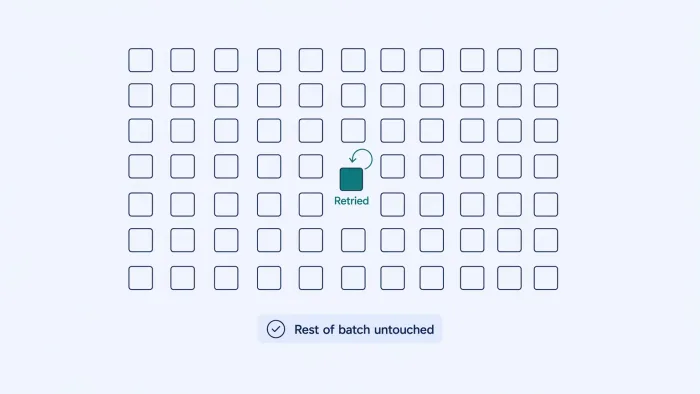
Retry logic is one of the oldest patterns in distributed systems, and it's also one of the most commonly implemented badly. "Retry on failure" sounds like a complete policy. It isn't. It's missing the three questions that actually determine whether a retry helps or makes things worse: should this specific failure retry at all, how long should it wait between attempts, and what happens if it never succeeds.
Skip any one of those questions and the retry logic isn't recovering from failures — it's just delaying the moment someone has to deal with them manually, sometimes with extra duplicate records to clean up first.
A retry policy is only as safe as its worst assumption. The gap between automatic recovery and a retry loop that quietly makes things worse usually comes down to three decisions, not one.
Not every failure should be retried
The first question a retry policy has to answer is whether retrying will do anything at all. A connection timeout against a downstream API is often transient — retry it and it frequently resolves on its own. An authentication failure from an expired credential will fail exactly the same way on the tenth attempt as it did on the first, because nothing about the failure condition changed between retries.
Retrying a non-retryable error isn't neutral. It burns through attempt budgets that could be spent on failures that would actually benefit from another try, delays the escalation that would actually fix the problem, and in high-volume systems, adds noise to failure logs that makes the real pattern harder to see.
The failure categories worth distinguishing here map to how they behave under a retry: connectivity and rate-limit errors are frequently transient and retry-worthy; authentication, validation, and mapping errors are usually deterministic and won't change outcome without an external fix.
A policy that treats all six categories the same way is guaranteed to be wrong about at least half of them.
Backoff decides whether a retry helps or piles on
Once a failure is confirmed retryable, the next question is timing. Retrying immediately, over and over, on a system that's already struggling — rate-limited, overloaded, or mid-outage — doesn't give it room to recover. It adds load at exactly the moment the destination system has the least capacity to absorb it.
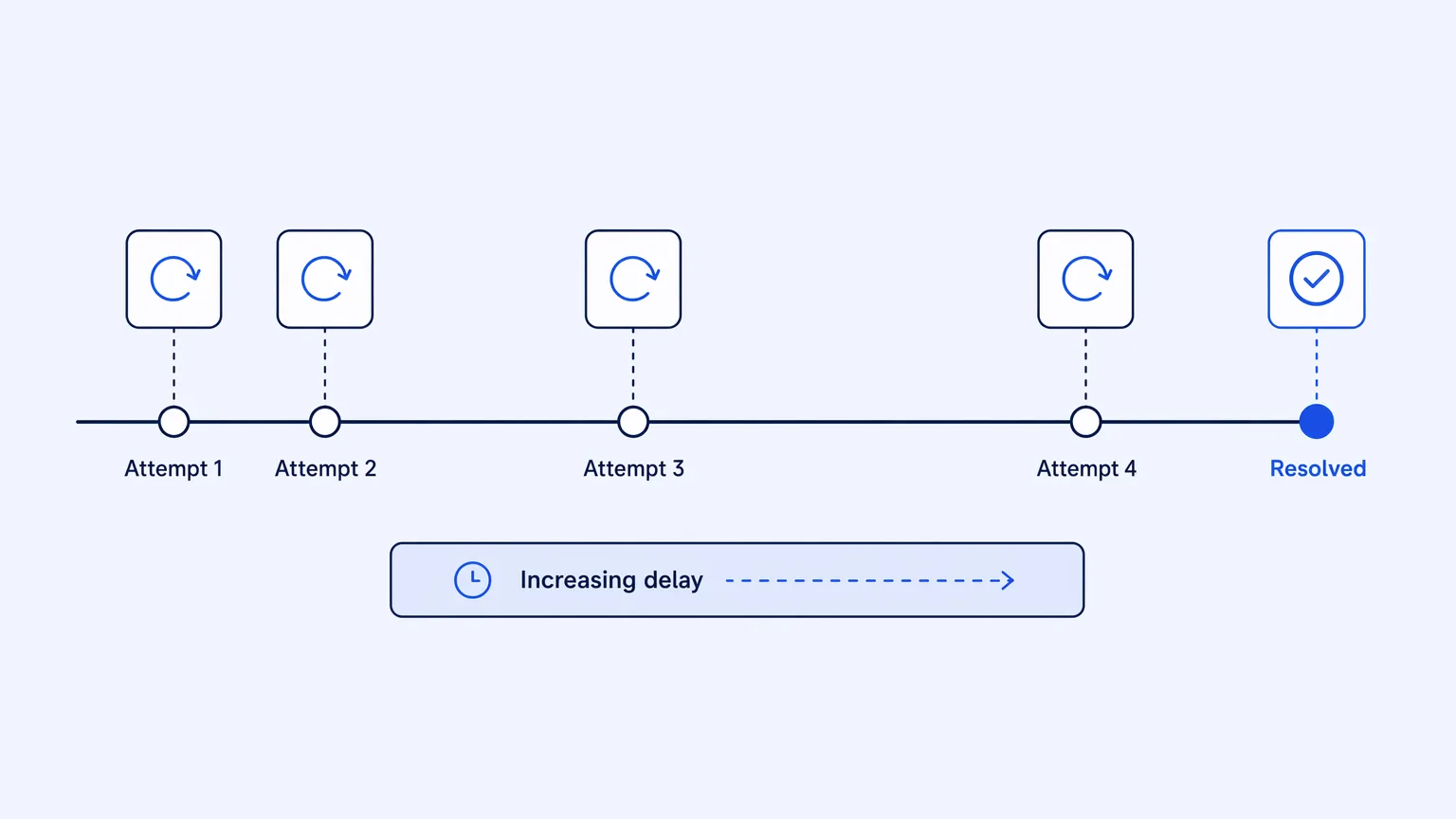
Exponential backoff spaces retries out with increasing delay between attempts: a short wait after the first failure, longer after the second, longer still after the third. That gives a transient problem time to actually resolve instead of hammering a struggling system with the request pattern that may have contributed to the failure in the first place. It's a small mechanical detail with an outsized effect on recovery success rate, and on whether a downstream system experiences the integration as a neighbor or as a source of additional load.
Immediate, uniform retries don't test whether a problem resolved. They just test how much load a struggling system can take before it gets worse.
A retry ceiling is what turns "keep trying" into a decision
Retries without a ceiling aren't a recovery mechanism — they're an indefinite delay on someone finding out something is actually broken. A retry policy needs an explicit answer to "how many attempts, over what window, before this counts as exhausted and needs to escalate."
The right ceiling depends on the failure category and the cost of delay. A rate-limit failure might reasonably retry for an hour with generous backoff, since the underlying condition often resolves within that window. A connectivity failure against a system that's core to same-day operations might need a much shorter ceiling before it escalates, because the cost of a delayed resolution is higher than the cost of pulling in a person slightly earlier than strictly necessary.
| No ceiling | Explicit ceiling | |
|---|---|---|
| Transient failure | Eventually resolves, nobody notices the delay | Resolves within the retry window, nobody notices |
| Permanent failure | Retries indefinitely, never surfaces | Escalates once exhausted, with context attached |
| Time-sensitive failure | Same treatment as any other failure | Shorter ceiling reflects the actual cost of delay |
Retrying safely means not creating duplicates
The failure mode that turns a well-intentioned retry policy into an incident is retrying an operation that already partially succeeded. A payment sync that failed after the charge went through but before the confirmation record was written will, on a naive retry, charge again. A record that was written to a destination system but failed on the acknowledgment step will, on a naive retry, write a duplicate.
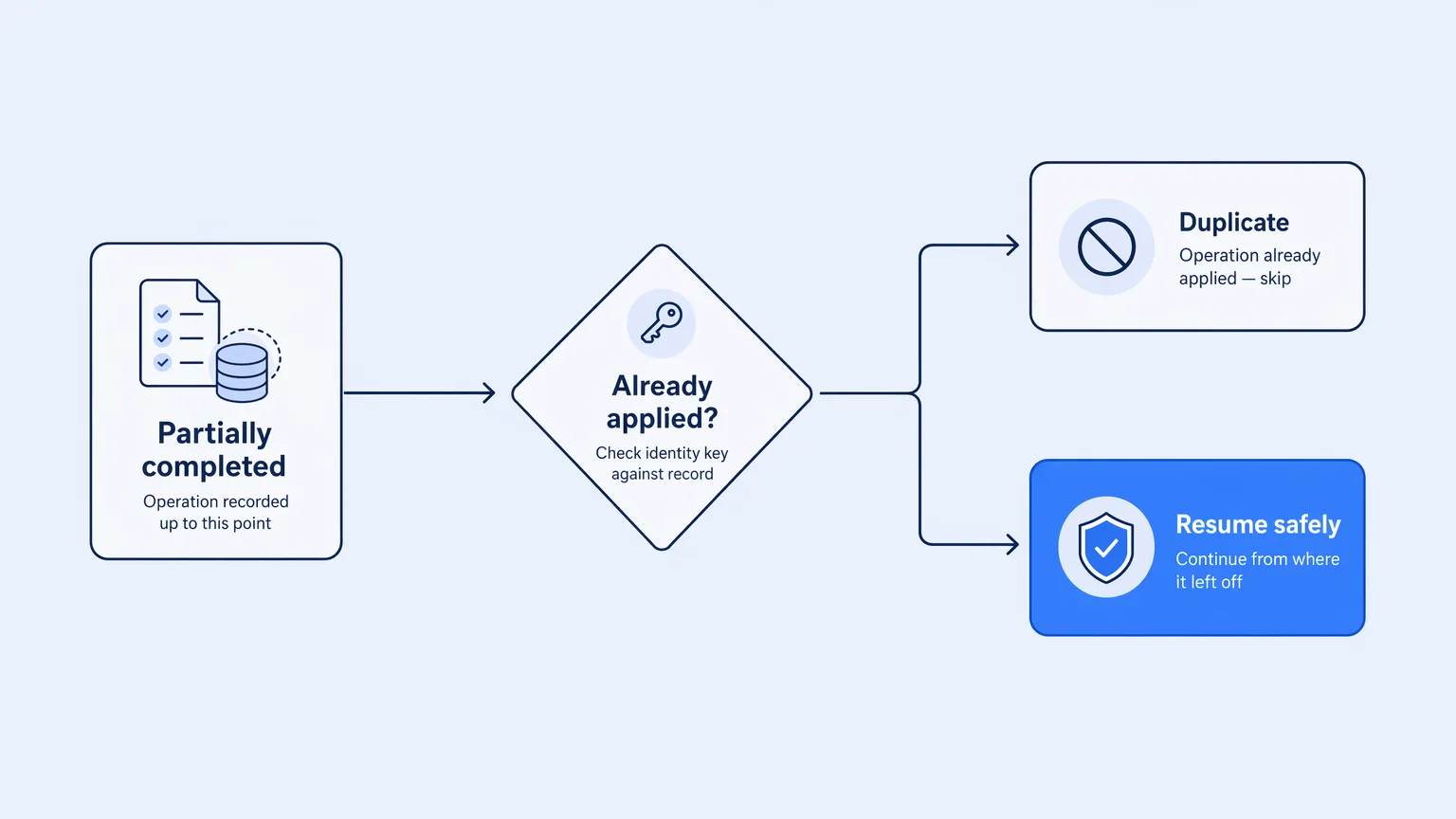
Idempotent retry handling prevents this: the retry carries enough identity — a request ID, an idempotency key, a check against whether the operation already landed — that retrying a partially-completed operation resumes or confirms rather than repeats it. Without that, "safe to retry" and "retried" are two different claims, and a policy that only guarantees the second one is making a promise it can't back up.
Retrying without idempotency isn't recovery. It's a second chance to cause the same problem twice.
What a safe retry policy actually checks
Put together, a retry decision that's earned the word "automatic" is really four checks running in sequence: is this failure category retryable at all, has the backoff window given the underlying condition time to resolve, has the retry ceiling been reached, and will this specific retry attempt avoid duplicating an operation that already partially succeeded. Skip any one of those checks and what's left isn't a safety net — it's a delay tactic that occasionally works.
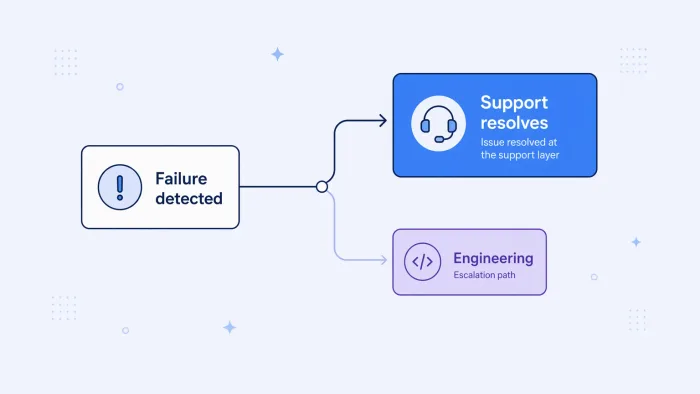
None of this replaces escalation. An exhausted retry ceiling is exactly the signal that should hand a failure to a person, with the classification, the attempt history, and the reason retries didn't resolve it already attached. Getting retries right doesn't eliminate the handoff — it limits it to failures that genuinely need a person, instead of every failure a badly-built retry loop couldn't be bothered to check first.
Building this as policy, not per-integration code
Koodisi Engage's retry policies are configured per failure category rather than hardcoded per integration: which classes retry automatically, how backoff scales, where the ceiling sits, and how idempotency is enforced before a retry executes. That's the difference between a team writing the same retry-safety logic from scratch in every integration and a team defining it once, correctly, and applying it everywhere a fallout gets classified.
If your current retry logic is "try again a few times" without an answer to retryability, backoff, ceilings, or duplicate prevention, it's worth testing what a policy-driven version looks like against your own integrations on Koodisi's Community tier.