The Plaid webhook lands at 11:47 PM, your KYC vendor times out, and the user ends up in a half-verified limbo that your database has no state for. Nobody gets paged because the flow didn't error — it just stopped. You find it six hours later when a support ticket comes in.
This is not a connection problem, and it's the same gap the broader guide to what API integration actually involves argues most explainers skip. You got Plaid connected in a weekend. The Sardine integration went live inside two weeks. The problem is what happens between connections: the retries that bill twice, the version mismatches that surface on a Tuesday after a provider upgrade, the traces that die at the boundary of your orchestration layer and leave you rebuilding a timeline from logs across four systems. Financial API integration is an operations problem disguised as a plumbing problem.
The Real Shape of the Stack
Most engineering teams handling financial APIs have built the same thing without meaning to. There is a cluster of point-to-point integrations, each written by whoever had the context at the time, each handling its own retry logic (or not), each logging in its own format. Plaid goes to Lambda. Stripe webhooks hit a queue. KYC flows through a workflow tool someone installed for a different project. The census of these integrations usually comes as a surprise when someone draws the actual map.
This is not a failure of effort. It is the natural shape of organic integration work — each integration was the right call when it was built, and the coupling was invisible until the stack got wide enough to feel it.
The problems that come out of this shape are predictable:
- Idempotency failures: Payment confirmation webhooks arrive twice; the handler was not written with that in mind; the user sees a double charge.
- Version drift: A KYC provider bumps their verification object schema; your transformer was written against the old shape; failures surface as malformed data downstream, not as API errors.
- Silent failure accumulation: An ACH settlement status update fails to reach your ledger; no alert fires because the failure count is below whatever threshold the alert was set to.
- Audit gaps: A compliance team asks which users ran through which verification flow on a specific date; the answer requires reconstructing a timeline from four log formats across three systems.
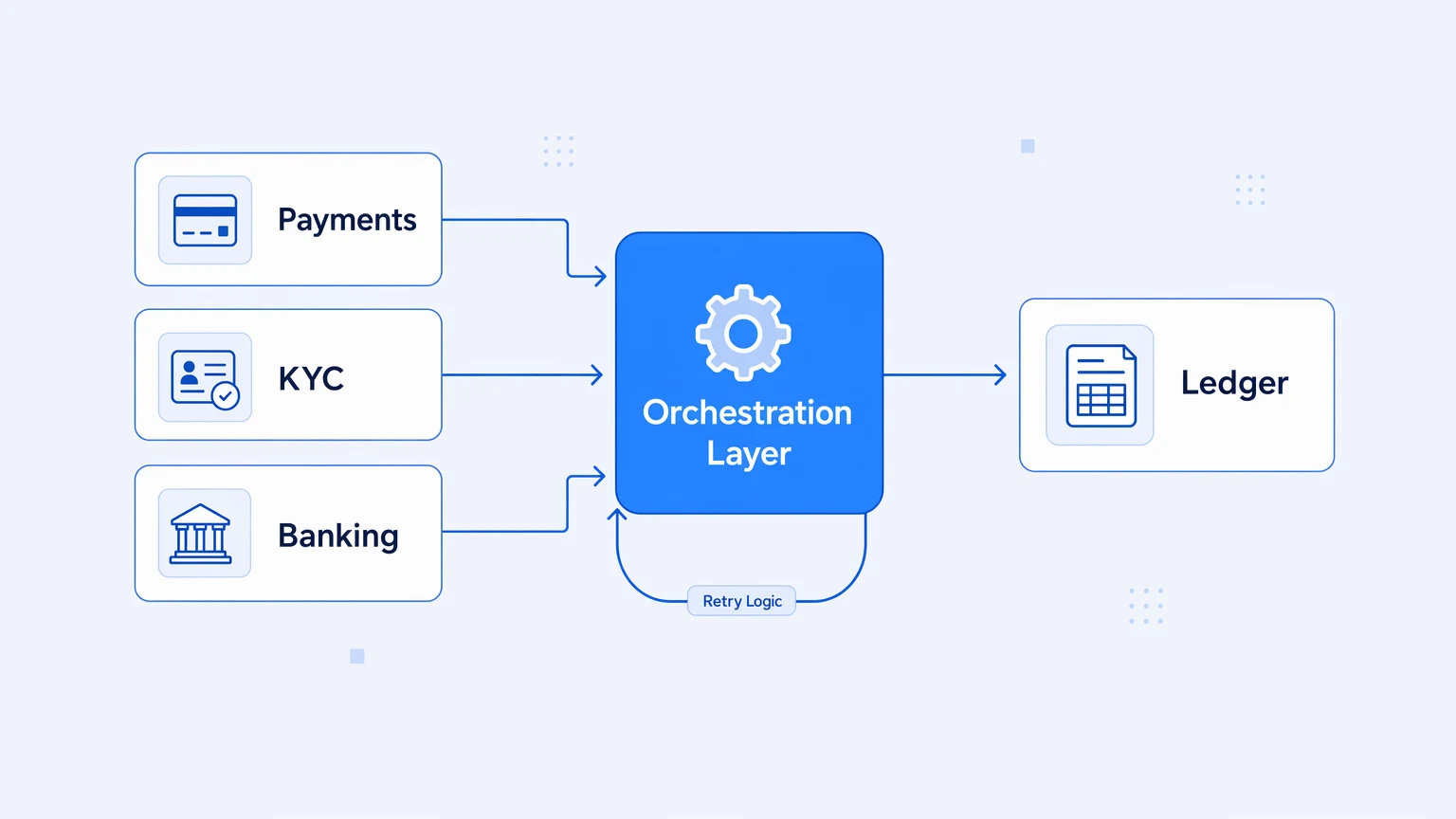
The connection between systems is not where financial API integrations break. The orchestration between them is.
What Good Orchestration Actually Looks Like
Retry logic is not optional and not generic. An idempotency key on a Stripe charge guarantees the charge runs once regardless of how many retries you throw at it. ACH transactions work differently — there is no retry in the traditional sense; you are handling return codes that arrive days later. Webhook delivery from KYC providers may not retry at all. A single retry strategy applied uniformly across this set will be wrong for most of it. The teams that get this right treat retry semantics as a per-provider contract, not a platform setting.
The harder problem is observability at the boundary. Most teams can trace what happens inside their own service. Tracing across an outbound API call through a provider's processing time and into a resulting webhook is a different problem — especially when those legs are separated by hours. If the trace context dies at the first outbound HTTP call, what you have left is three disconnected log streams and a gap in the middle. You end up correlating by transaction ID, manually, hoping the log retention hasn't expired.
Schema drift from financial providers is not an edge case. It is a regular event. The teams that handle it without incident validate provider schemas on ingest, treating each payload shape as an external contract they hold a version of — not a stable structure they can assume will not change. The teams that do not treat it this way find out about schema changes the same way: a malformed record in a downstream system that nobody connected to the provider upgrade.
Stop thinking of financial API integration as "connecting to providers." Think of it as "running a system that happens to have providers on the edges."
The Versioning Problem That Everyone Underestimates
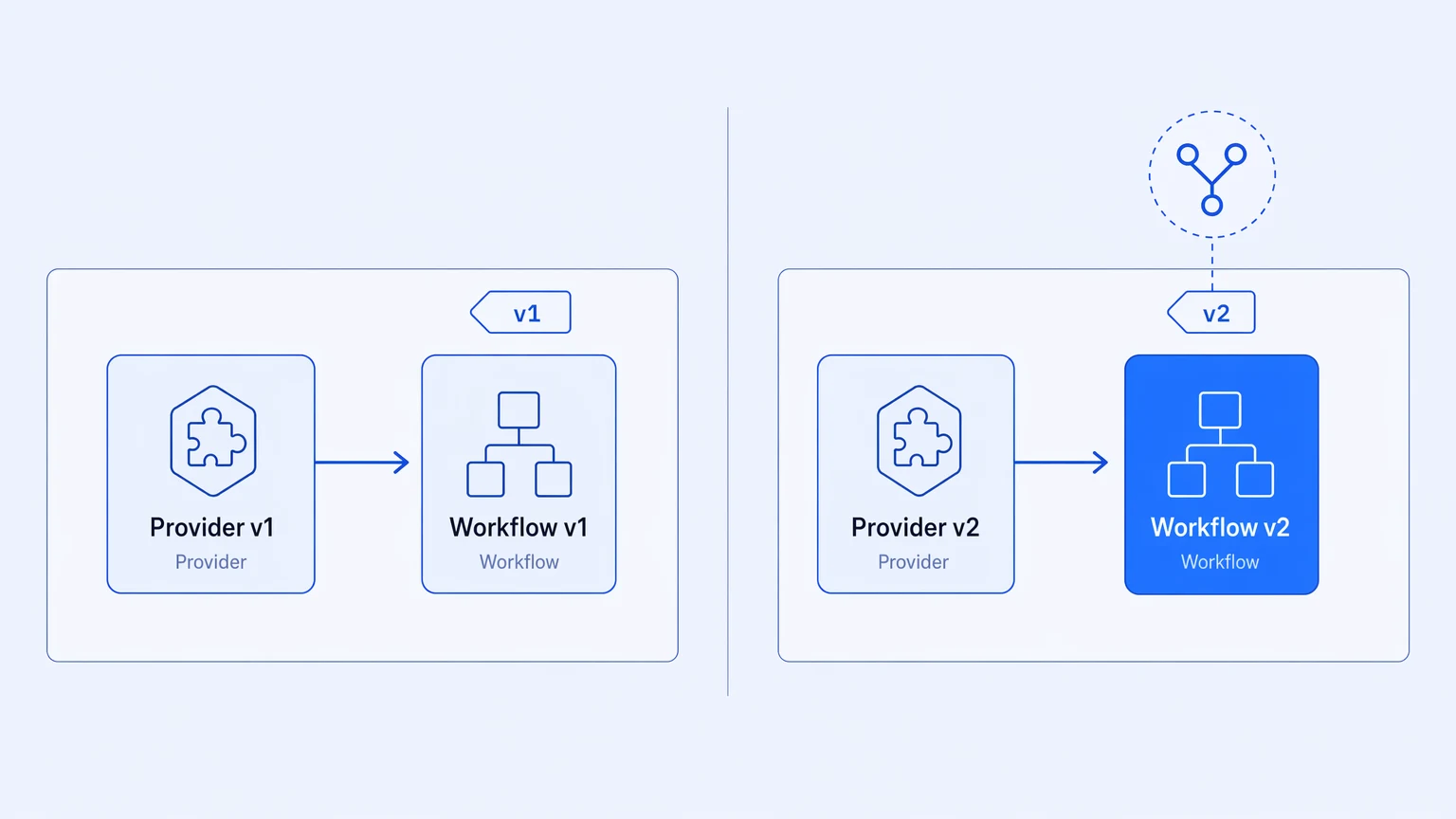
When a provider changes a field name, drops a field, or adds a required field to a webhook payload, you want to know three things: which workflows were processing that payload shape, which ones are now receiving the new shape, and whether the transformation layer handled the change or silently dropped it.
This is hard to answer when integration logic lives in hand-rolled Lambda functions or in a workflow tool that does not version its workflow definitions. There is no audit trail for "what transformation rule was applied to this specific event on this specific date."
Real Git versioning on workflow definitions changes this. When your integration logic is a versioned file in your repository, you can answer "what was the transformer doing at the time of this incident" with a git log query — not by asking whoever wrote the Lambda six months ago if they remember. The value compounds with team size: the third engineer does not have to reverse-engineer the retry logic from a workflow tool's visual canvas with no history.
In-platform branching lets you develop a new version of the integration against the provider's new schema in isolation, run it against test payloads, and promote it to production as a deployment. The PR and merge happen through your existing GitHub or GitLab flow. What you get on the platform side is a deployment record, a trace history, and rollback without a rewrite.
Version control on integration logic is not a workflow-tooling convenience feature — it is the difference between recoverable incidents and archaeology sessions.
Observability Is the Unglamorous Gap
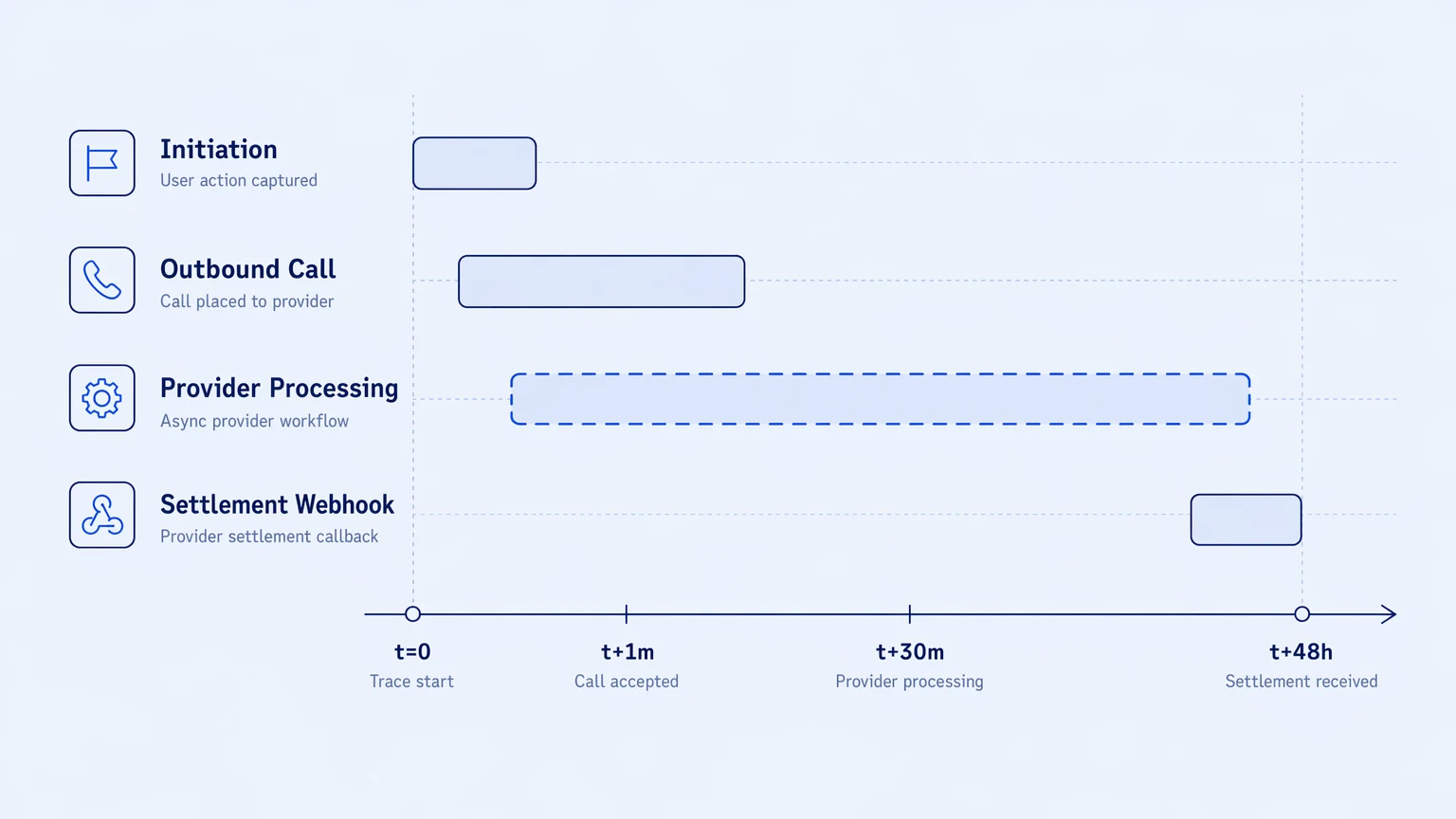
If you had to pick the single capability most consistently missing from financial API integration stacks, it is distributed tracing across the full event lifecycle. Not metrics on individual services. Not logs in individual systems. End-to-end traces that span from the originating event through every transformation, every outbound call, and every resulting state change — with the ability to replay a failure against the exact same data.
The reason this matters specifically for financial integrations is that failures are often delayed. An ACH return arrives two banking days after the initiation. A fraud flag from a KYC provider may trigger a webhook 48 hours after the verification session. If the trace context was not carried forward and stored, finding the originating event for a delayed failure requires manual correlation — matching transaction IDs across systems, hoping the log retention is long enough.
OpenTelemetry as the wire format for integration traces is useful here because it is not proprietary. The traces you generate in your integration platform go to the same observability backend — Datadog, Honeycomb, Grafana, Elastic — that your application traces go to. You are not running a separate debugging console for the integration layer. The financial workflow trace shows up in the same search interface as the application trace that preceded it.
This matters at audit time. When a compliance team asks to reconstruct the sequence of events for a specific user's verification and onboarding flow, the answer is a trace search, not a request to four teams to pull their logs.
Operational visibility into the integration layer is not a feature you bolt on after the integrations are running — by then the data you needed is already gone.
Close
The honest answer to how financial API integration works in production: it breaks at the orchestration layer, for teams that got the connections working and called it done. Getting Plaid connected is not the work. Managing retries that carry different semantics per provider, versioning workflow definitions so you can answer incident questions without guessing, and tracing async event flows across a 48-hour settlement window — that is the work.
Before adding the next integration, three questions worth answering: Does this workflow have a versioned definition I can inspect after an incident? Can I trace the full event lifecycle, including the provider processing time I did not send? Will a schema change surface as a detectable error or as silent corruption in a downstream system?
If you want to run a real financial workflow through an integration layer with OpenTelemetry on every tier, real Git versioning, and no per-execution billing or overage invoices at Professional pricing ($399/mo), Koodisi's Community tier is $0 with 1,000 executions a month. Start at koodisi.io/start.