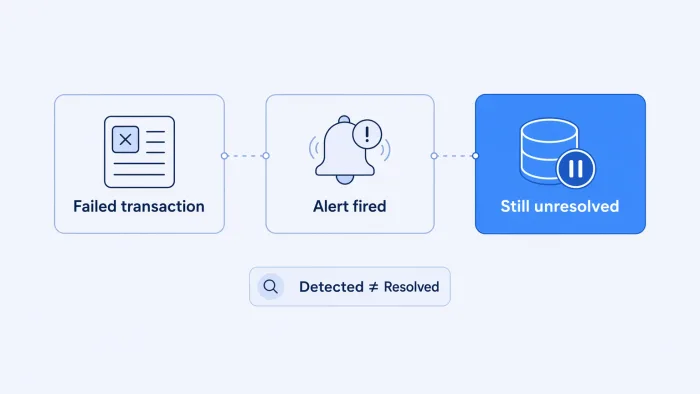
An alert fires. Someone looks at a dashboard, sees a red status on a payment sync, and confirms: yes, it broke. That confirmation is where most people stop describing "what happened." It's also where the actual work starts.
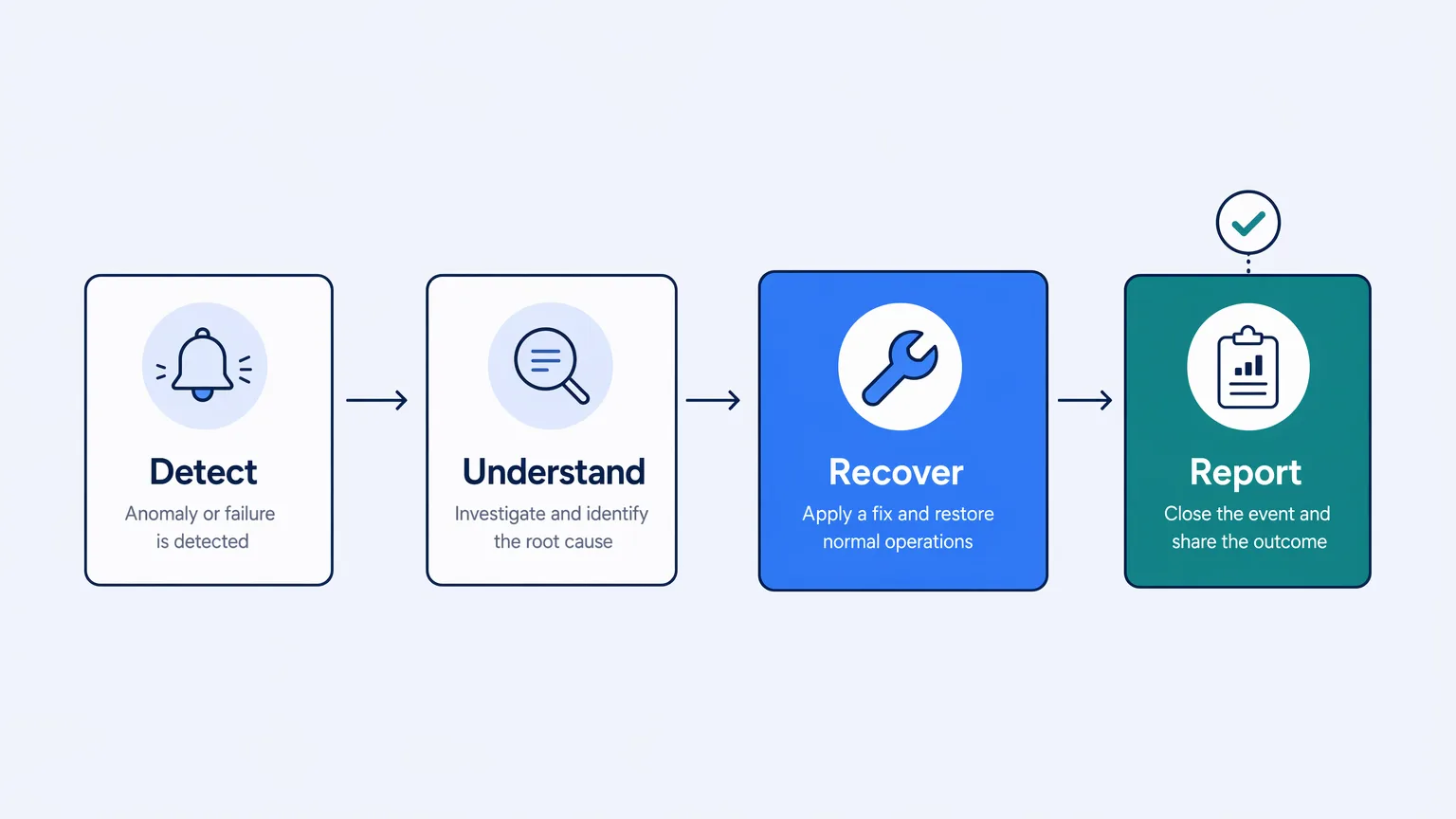
Detecting a fallout answers one question. Getting it resolved and accounted for requires four more steps, in order, each doing a distinct job: understand what kind of failure this is, act on it correctly, escalate it if it can't be resolved automatically, and record what happened so the failure doesn't just vanish once the retry succeeds.
A failure that's detected but not carried through that full chain isn't handled — it's just visible. Most integration tooling treats detection as the finish line. It's the starting gate.
Classification decides everything that happens next
The moment a fallout is detected, it has to be sorted before anything useful can happen with it. Not all failures are the same problem wearing different error messages, and treating them as if they were is how retry logic ends up either too aggressive or too cautious.
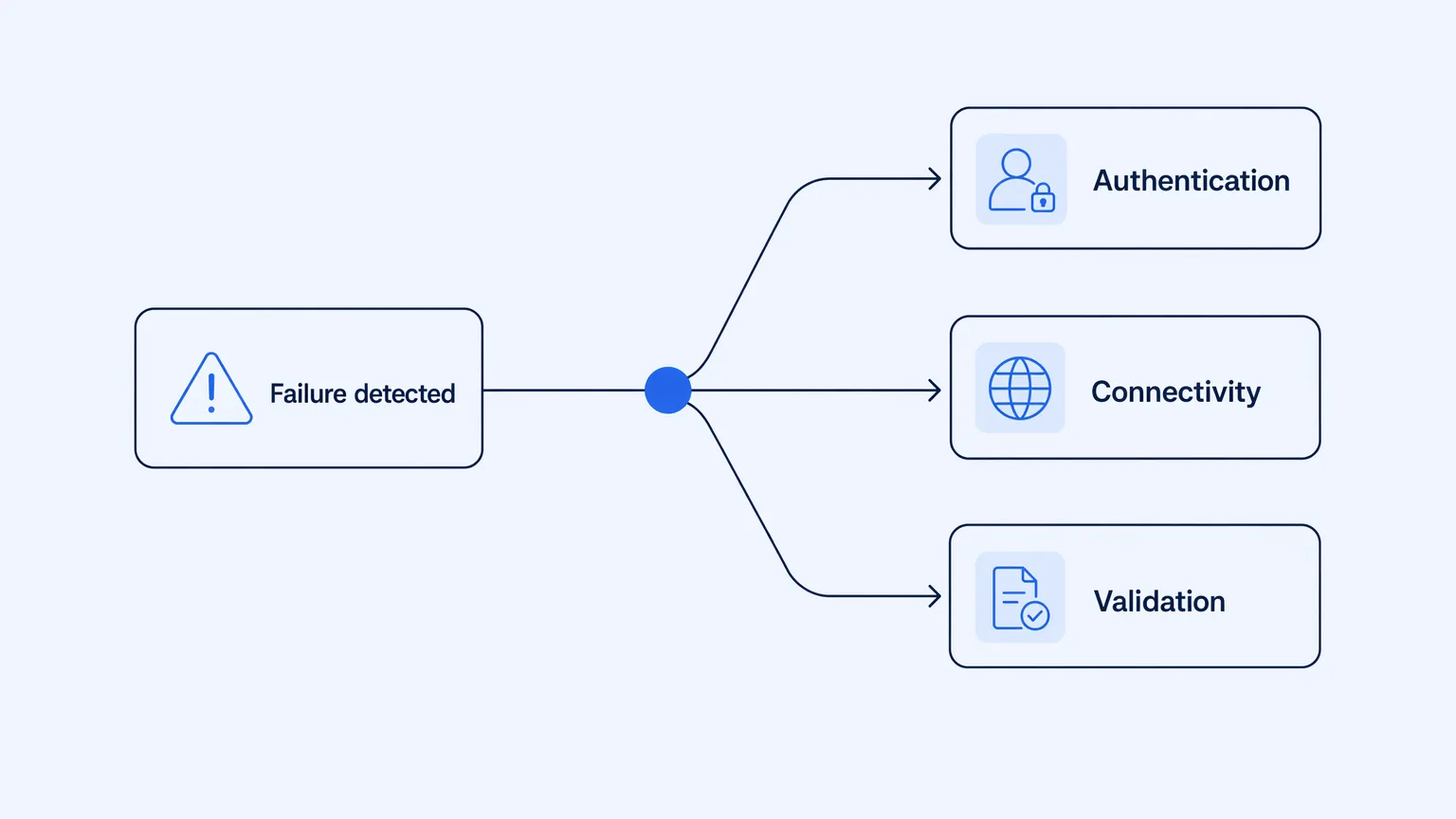
A useful classification scheme separates failures by what actually broke: authentication (a token expired or a credential rotated), validation (the payload doesn't match the destination schema), connectivity (the downstream system is unreachable or timing out), rate limits (the destination is throttling), mapping (a transformation produced the wrong shape), or destination-system errors (the receiving application rejected the record for its own reasons).
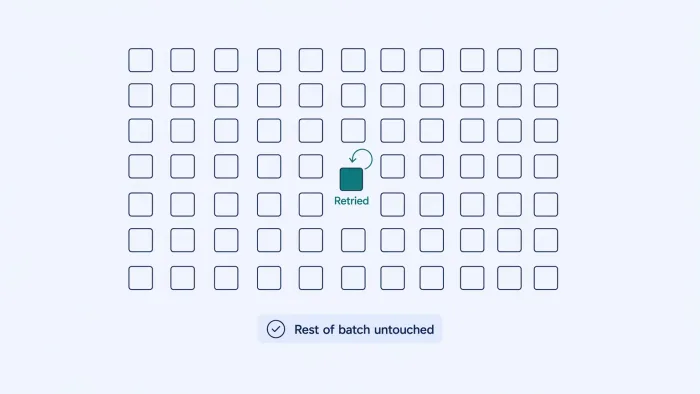
Each category implies a different response. An authentication failure won't fix itself on retry — it needs a credential refresh, and retrying blindly just burns attempts and pollutes the failure log. A rate-limit failure is often self-resolving with a delay. A validation failure on one record says nothing about the other 9,999 in the batch.
Classification turns a wall of red alerts into a set of decisions someone can actually make.
Acting on a failure means routing it, not just retrying it
Once a fallout is classified, the system has to decide what to do with it, and "retry" is only the right answer for some of the categories above. A connectivity blip or a rate-limit throttle is a strong candidate for automatic retry, on a schedule that respects the failure type. An authentication error is not — it needs a human or an automated credential-rotation step before a retry has any chance of succeeding.
This is where a configurable retry policy earns its keep: it defines which error classes get retried automatically, how many attempts happen before giving up, and what counts as exhausted. Genuinely temporary failures get resolved without anyone noticing. Failures that need judgment get routed to a person, with the classification and context already attached, instead of landing as a raw stack trace at 2 a.m.
Retrying every failure the same way, on the same schedule, treats a five-second network blip and a permanently broken mapping as identical problems.
A retry policy that can't tell those two apart isn't saving anyone work — it's just automating the same guesswork faster.
Escalation is a handoff, not a dead end
Some failures aren't retryable, and some retryable failures exhaust their attempts without resolving. Both need to escalate — but escalation done badly just moves the 2 a.m. page from "here's an error" to "here's an error, plus you now have to reconstruct what already happened."
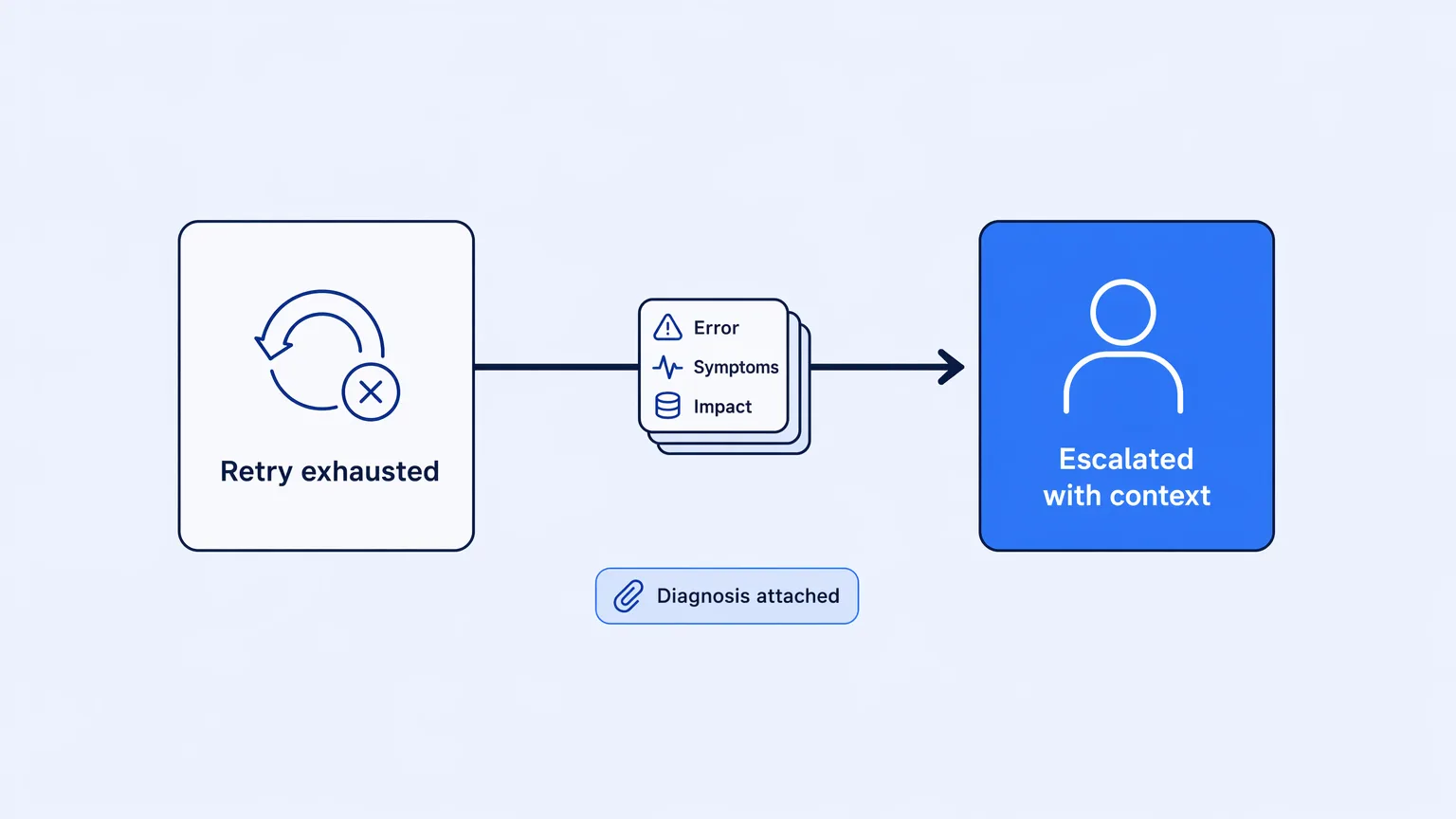
A useful escalation carries forward everything the system already knows: the classification, the affected record or batch, what was already tried, and why those attempts didn't resolve it. That's the difference between an engineer starting from a blank investigation and an engineer starting from a pre-diagnosed problem with the guesswork already done.
Escalation also needs to reach the right team, not just any on-call rotation. A rate-limit failure escalating to the team that owns the destination system's account tier is a different, faster resolution path than the same alert landing generically on whoever's holding the pager. Routing by failure category, not just by integration name, is what separates a handoff that saves time from one that just relocates the problem.
An escalation without context is just a slower alert.
Report is where the loop actually closes
The lifecycle doesn't end when a record finally succeeds on retry or an escalated failure gets manually resolved. If nothing records what happened, the same failure mode will resurface, get investigated from scratch again, and nobody will notice the pattern until it's cost real time three or four times over.
Reporting on failure trends does two jobs at once. For an engineering lead, it answers "is this getting better or worse" — is the connectivity error rate against a specific destination climbing, is a mapping error recurring on the same field, is retry policy actually resolving what it's supposed to without manual intervention. For the business side, it answers a different question: how many transactions failed, how many resolved automatically, how many needed a person, and how long did resolution take.
Both views come from the same underlying data — the classification, the retry outcome, the escalation path, the resolution — just presented at different altitudes: one tracking error-category trends over time, the other tracking resolution rates and outstanding fallouts. A platform that only produces one is answering half the question a failure creates.
| Detection only | Full lifecycle | |
|---|---|---|
| A retryable error occurs | Alert fires, engineer investigates | Classified, retried per policy, resolved automatically |
| A non-retryable error occurs | Alert fires, engineer investigates from scratch | Escalated with classification + context attached |
| A failure pattern recurs | Nobody notices until it happens again | Surfaces in failure-trend reporting |
Where this still needs a person
None of this removes judgment from the system — it scopes where judgment is actually required. A genuinely novel failure mode, a destination system that changed its contract without notice, a data-quality problem that needs a source-side fix: these still need someone to look at them, and no classification scheme replaces that.
The honest claim isn't "failures resolve themselves." It's that a well-built lifecycle handles the categories of failure it can classify with confidence, and hands off the rest with enough context that the person picking it up isn't starting cold.
The lifecycle is the product, not the alert
Koodisi Engage is built around this exact chain — detect, understand, recover, report — as one continuous operational path rather than four separate tools bolted together. Detection feeds classification, classification decides the retry policy, exhausted or non-retryable failures escalate with full context, and every outcome lands in a report that shows whether the underlying failure rate is actually improving.
If your team's current setup stops at the alert and reconstructs the rest by hand every time, test it against your own integrations on Koodisi's Community tier before deciding whether the rest of the chain is worth building yourselves.