Every serious integration platform today ships dashboards, alerts, and execution traces. That's been true for years, and it's no longer what separates a good platform from an average one — it's the baseline every vendor in the category clears. The real split in this market isn't between platforms with good observability and platforms without it. It's between platforms that stop at observability and platforms that treat it as the first stage of something larger.
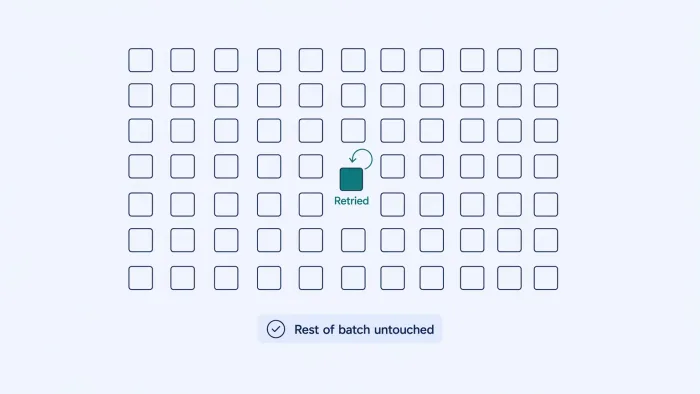
This series has walked through what that larger thing looks like in practice: classification that sorts a failure before deciding how to act on it, retry policy that distinguishes a transient blip from a permanent break, escalation that hands off with context instead of a bare alert, permissions that let the right person resolve a failure without needing an engineer, and record-level recovery that doesn't punish 9,999 good records for one bad one.
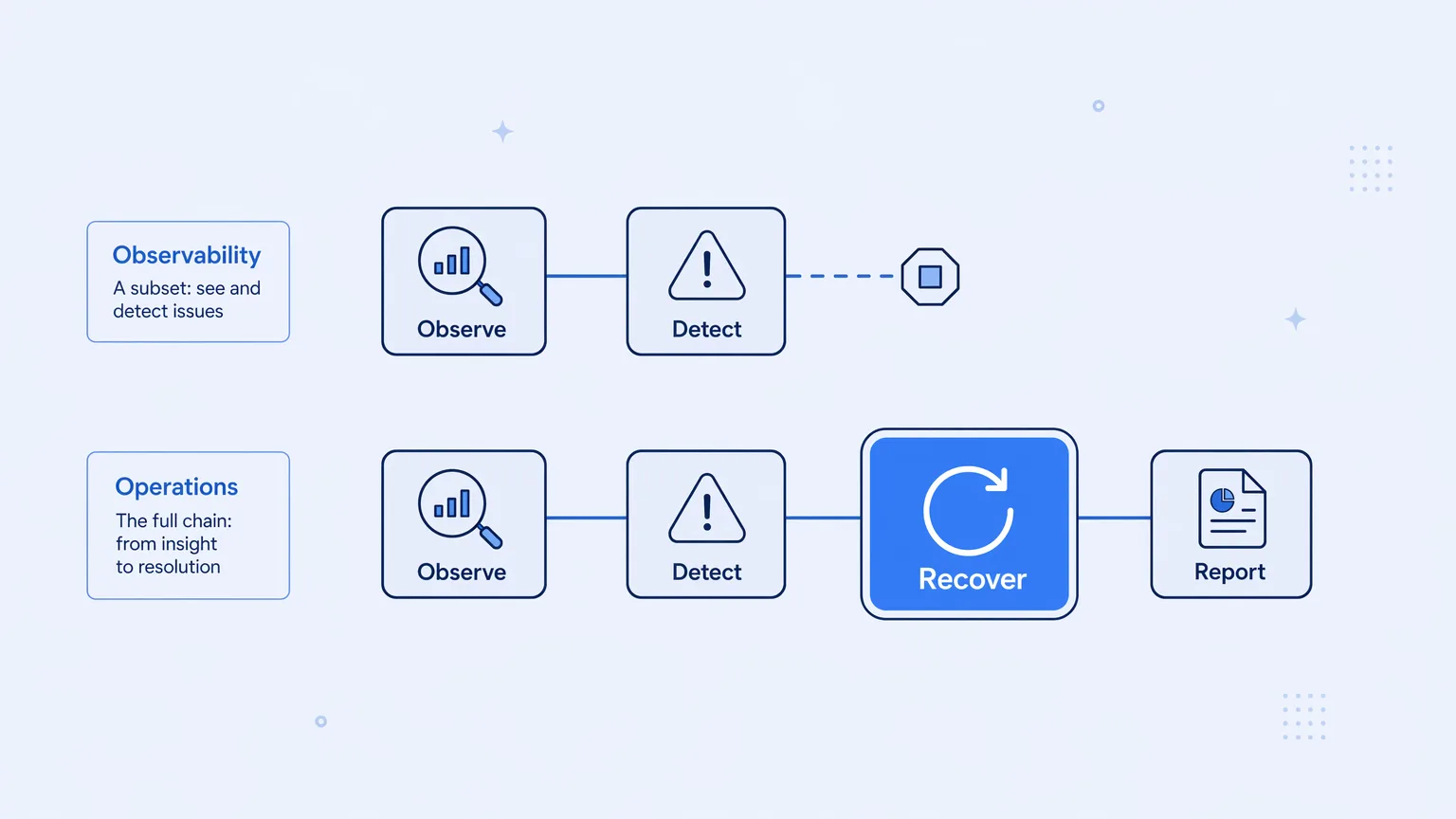
None of that is observability. It's a different layer, built on top of observability, and it deserves its own name: integration operations.
Observability answers "what happened." Operations answers "what do we do about it."
Observability, done well, is genuinely valuable: real-time transaction monitoring, execution history, drill-down into exactly where and why something failed. A team without this is flying blind, reconstructing failures from application logs never designed for the purpose. Getting this right is not a small thing.
But observability's job ends at description. It tells you a record failed, when, and with what error. It doesn't decide whether that failure should retry, doesn't know if it's the fifth occurrence of the same root cause this week, doesn't route it to the team that can actually fix it, and doesn't confirm whether the fix worked. Those are operational decisions, not observational ones — and a platform that only observes hands every one of them back to a person, every time, regardless of how routine the pattern is.
Observability is the sensor. Operations is what happens after the sensor fires.
The category most vendors compete in is smaller than it looks
Look at where integration vendors invest their content and their roadmaps, and it clusters heavily around visibility: better dashboards, richer traces, more granular alerting. That's a real and valuable thing to build, and most of the category has built it well. What's thinner across the market is treating recovery as a first-class, policy-driven capability rather than a basic retry button bolted onto a monitoring view.
Usage-metered platforms and lightweight automation tools tend to stop at "here's the error, here's a manual retry option." Enterprise-grade platforms in this space have started building genuine retry-and-resolve workflows and error classification, which signals the category is moving in this direction. But a fully closed detect-classify-recover-report loop, with record-level precision and bulk remediation both available, is still the exception rather than the norm across the vendors we've reviewed.
That gap is the actual competitive terrain. Not "whose dashboard looks better," but "whose platform actually closes the loop between a failure being visible and a failure being resolved."
Why the four-stage model is the honest shape of the problem
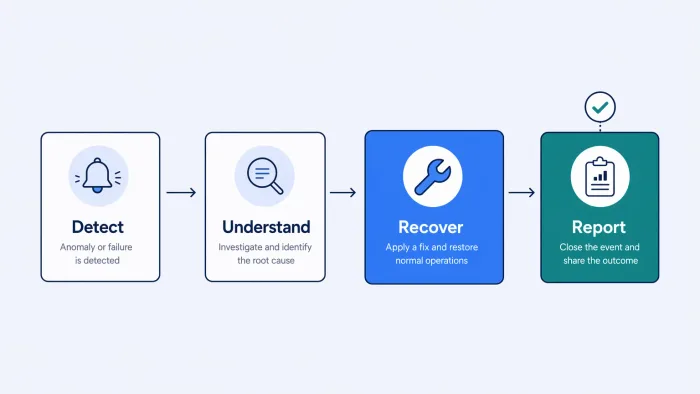
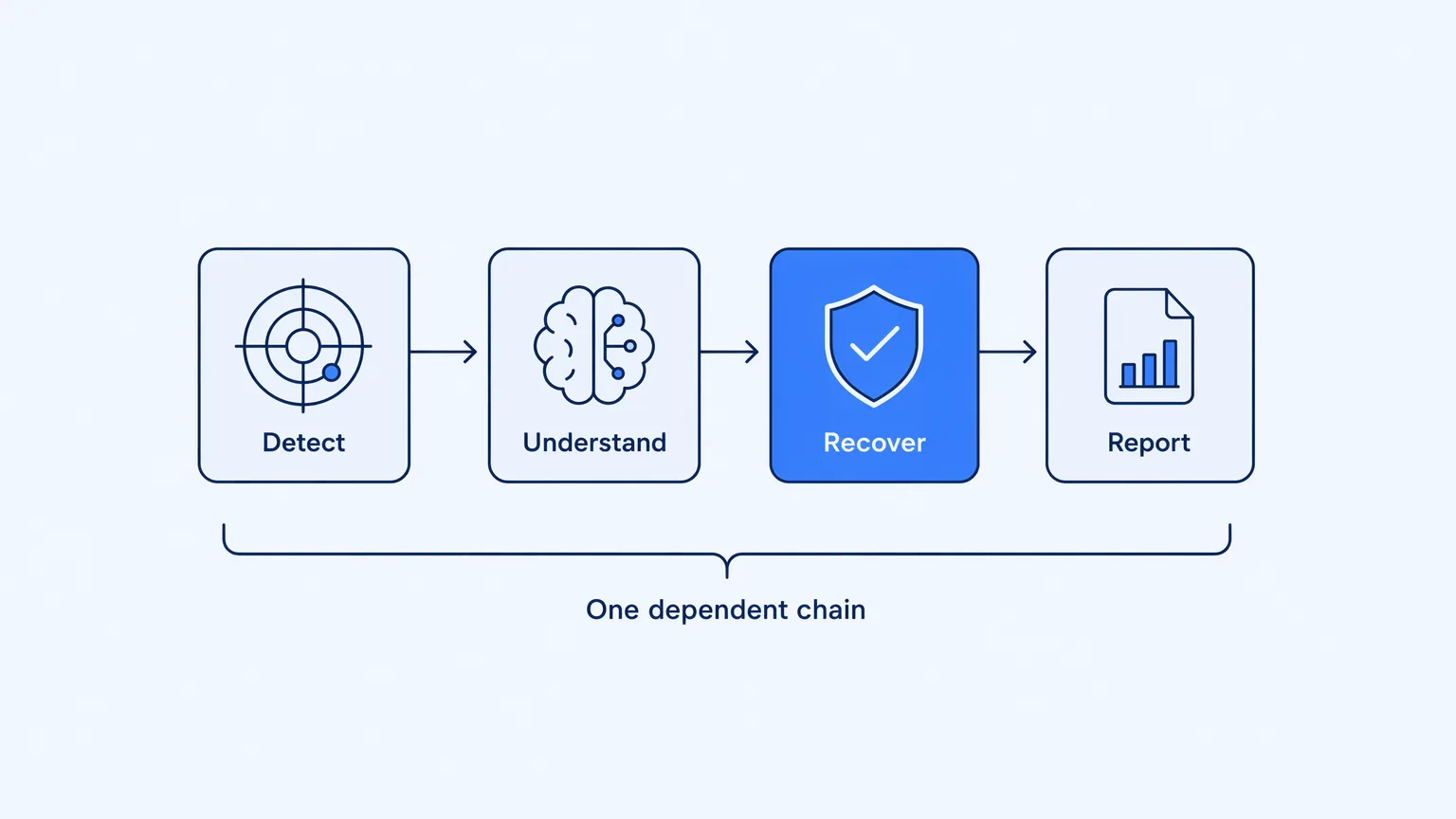
A failure's lifecycle isn't two stages — detect, then somehow it's fixed. It's four, and skipping any one of them just relocates the work rather than eliminating it. Detect surfaces the fallout. Understand classifies it into a category that determines what response makes sense. Recover applies that response, automatically where policy allows and with guided human input where it doesn't. Report closes the loop by showing whether the underlying failure rate is actually improving, not just whether this one instance got resolved.
| Observability-only | Integration operations | |
|---|---|---|
| A transient error occurs | Alert fires, engineer manually retries | Classified, retried per policy, resolved automatically |
| A batch has 3 bad records out of 10,000 | Rerun everything, or leave 3 unresolved | Record-level retry, 9,997 untouched |
| A routine failure needs resolving | Routes to engineering regardless of complexity | Resolves at the support layer within permissioned scope |
| Failure patterns over time | Nobody notices until it recurs | Surfaces in operational reporting |
Cut any one stage from that model and the other three degrade. Detection without classification produces noise. Classification without a recovery policy produces informed inaction. Recovery without reporting produces recurring failures nobody tracks.
What this reframing actually changes for a buying decision
"Does it have monitoring" is no longer a differentiating question to ask a vendor — nearly everyone will say yes, and nearly everyone will be telling the truth. The differentiating questions sit further down the chain: does it classify failures into actionable categories, does its retry policy distinguish retryable from non-retryable errors, can a non-engineer resolve a routine failure without engineering access, does it track failure at the record level or only at the job level, and does its reporting show whether the failure rate is trending down.
Those questions map directly onto the five posts that came before this one in this series, and that's not a coincidence — they're the concrete, checkable version of "does this vendor do operations, or just observability."
Where Koodisi draws this line
Koodisi Engage is built around the operations definition, not the observability one: detection feeds classification, classification decides retry policy, unresolved failures escalate with context to the right team or permission level, record-level and bulk recovery both exist as first-class capabilities, and reporting closes the loop with technical and business views alike. Koodisi already ships OpenTelemetry-based observability from the Community tier — Engage is the operations layer built on top of it, not a replacement for it.
If your current evaluation of an integration platform stops at "how good is the dashboard," it's worth extending the question to the rest of the lifecycle — classification, recovery policy, permissioned resolution, record-level precision, and reporting — before deciding what "good integration tooling" actually means for your team. Koodisi's Community tier is a reasonable place to test that distinction against your own integrations.