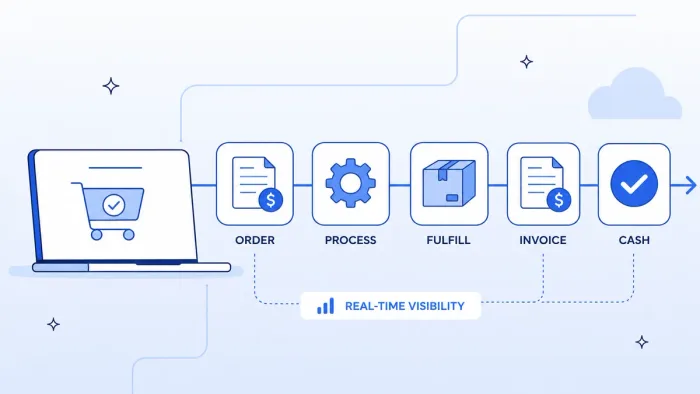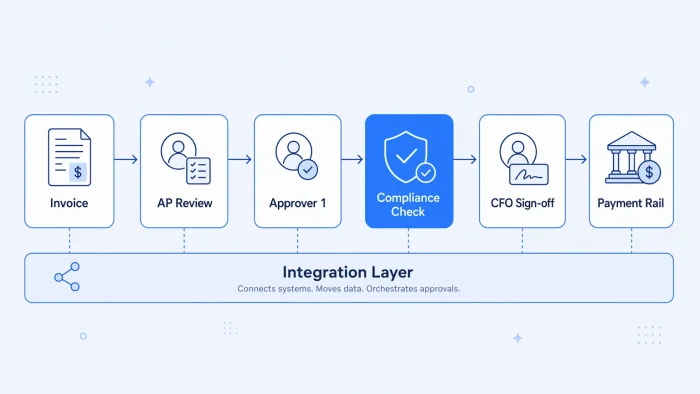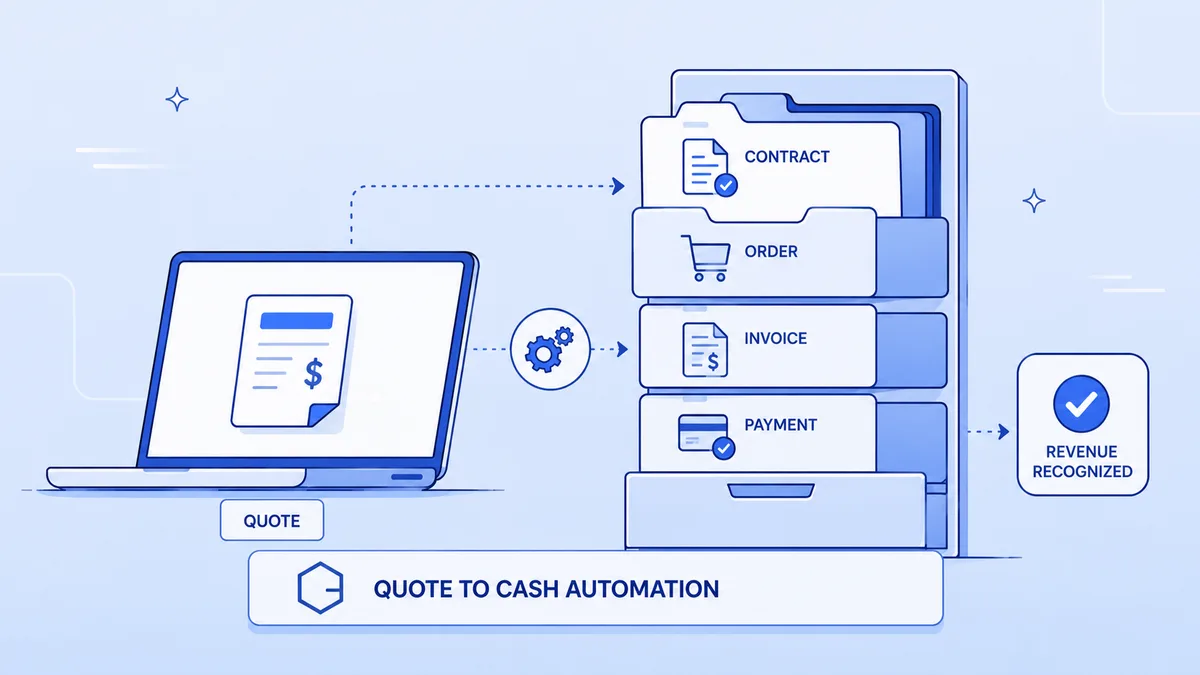
Quote to cash automation connects the systems that handle pricing, contracts, fulfillment, and billing into a single workflow — so revenue executes without manual handoffs. The result: faster deal cycles, fewer errors, and revenue recognized in days instead of weeks.
This guide covers what Q2C automation actually involves, where most enterprises lose time, and how to build the workflow in Koodisi.
What Is the Quote to Cash Process?
Quote to cash (Q2C or QTC) is the end-to-end revenue process that starts when a sales rep creates a quote and ends when payment is collected and recognized in your ERP.
It spans six core stages:
- Configure, Price, Quote (CPQ) — sales configures a product/service offer and generates a quote
- Contract creation and approval — legal reviews, redlines, and e-signs the order document
- Order management — the signed order is submitted into the ERP
- Fulfillment — product delivery or service provisioning is triggered
- Invoicing — the ERP generates and sends an invoice based on order terms
- Payment and revenue recognition — payment is collected and booked to the correct revenue period
Most enterprises do steps 2–4 manually. That's where the 30-day cycle time lives.
Where Q2C Breaks Without Automation
Manual quote-to-cash has three failure points that cost real money:
Handoff delays. A rep closes a deal in Salesforce, then emails the contract to legal, who redlines in Word, emails back, rep updates the CPQ quote, finance re-keys the order into NetSuite. Each handoff adds 2–5 business days. According to Forrester, companies with automated Q2C processes recognize revenue 28% faster than those running manual workflows.
Data re-entry errors. When someone types an order from Salesforce into NetSuite by hand, the error rate is roughly 1-in-4 records — wrong quantities, wrong billing terms, wrong ship-to address. A single bad field delays payment by weeks.
No visibility. Without a connected workflow, no one knows where a deal is between closed-won and first invoice. Finance can't forecast. Sales can't give customers an accurate fulfillment date.
How to Automate Quote to Cash with Koodisi
Koodisi orchestrates your Q2C workflow by connecting Salesforce CPQ, DocuSign, NetSuite (or SAP), and your billing system through a single no-code workflow — no custom integration code required.
Stage 1: Quote Generation (Salesforce CPQ → Koodisi trigger)
When a sales rep marks an opportunity as Closed Won in Salesforce, Koodisi's webhook trigger fires. It pulls the full opportunity data — line items, pricing, customer record, payment terms — via Salesforce's REST API.
Trigger: Webhook → Salesforce Opportunity status = "Closed Won"
Action: REST Client → GET /opportunity/{id} (fetch full record)
Stage 2: Contract Creation (Koodisi → DocuSign)
Koodisi uses the Mapper activity to populate a contract template with the deal data, then calls the DocuSign API to send the envelope for e-signature. No manual document prep.
Action: Mapper → populate contract template fields
Action: REST Client → POST /envelopes (DocuSign — send for signature)
Stage 3: Order Entry (DocuSign webhook → NetSuite)
When DocuSign fires the completion webhook, Koodisi receives the signed document and immediately creates the Sales Order in NetSuite via its REST API — line items, pricing, and terms mapped directly from Salesforce.
Trigger: Webhook → DocuSign envelope completed
Action: REST Client → POST /salesorders (NetSuite — create order)
No one touches a keyboard between contract signature and ERP order creation.
Stage 4: Invoicing (NetSuite → billing system)
Once the order is created, Koodisi triggers NetSuite to generate an invoice on the contracted payment schedule. For subscription products, it sets up recurring billing rules. For one-time orders, it sends the invoice immediately.
Action: REST Client → POST /invoices (NetSuite — generate invoice)
Action: SendMessage → email customer invoice PDF
Stage 5: Audit and Alerting
Every step writes to a Log activity — timestamps, system responses, error flags. If any API call fails (DocuSign timeout, NetSuite validation error), Koodisi fires an alert to the ops team via Slack before the deal stalls.
Action: Log → write audit entry
Action: Conditional → if error → REST Client → POST Slack alert
Which Systems Does This Connect?
| Stage | System | How Koodisi Connects |
|---|---|---|
| CPQ / CRM | Salesforce | REST Client via Salesforce REST API |
| E-signature | DocuSign | REST Client via DocuSign eSignature API |
| ERP / Order Management | Oracle NetSuite | REST Client via NetSuite REST Web Services |
| ERP (SAP shops) | SAP S/4HANA | REST Client via SAP Business Hub APIs |
| Billing / Subscription | Stripe, Zuora | REST Client via respective APIs |
| Finance | Workday Financials | REST Client via Workday REST API |
Koodisi connects to all of these through its no-code REST Client — no dedicated connector licensing, no per-app fees.
What Q2C Automation Delivers
Teams that automate the full Q2C cycle with Koodisi typically see:
- Quote to invoice in under 48 hours vs. the industry average of 14–30 days
- Near-zero order entry errors — data flows from Salesforce to NetSuite without re-keying
- 100% audit trail — every approval, signature, and system write is logged
- Finance visibility — dashboards show every deal in flight between closed-won and first payment
The biggest impact is on cash flow. Faster invoicing means faster collection. A team closing 50 deals a month at $20K average contract value, cutting invoice delivery from 14 days to 2 days, recovers over $1M in working capital per quarter.
Frequently Asked Questions
What is quote to cash automation?
Quote to cash automation is the process of connecting CPQ, contract management, ERP, and billing systems so that a won deal moves through pricing, signature, order creation, fulfillment, and invoicing without manual data entry at each step.
How long does it take to automate the Q2C process?
With a no-code platform like Koodisi, most teams build and deploy a working Q2C workflow in 2–4 weeks. The main effort is mapping Salesforce opportunity fields to NetSuite/SAP order fields and configuring the DocuSign contract template.
What's the difference between Q2C and O2C?
Quote to cash starts at the quote/CPQ stage (pre-order). Order to cash starts when the customer order is placed (post-quote). Q2C is the revenue operations layer; O2C is the fulfillment and collection layer. They often share ERP and billing systems but cover different parts of the cycle.
Does Koodisi have a native Salesforce connector?
Koodisi connects to Salesforce via its no-code REST Client, which calls the Salesforce REST API directly. You configure the endpoint, authentication (OAuth 2.0), and field mappings in the visual workflow builder — no code required.
Can Q2C automation handle subscription and usage-based billing?
Yes. Koodisi can trigger different billing actions based on contract type — one-time invoice, monthly recurring, or metered usage. The billing logic is configured as a conditional branch in the workflow, and it pushes the correct billing schedule to Stripe, Zuora, or your ERP's billing module.
What happens if a step fails mid-workflow?
Koodisi workflows include error handling at each activity. If an API call fails, the workflow can retry (with configurable backoff), route to an error branch, or alert your ops team via Slack. No deal silently stalls.
Ready to see the Q2C workflow running on your systems? Book a demo and we'll map your Salesforce-to-ERP flow in the first call.