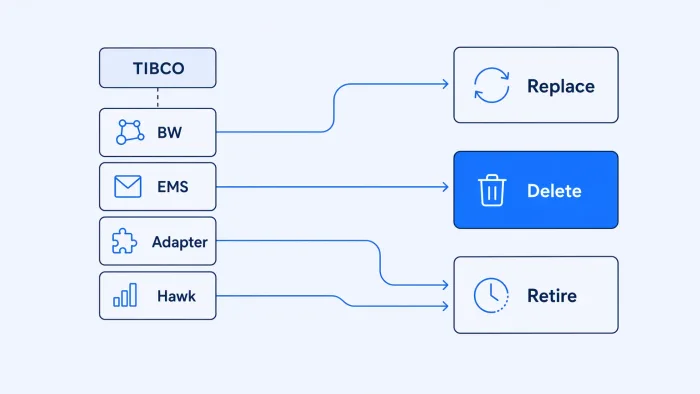
A TIBCO BusinessWorks migration usually starts the same way. Someone runs an inventory of every process, every EMS queue, every custom Java extension wired into the ESB, and the number that comes back is bigger than anyone guessed. The team that built half of it moved on years ago. The change that should take an afternoon takes a sprint, because the flow that needs editing sits behind three others nobody wants to touch. Finance is looking at the license renewal. Platform is looking at the VM fleet it still has to patch and scale by hand. Both are looking at each other, waiting for someone to say the word "migration" out loud.
Once it's said, most teams reach for the same playbook: audit the estate, map TIBCO components to the new platform's building blocks, stand up the replacement, run it in parallel with the old system until the numbers match, cut over. That process is sound. The part worth stopping on is what "the new platform" turns out to be.
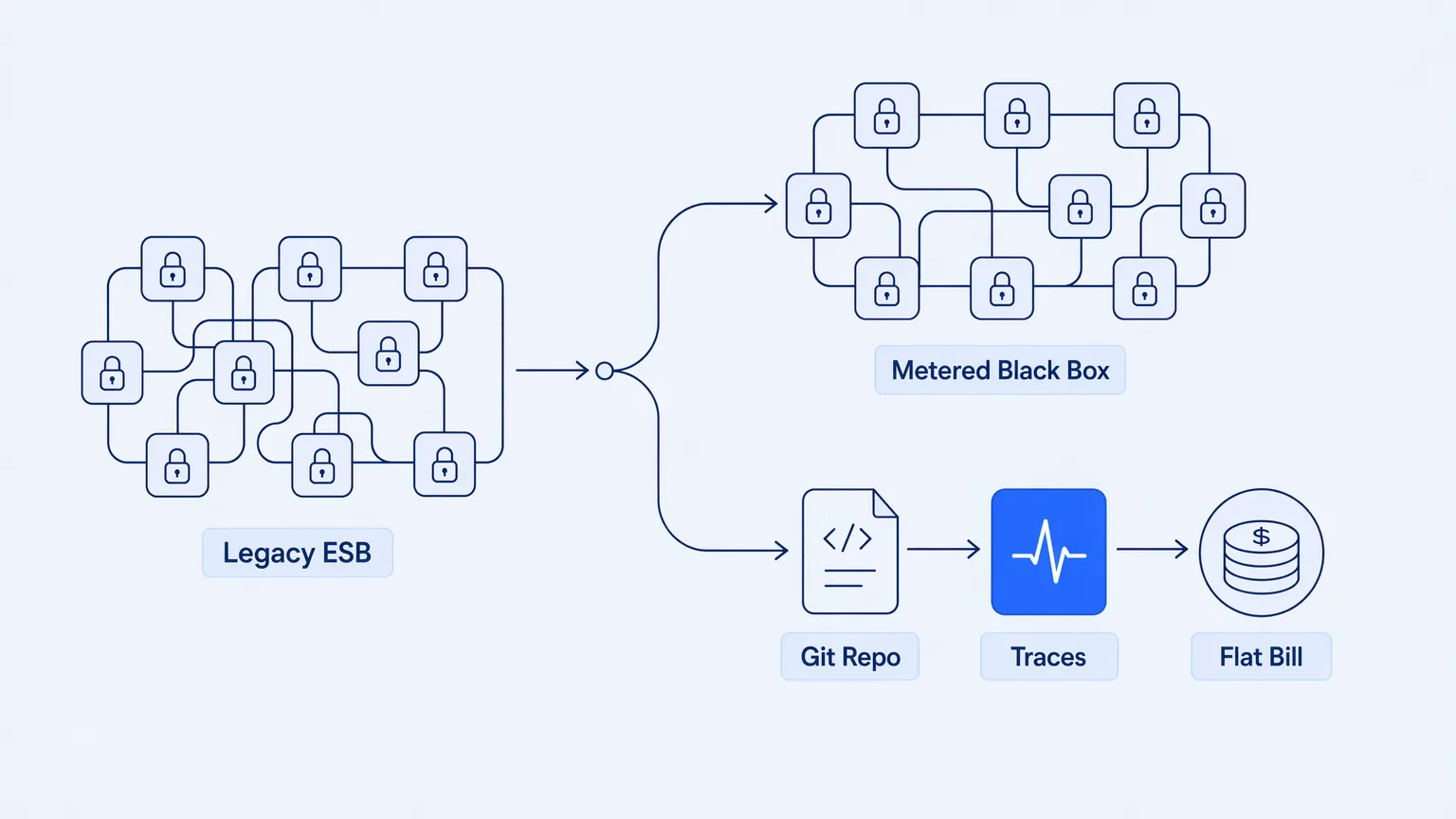
The standard move is to trade one ESB for a different black box — a low-code recipe platform metered by task volume instead of a licensed one metered by cores. That fixes the symptoms TIBCO made obvious. It does not fix the underlying failure, which is that the integration layer answers to a vendor's UI instead of to your own engineering practices. Migrate without addressing that, and the same three gaps — no version control, no telemetry you own, a bill you can't forecast — just reappear in a different shape, usually a few quarters after the migration project gets marked done.
TIBCO's pain points are structural, not a verdict on the team that built it
The list of complaints about BusinessWorks is familiar to anyone who's run it in production: a workflow change that takes months instead of days, because it has to move through a cluster topology built for stability, not iteration speed. VMs and middleware that scale by provisioning, not by policy — someone has to size the next environment by hand. Configuration deep enough that only a specialist who's spent years in the ESB can safely touch the orchestration logic. License and maintenance costs that scale with the estate, not with the value it delivers. Connectivity to modern SaaS and AI tooling bolted on after the fact, because BusinessWorks was designed for an on-premises, point-to-point world.
None of that is a knock on the engineers who built and ran it. It's what integration tooling looked like when TIBCO shipped it, and it did the job it was built for. The pain shows up now because the surrounding world moved and the platform's architecture didn't: cloud-first infrastructure, elastic scaling, and AI-assisted development all assume an operating model TIBCO was never built to support. The gap is structural, inherited from when the platform was designed, not a mistake anyone on the current team made.
That distinction matters for what comes next. If the failure were about one vendor's bad decisions, swapping vendors would fix it. It isn't. Logic locked in a proprietary format, no way to inspect what a workflow did without opening the vendor's console, cost that doesn't track anything your team controls: these are properties of the category TIBCO belongs to, ESB and its low-code iPaaS descendants alike. Swap the ESB for a differently-shaped black box and the same failures ride along, just under a friendlier UI.
The migration project measures the wrong thing if it stops at "modernized"
Every TIBCO migration methodology reads roughly the same: assess the estate, evaluate the orchestration logic for what can be simplified, map TIBCO adapters and processes to the new platform's connectors and recipes, migrate in parallel, cut over once validated, then train the team on the new tool. It's a reasonable sequence. The risk is in what "validated" gets measured against.
Most parallel-run validation checks one thing: does the new platform produce the same output as the old one for the same input. That's necessary, but it's a functional-parity bar, and functional parity is compatible with recreating every governance gap TIBCO had. A workflow that matches TIBCO's output today still has no diff, no review, and no rollback if a proprietary low-code recipe format is all that holds the logic. It still has no traces an SRE can query if the platform's monitoring dashboard is the only place execution history lives. It still turns into a forecasting problem the day it gets promoted to production, if the pricing model bills by task or execution and the newly-consolidated estate runs that workflow more, not less.
A migration that only tests for output parity will happily replatform you onto the next black box.
The honest test for a migration isn't "does it do what TIBCO did." It's whether an engineer can diff a change to this workflow the way they'd diff a change to any other production code, whether whoever's on call can trace a failure without a second login, and whether the bill for this workflow stays flat once the business trusts it with real volume. Ask those three questions about the target platform, not just the legacy one, before you sign off on cutover.
What the assessment phase should actually be evaluating
The comprehensive assessment phase already involves mapping every TIBCO process, adapter, and custom extension. That inventory is the natural place to also decide what you're demanding from whatever replaces it — because it's the one moment in years where the whole integration layer is laid out and open to a real decision, instead of quietly inherited from whatever got chosen last time.
Three properties are worth putting on that evaluation list, matched directly against the three TIBCO failure modes above:
| TIBCO-era gap | What to demand of the replacement |
|---|---|
| Logic locked in ESB config, no diff or review | Workflows stored as real files in your own Git repo, branched and reviewed through the provider flow your team already uses |
| Execution history trapped in a vendor console | Every step emits OpenTelemetry traces into the observability stack you already run — not a second login for on-call to remember |
| Licensing tied to infrastructure footprint | Pricing tied to the features you use, not the volume a workflow runs at, so a workflow's success doesn't inflate the bill |
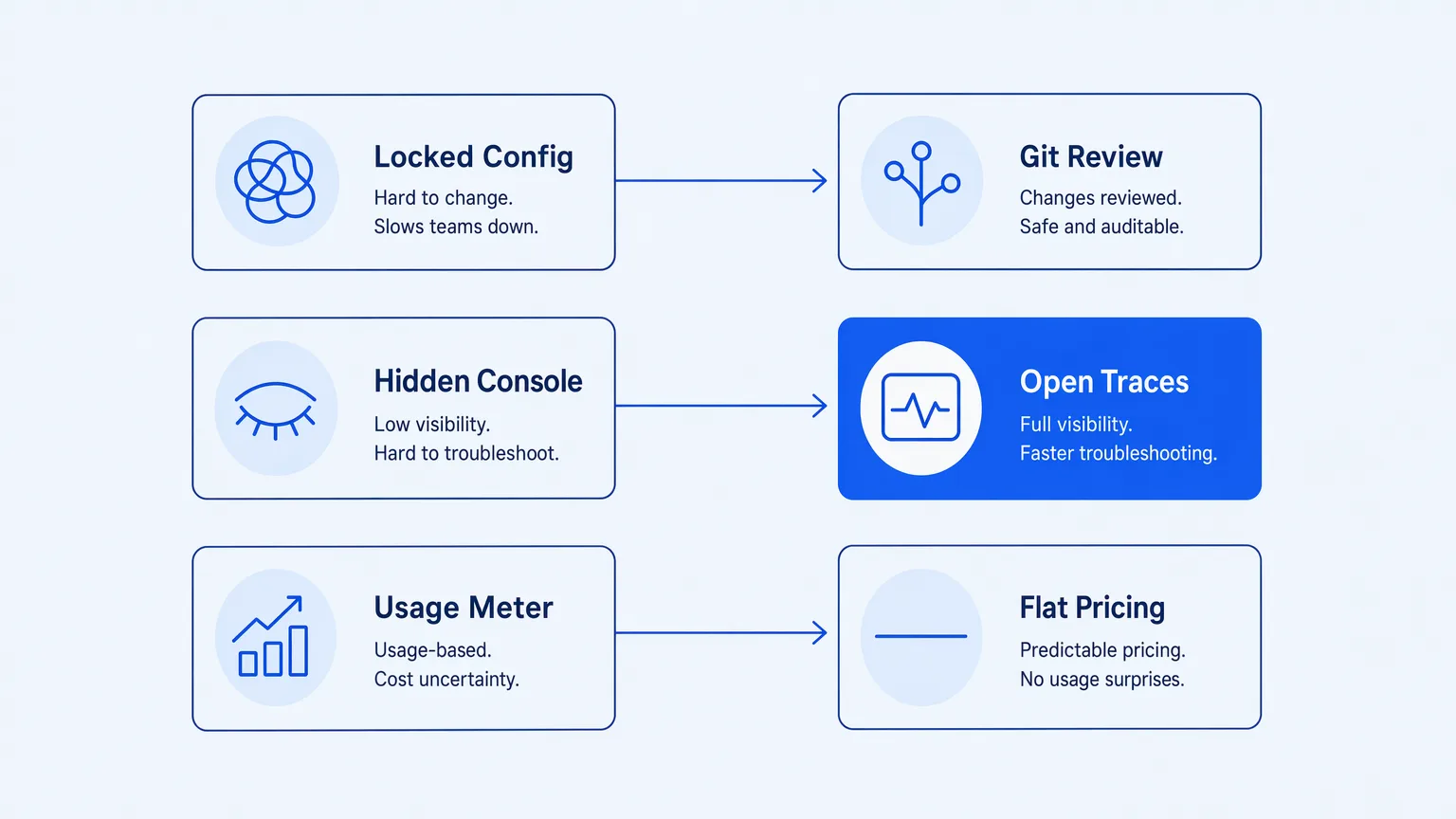
A migration that swaps TIBCO's licensing model for a per-task meter has fixed the invoice's shape without fixing what it measures. The complaint about TIBCO was never "the pricing unit is wrong." It was that cost scaled with something the engineering team doesn't control and can't forecast — server count in TIBCO's case, task volume in a lot of its replacements. A workflow that gets promoted from prototype to production and starts carrying real traffic should be a success story, not a line item finance has to explain in the next budget review.
The same logic applies to the low-code recipe format most modernization projects land on. It solves TIBCO's "requires ESB experts" complaint by making the tool approachable — genuinely useful for a large share of workflows. But approachable and owned are different properties. A recipe stored in a vendor's database, exportable only as a backup snapshot, still leaves the team without a diff, a blame history, or a way to review a change before it ships. Low-code is a real answer to "who can build this." It isn't an answer to "who can prove what changed."
Where a lighter tool is still the right call
Not every workflow coming off TIBCO deserves this level of scrutiny. A notification hook, a one-off sync, an integration nobody would notice if it broke for an afternoon — those don't need Git-backed review or dedicated tracing, and building that rigor into something disposable is overhead without a return. Part of the assessment phase should be sorting the TIBCO estate by how load-bearing each process actually is, not assuming everything gets the same treatment on the other side.
The scrutiny earns its keep on the processes that would hurt if they failed silently or got expensive without warning. That list is usually shorter than the full estate. It's also the one that matters.
The migration moment is a decision point, not just a lift-and-shift
A TIBCO migration already forces a team through assessment, component mapping, and a parallel-run validation window. That's real work regardless of what it lands on — which is exactly why it's worth spending on a target that closes the actual gaps instead of moving them. The short version: code in your repo, telemetry in your stack, a bill that doesn't move with traffic.
Koodisi's Git-Enabled workflows are stored and versioned in your own repository, branched in the platform and reviewed through your existing GitHub or GitLab flow. Every execution emits OpenTelemetry traces exportable to the observability stack your team already runs. And the Professional tier removes execution-based overages entirely — cost tracks the capabilities you use, not how hard a workflow runs once it earns your team's trust. None of that requires you to keep TIBCO's infrastructure footprint either: Koodisi deploys to cloud, on-prem, or hybrid, so the migration doesn't force a cloud-only rewrite on top of everything else changing at once.
If you're already in the assessment phase of a TIBCO migration, run the parallel deployment against those three questions, not just output parity. You can stand up the Git-Enabled version of one contested workflow on Koodisi's free tier and put it next to the existing parallel-run pipeline. Watch where the traces land. Check what the bill looks like once you throw production volume at it. That comparison is worth more than any migration methodology on a page — this one included.