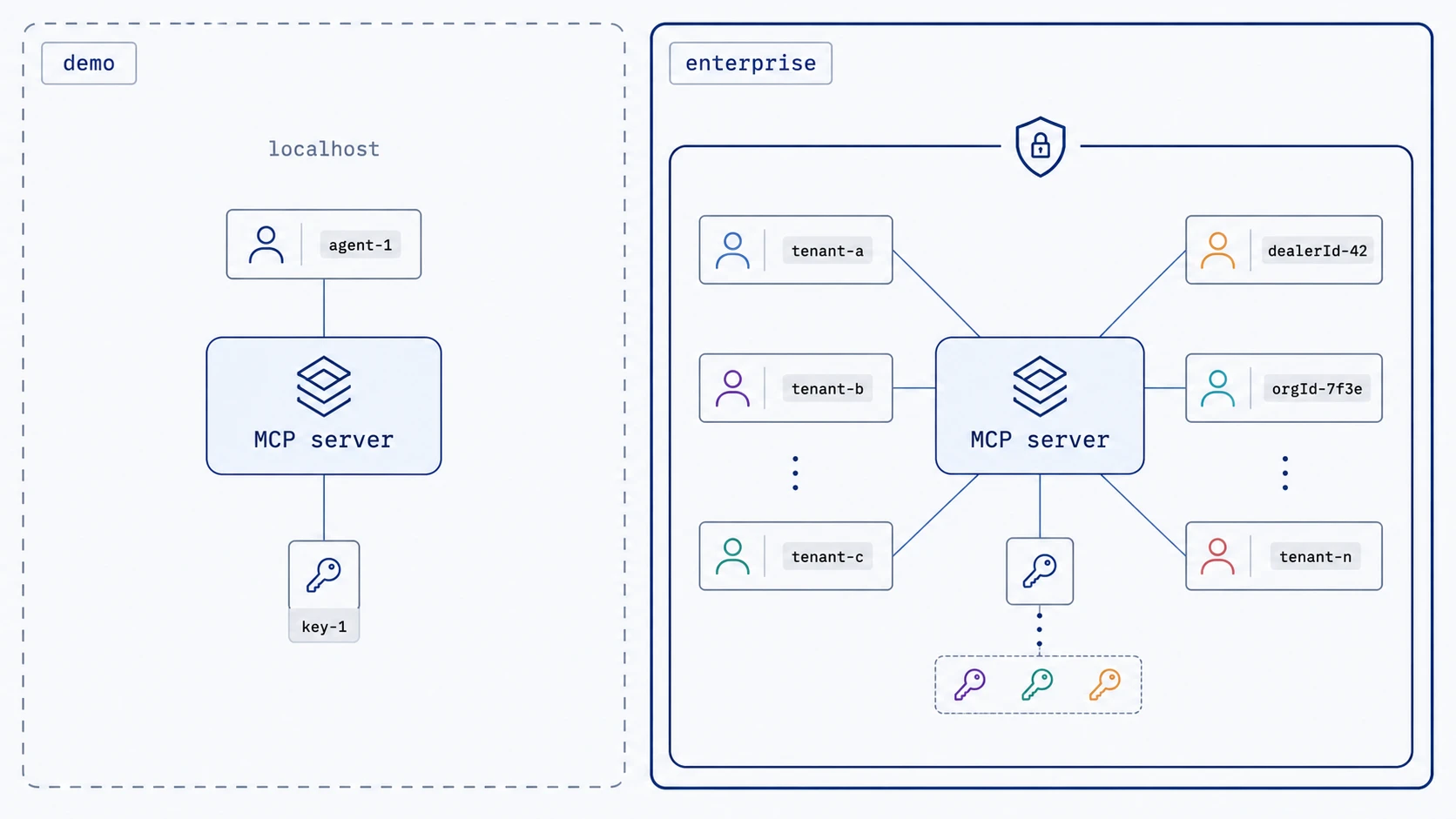
Standing up an MCP server is a weekend project. You wrap a few endpoints, hand the agent a key, point it at localhost, and watch it call your tools. It works on the first try, the demo lands, and someone in the room says "ship it."
Then you try to put it in front of customers, and every assumption that made the weekend easy turns into a liability. The single key is now a single key for everyone. The localhost trust boundary is gone. The agent that helpfully called your tool forty times is now calling it on behalf of a customer who should never have seen that data. Enterprise MCP is the name for everything that stands between those two moments.
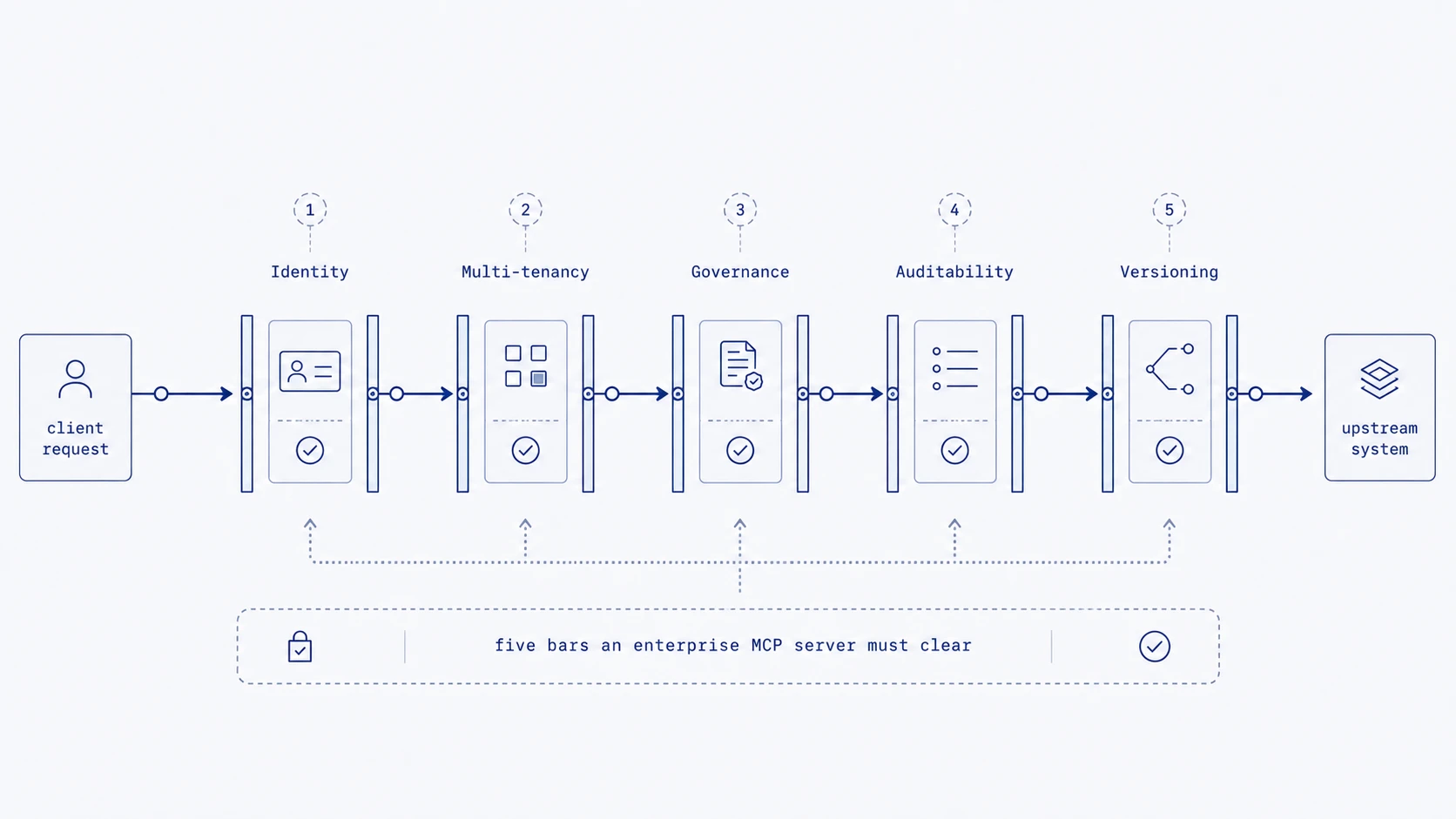
It is not a different protocol — see what MCP actually is and what it deliberately leaves to you for the base definition. It is the same Model Context Protocol, held to the standard you hold the rest of your production systems to. A toy server and an enterprise one can speak identical wire messages and still be worlds apart, because the hard part of MCP was never the protocol. It was making a tool safe for a model to call on behalf of someone real. Five things separate the demo from the deployment.
| The bar | A demo server | An enterprise server |
|---|---|---|
| Identity | one static key, one implicit user | identity carried per request |
| Multi-tenancy | one stack per customer | one server, hard walls per call |
| Governance | "is this user allowed?" | per-tool visibility + risk class |
| Auditability | a line in a vendor console | a span in your own observability stack |
| Versioning | tools change when you do | a published, frozen tool surface |
1. Identity: who is the agent acting for?
A demo server has one user, implicitly: you. There is no question of "for whom," because the answer is always the same person holding the only key.
In production that question is the whole game. The same agent, calling the same tool, must act for a different customer on every request, and it must be physically unable to act for the wrong one. That means identity is not a property of the server. It is a property of each call. The caller's tenant, role, and entitlements have to ride along with the request and reach the systems behind the tool, so a lookup runs against the right customer's data and nothing else.
This is the line most servers never cross. They treat identity as deployment configuration, one identity per running instance, and then discover that "one instance per customer" does not survive contact with a hundred customers.
2. Multi-tenancy: one server, many customers, hard walls
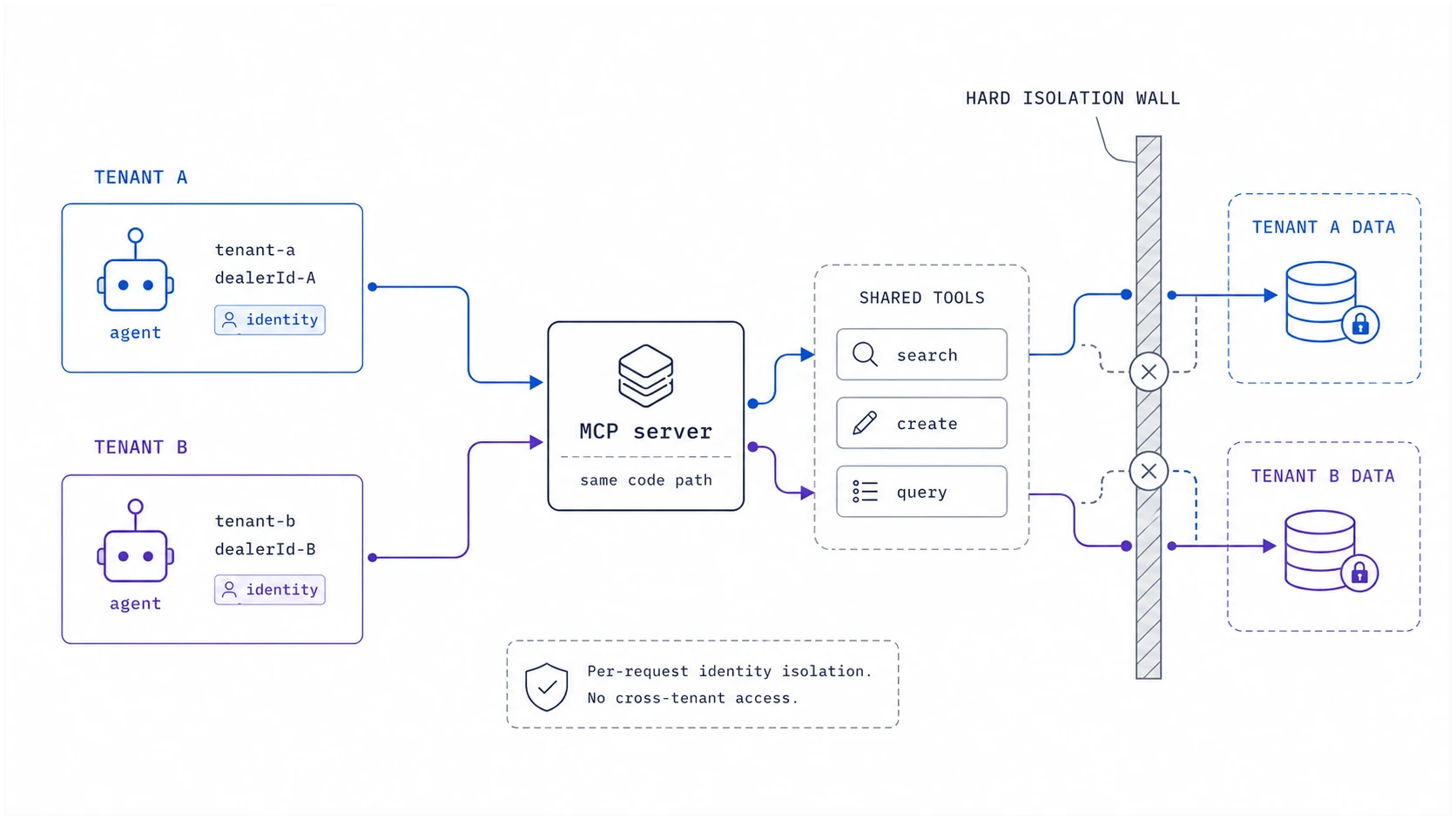
Once identity is per request, multi-tenancy is the payoff and the trap. The payoff is one server serving everyone. The trap is that one server serving everyone is also one server one mistake away from serving the wrong data to the wrong tenant.
The naive fix, a separate stack per customer, is a tax you pay forever in deployment, monitoring, upgrades, and cost. It is tolerable at ten customers and a second job at a hundred. The enterprise pattern is a single server that binds tenant identity per request and isolates on that, so tenant A's agent cannot reach tenant B's data even though they share the same endpoint, the same tools, and the same code path.
If a server cannot tell you, for a given call, which tenant it ran as and prove it could not have run as another, it is not ready for more than one customer.
3. Governance: control built for agents, not users
Every access model most teams own was designed for a human user or a service account standing in for one. OAuth scopes, role-based access, audit trails, all of it answers "is this user allowed to do this."
An agent breaks the question, because there is no user, just a task and a set of tools it might reach for. The governance surface moves. It becomes which tools an agent can even see, since a tool never offered cannot be misused. It becomes which fields it may read or write, because the caller will pass along whatever it is given. And it becomes whether a given call is a read, a write, or something destructive, so the dangerous ones can be gated before they run rather than explained after. Tool visibility and per-operation risk become first-class controls, not documentation.
4. Auditability: you can reconstruct what happened
When a human does something wrong, they remember it, or at least they can be asked. An agent cannot be asked. It decided, retried, and composed calls on its own, fast, without narration, and by the time you notice the bad outcome the reasoning is gone.
So the trace is the only witness. Enterprise MCP means an agent's call is something you can reconstruct after the fact, in the observability stack you already run, not a line in a vendor console with a week of retention. You need to see the span where the latency came from, correlate a retry with a downstream slowdown, and answer "what did this agent actually do, and on whose behalf" with evidence rather than a guess. A server you cannot audit is a server you cannot trust with anything that matters.
5. Versioning: the tool surface holds still
A demo's tools change when you change your mind. That is fine when the only caller is you. It is a production incident when the caller is an agent that leaned on the tool's contract being true.
Enterprise MCP means the tool surface is versioned and stable. What an agent can call is something you published on purpose, frozen at a known version, not whatever your live configuration happens to look like this afternoon. Editing the system behind a tool should not silently change the tool a deployed agent is already calling. Tool definitions deserve the same discipline as the services behind them: published versions, review before change, the ability to roll back. Without it, your agents discover your changes the hard way, in loops, against contracts that no longer hold.
The honest line
You do not need any of this for a prototype. A single internal agent calling two read-only tools is genuinely fine on a static key and a log file, and reaching for identity cascades and audit pipelines there is wasted motion. Enterprise MCP earns its name the moment agents call tools you didn't write, for customers who aren't you, often enough that a wrong answer costs something. Most teams cross that line before they notice, because the demo still works right up until the first time it matters.
Where Koodisi fits
We built Koodisi MCP to clear all five bars by default rather than as upgrades you grow into.
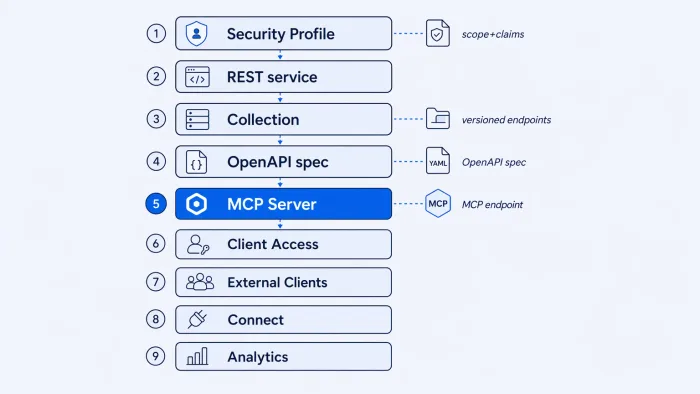
Identity is the starting point, not a bolt-on: a Security Profile, bound to your existing identity provider, declares the claims that say who a caller is, and those claims are injected into your services and forwarded through to your upstream APIs on every call. Multi-tenancy follows from it. Claim values cascade from the profile to a per-client default to a per-user override, so one server serves many tenants and each call runs as exactly the tenant bound to its credentials. Governance is per tool: you choose which operations are exposed, classify each as read, write, or destructive, and set the scopes and claims it requires. Auditability comes from OpenTelemetry on every tier, including the free Community tier, so an agent's call is a span in your own stack. And versioning is structural: services are grouped into a published collection, frozen into an OpenAPI snapshot, and served from that snapshot, so a deployed agent's tools do not move under it.
None of that requires a sales call to try. You can stand up a profile, publish a collection, and expose a governed, tenant-scoped tool on the free tier and see what production-grade looks like before you have a single customer on it.
Enterprise MCP is not a feature you buy. It is a bar your server either clears or does not. The useful question for any platform, ours included, is simple: for a given call, can it tell you who the agent acted for, prove it could not have acted for anyone else, show you exactly what it did, and guarantee the tool it called is the one you published.
If the answer is yes, you have an enterprise MCP server. If it is no, you have a very good demo.