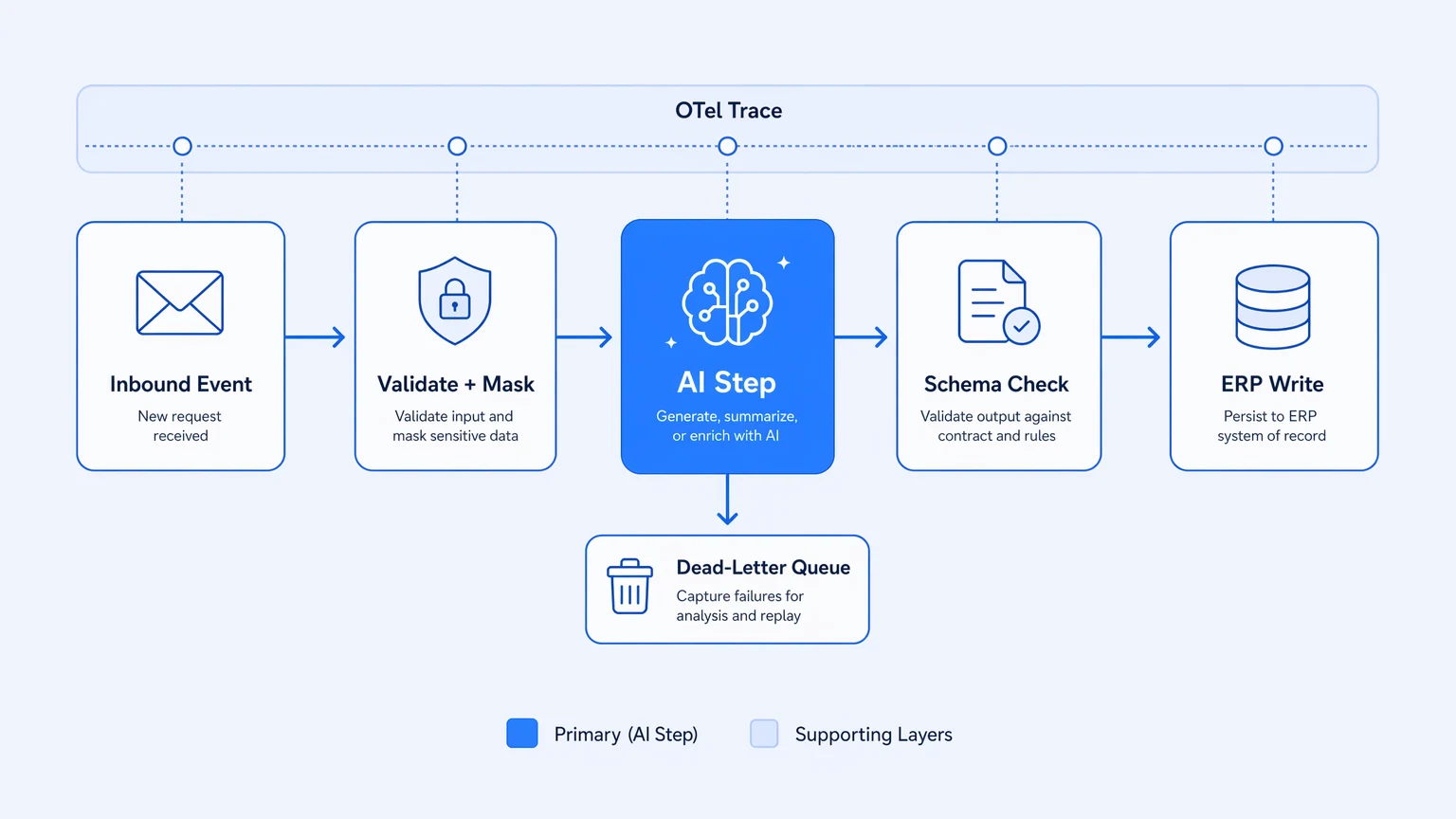
The AI prototype took three weeks to build and impressed everyone in the demo. Two sprints later it's in production, and it's calling an LLM on every inbound event. Last Thursday it retried 40,000 times in a two-hour window because the upstream system sent malformed payloads. Nobody noticed until the model bill arrived. The workflow had no circuit breaker, no dead-letter queue, and no trace you could actually read. You found out from finance.
This is not a model problem. It's an integration problem.
Generative AI adds a new class of step to your workflows: expensive, non-deterministic, and slow enough that everything around it matters. Retries aren't cheap. Timeouts compound. Governance requirements show up the moment you hit a regulated dataset. And unlike a database call that either returns or fails fast, an AI step can partially succeed in ways that are genuinely hard to detect. Every vendor demo shows you the happy path. None of them show you what happens when it doesn't.
If you want to integrate generative AI into enterprise workflows in a way that survives contact with production, the advice you need is less about the models and more about the orchestration layer underneath them.
GenAI Integration Checklist: 4 Things to Get Right
| Get this right | Or this breaks in production |
|---|---|
| Treat the AI step as its own failure class | Retries and timeouts built for REST calls silently corrupt data on a non-deterministic step. |
| Govern from day one — model allowlist, input validation, data policy, output review | "Add governance later" becomes a paper trail after the fact, not real control. |
| Trace the AI step end-to-end, including token cost per workflow run | A workflow you can't trace is a workflow you can't operate or budget. |
| Know your pricing model before an AI step causes a retry storm | Per-execution billing turns one bad LLM call loop into a runaway invoice. |
The integration layer is where GenAI actually breaks
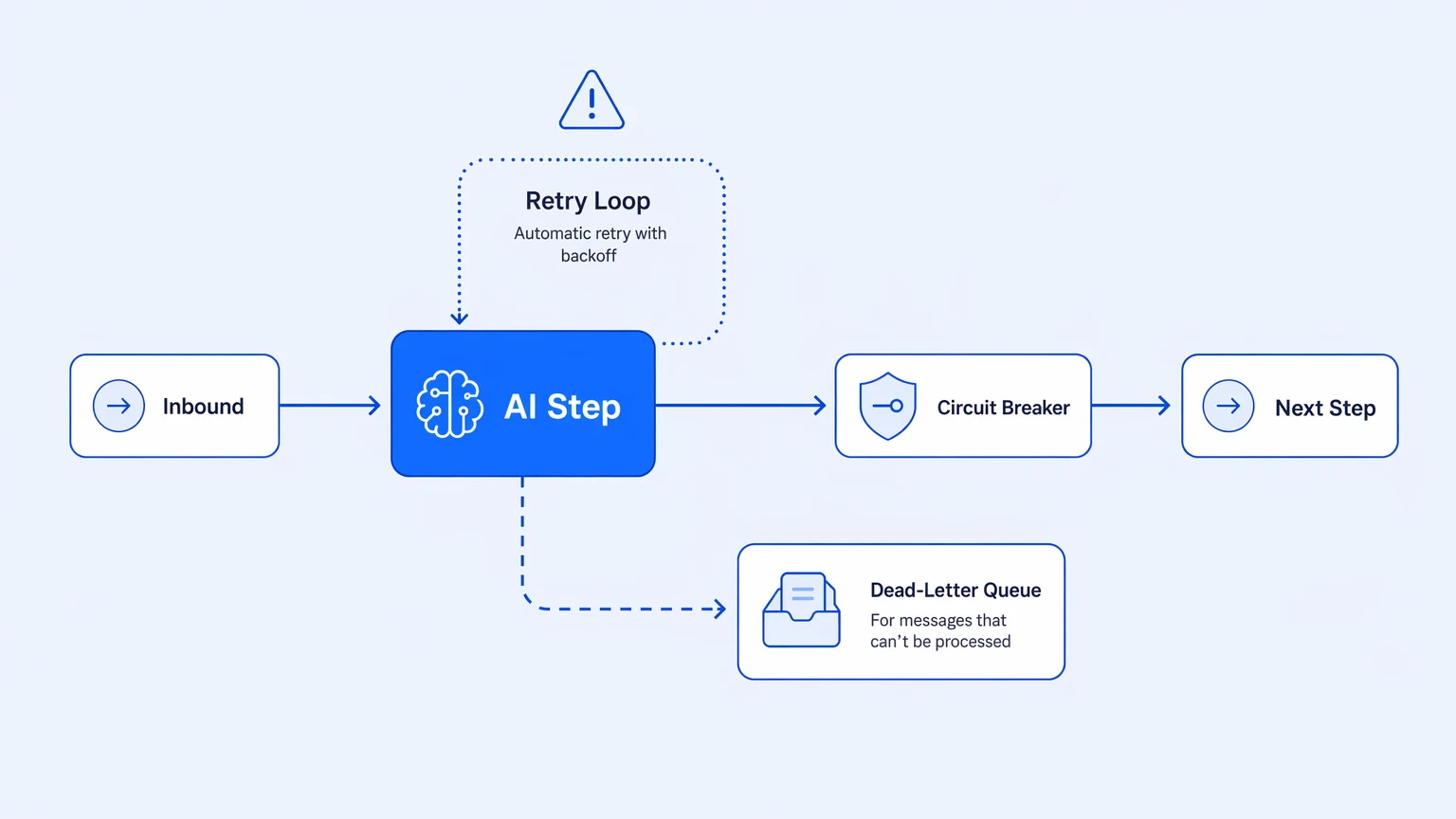
Ask most teams where their GenAI integration fails and they'll say "the model" — hallucinations, latency, rate limits. Spend a week in production and you'll discover the real list: the step that calls the model is usually fine; it's everything around it that isn't.
An AI step has a different failure profile than a REST call. It can time out in ways that leave state ambiguous. It can return a result that passes basic validation but is semantically wrong, and the next step in the workflow happily forwards it. It can be called by three parallel branches simultaneously, driving costs in ways that looked fine on a whiteboard and ugly on an invoice. The circuit breaker you'd put on a flaky external API is just as necessary here, but almost nobody puts one in on the first pass because "LLM as an API" feels like any other API call until it isn't.
The downstream failures are the sneaky ones. An AI step that extracts structured data and passes it to an ERP write can silently corrupt records when the extraction is 90% right. No exception. No alert. The data is wrong in a way that only surfaces in a reconciliation run six weeks later.
What breaks in GenAI-integrated workflows is almost never the model — it's the absence of the same failure-handling discipline you'd apply to any other production dependency.
Governance isn't a second phase
The standard advice is: get it working first, add governance later. For AI-assisted workflows in enterprise settings, this is wrong, and the gap is expensive to close after the fact.
Governance in this context means four concrete things: which models are allowed to run, what data is allowed to flow through them, who can change those rules, and what the audit trail looks like when something goes wrong. None of these are hard to define upfront. All of them are painful to retrofit into a workflow that's already in production serving real customers.
The model-allowlist problem is real and underappreciated. Your organization might have approved GPT-4o for internal tooling and nothing else. Your workflow that calls an embedding model from a different provider is now outside policy — but there's no enforcement if the allowlist exists only in a document. Governance needs to be an evaluated constraint at execution time, not a checklist item someone filled out before the project kicked off.
Data policy is where regulated industries run into walls. Healthcare and financial services workflows often need to redact or mask PII before a payload touches a third-party model. That transformation step needs to run before the AI call, reliably, on every execution. The moment it's a convention rather than a verified pre-condition, you have an audit gap. And the moment you have an audit gap in a regulated dataset, you have a compliance event.
Governance that exists only in documentation isn't governance — it's a paper trail for blame attribution after the incident.
None of this requires building a bespoke policy engine. It requires treating the AI step as a first-class citizen in your workflow tooling: something that carries model constraints, input validation, and an audit record the same way a database write carries a schema and a transaction log.
Observability at the AI step is not optional
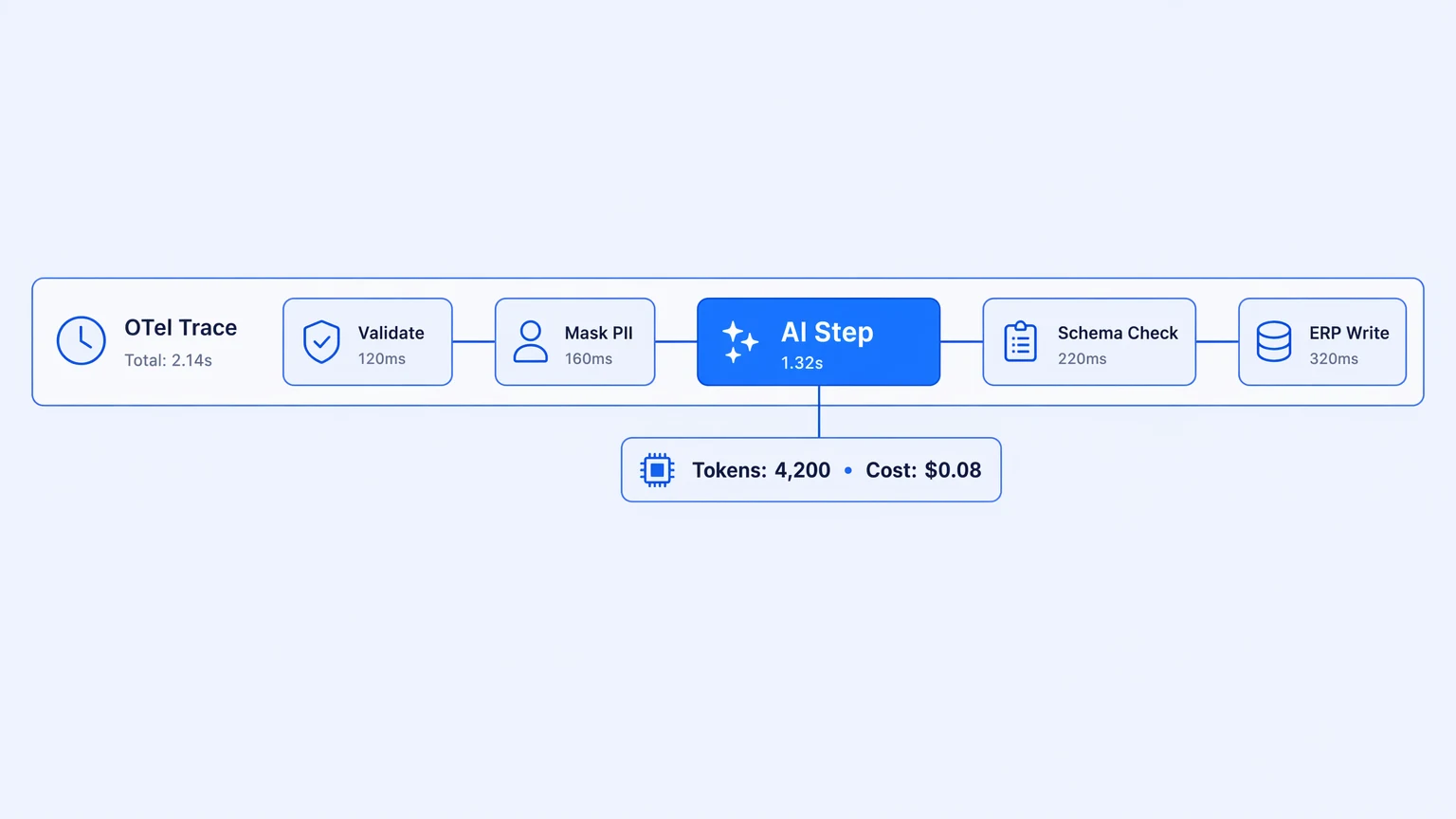
Here's the operational reality of an AI step in a workflow: you need to know what went in, what came out, how long it took, how much it cost, and whether the output was used. Without that, debugging a production failure is archaeological. You're inferring what the model saw from the payload you think you sent and the output you think it returned.
OpenTelemetry traces that span the full workflow — including the AI step — let you move from symptom to root cause the way you'd investigate any other production failure. You filter on the trace where the downstream write produced bad data, you find the AI step that fed it, you look at the extracted output, and you have a root cause in minutes instead of hours. Without the trace, you're grepping logs across multiple systems and hoping for timestamps that align.
Cost attribution is the less obvious observability requirement. Token counts per workflow execution, aggregated by workflow and by client, tell you whether your pricing assumptions are still accurate. Many teams discover that a workflow that looked cheap in testing gets expensive in production because real-world inputs are longer than their test fixtures. That's not a model problem. It's a measurement gap.
A GenAI workflow you can't trace end-to-end is a workflow you can't operate.
Rethink what "no execution overages" means when AI is in the loop
Usage-metered integration platforms were a predictability problem before AI. With AI in the loop they become a material financial risk.
The math: on a per-execution-billed platform, a retry storm on an AI step that calls an LLM on each attempt doesn't just spike your integration bill — it compounds across both surfaces. Your platform charges per execution; your model provider charges per token. A runaway loop at 3 a.m. isn't one bill. It's two, and neither cap the other.
Feature-tiered pricing — where your integration platform charges a flat monthly rate independent of execution volume — doesn't eliminate the model API cost, but it eliminates one of the two meters. Your integration bill no longer moves when traffic spikes, when a retry loop fires, or when you promote a workflow from prototype to production and call volume triples. That's a real change to the risk profile of building GenAI-integrated workflows, not a theoretical one.
It also changes how you test. On a per-execution platform, load testing costs money. Teams under-test as a result. On a flat-priced platform, you can drive realistic load against your AI-integrated workflow, see where it breaks, and fix it before it breaks in production. The testing discipline that should surround any production dependency is no longer disincentivized by the billing model.
The honest tradeoff: feature-tiered pricing still has a fair-use ceiling at scale. It removes per-execution billing and overage invoices — it doesn't mean unlimited compute at any volume. For most mid-market teams running AI-integrated workflows, the practical constraint is the model API cost, not the integration platform ceiling. But it's worth confirming where that ceiling sits before you commit.
What this looks like in practice
Integrating GenAI into enterprise workflows well is not exotic. It's applying the same engineering rigor you'd bring to any other production dependency, in an environment where the failure modes are a bit less familiar.
That means: define the AI step as a governed activity with a model allowlist, input validation, and a declared output schema. Wrap it in a circuit breaker. Route failures to a dead-letter queue with full payload capture so they're replayable and inspectable. Emit OpenTelemetry traces that span the full workflow. Attribute token costs to the workflows and clients that incur them. Test under realistic load before you promote.
None of that requires starting over. If your integration layer treats workflows as versioned software artifacts — where logic is in your repo, traces land in your observability stack, and your bill doesn't move when a retry loop fires at midnight — then adding an AI step is additive, not architectural. The discipline is already there. You're extending it to a new kind of dependency.
The longer argument for why that ownership posture matters, across the full integration layer, lives in why unobservable integration stacks are the real hidden bill.
If you want to see what this looks like on a real workflow, Koodisi's Community tier is free, gives you 30 active workflows and 1,000 executions a month, and has OpenTelemetry traces from day one. Start there.