
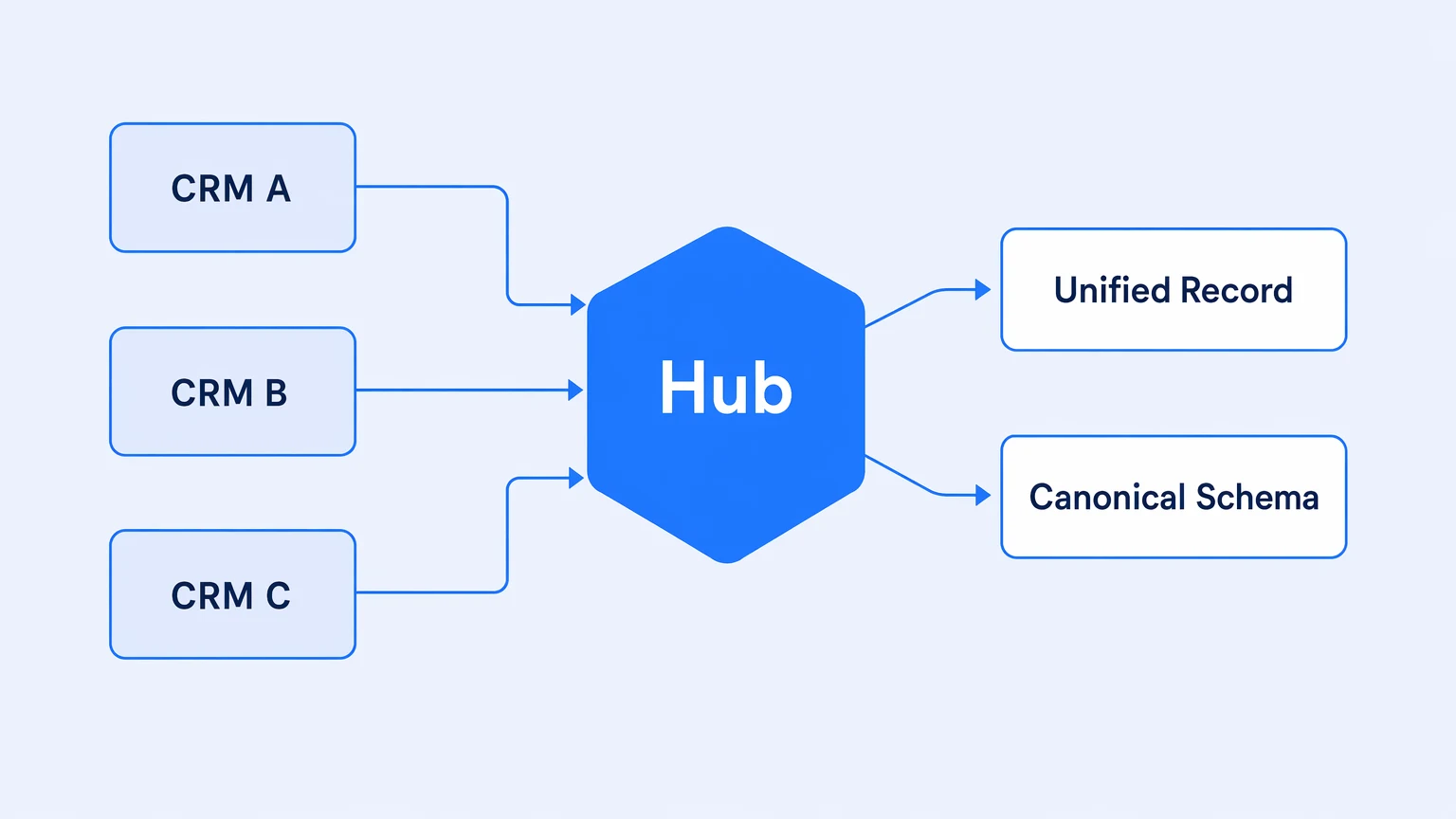
You didn't set out to run three CRMs. One was there when you arrived. One came in with an acquisition. One is the one the sales team insists on because it's the only one with the forecasting view they care about. Now you're responsible for making sure that what a customer tells any of these systems eventually reaches the others.
The initial integration probably shipped fine. The mess surfaces six months later: a record updated in one CRM hasn't propagated for forty-eight hours and nobody knows why, because there's no trace, no alert, and no clear owner. That's the problem worth solving. Not the plumbing — the visibility.
Can You Own Your Multi-CRM Integration? 3 Questions to Ask
Before touching a connector, decide these three things — they determine whether the integration is operable or just running:
- Hub-and-spoke or point-to-point? — every CRM talking through a central layer, or direct pairwise syncs that multiply with each new system added.
- Where does transformation logic live? — centralized and versioned, or scattered across per-connector scripts nobody owns.
- Can you answer "which records are out of sync right now" without opening a vendor's UI? — if not, the integration isn't owned, it's running unattended.
The build that ships is not the integration you'll be debugging
Most writing on how to integrate multiple CRM systems into one application treats this as a data-mapping problem: which fields go where, how to deduplicate, which system owns the record of truth. Those are real decisions. They're just not where multi-CRM integrations break in production.
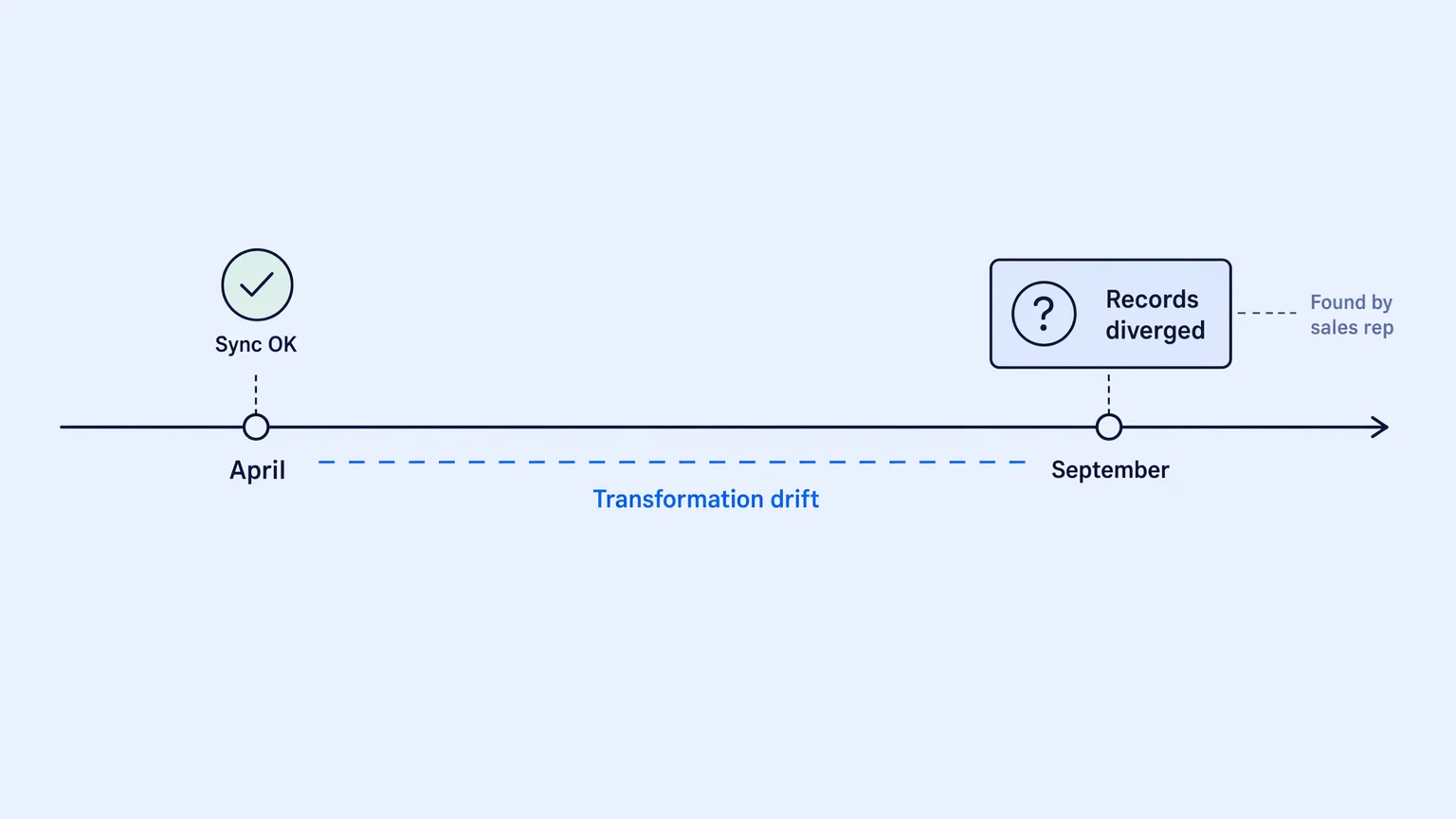
They break after the initial build. Someone changes a field name in one CRM without notifying the integration team. A new sales motion means a lead scoring field now carries different semantics than the routing logic expects. The transformation logic that was correct in April is quietly wrong in September. You find out when a sales rep mentions that twelve accounts haven't synced in two weeks.
The reason this pattern repeats is structural: most multi-CRM integrations are built to ship, not to be operated. The plumbing gets stood up, data flows, the integration gets handed off — and becomes a black box. No one owns its ongoing observability. No one has set alerts on sync lag or transformation errors. The workflow's internal state is visible only through the vendor's UI, if the vendor surfaces that level of detail at all.
An integration you can't observe is one you'll learn about from customers, not from your monitoring stack.
The three architecture decisions that determine operability
Before touching a CRM connector, three decisions determine whether you'll be debugging this in six months or in two years.
Hub-and-spoke versus point-to-point. Hub-and-spoke means all CRMs talk to a central layer that holds the canonical model, transformation rules, and routing logic. Point-to-point means each system has a direct connection to each other. Point-to-point gets you to a demo faster. It also means transformation logic changes propagate across N-squared connectors instead of one. For any multi-CRM integration with more than two systems and any expectation of schema evolution, hub-and-spoke is the only topology that stays operable over a two-year horizon.
Where transformation logic lives. The temptation is to push it into each connector — small coercion functions at the edges. The problem: transformation logic scattered across connectors has no visible home. When a field mapping breaks, finding which connector owns it and why requires whoever was in the room when it was written. Central transformation with explicit schemas — one place that declares what a canonical account or contact looks like, with each CRM adapter mapping into and out of it — is harder to build once and dramatically easier to operate.
How you handle failures. A synchronization error in a multi-CRM setup is not like a 500 from an API. It's usually silent. A record update gets dropped somewhere in the pipeline; no error surfaces; both systems stay in divergent state indefinitely. Dead-letter handling — capturing every failed event with full payload context, making it replayable, making it alertable — is the difference between an integration you trust and one you're always vaguely worried about.
The decisions that feel like overengineering in week one are the ones that save you in month seven.
What "owning" the integration actually requires
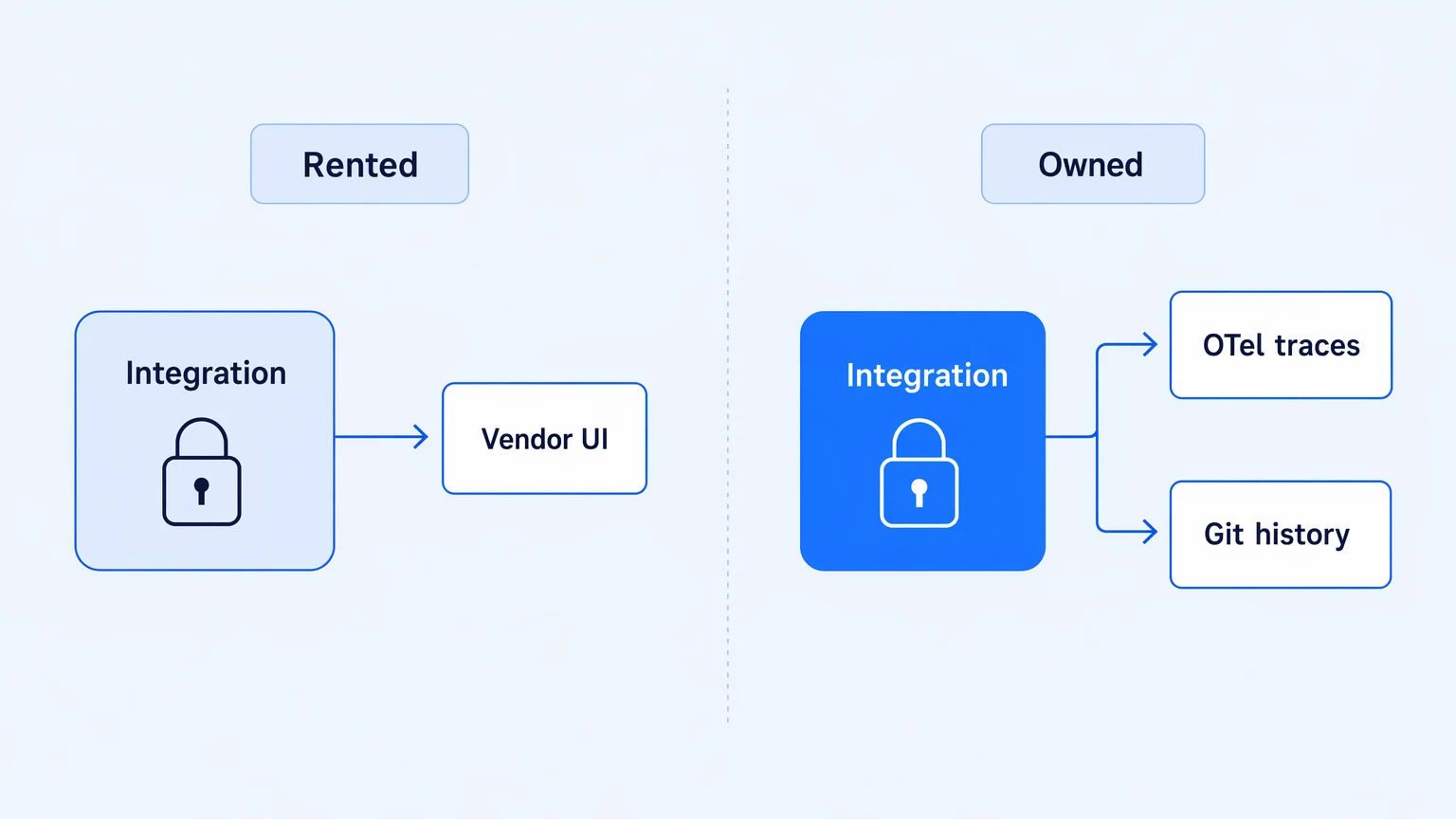
There's a useful test: can you answer three questions about your multi-CRM integration without opening a vendor dashboard?
Which records are currently out of sync? What changed in the transformation logic last Tuesday? If sync latency doubles this week, will you find out from monitoring or from a sales rep?
If any of those require poking through a vendor's UI, the integration isn't owned — it's rented. The cost of renting is that every incident begins with "let me go check the tool," which burns twenty minutes per investigation and puts your on-call team in the position of owning a black box they can't see from their normal tooling.
Owning the integration means its operational picture lives where the rest of your production visibility lives. Sync latency is a metric in your dashboards. Transformation errors are OpenTelemetry traces you can filter by CRM, record type, and time window. A new engineer can read the integration's logic in the same place they read the rest of the codebase, see what changed last month, and run it in a test environment before touching production.
The integration that ships quietly and runs invisibly is not a success. It's a liability that hasn't announced itself yet.
Most multi-CRM guides focus on delivery. The engineering teams who've lived with one of these integrations for two years focus on operation. The longer you've owned it, the more you care about the second question — not "does the data get there?" but "can I tell when it doesn't?"
The full argument for what owning the integration layer looks like across code, telemetry, and cost is in why unobservable integration stacks are the real hidden bill — the multi-CRM scenario is one concrete instance of a broader ownership posture.
The operational infrastructure that doesn't ship itself
Once hub-and-spoke is in place and transformation logic has a home, the operational layer is what determines whether this integration is something you can hand to a new engineer or something that only works while the original author is employed.
Every multi-CRM workflow needs:
- A versioned canonical schema. Documents what a unified record looks like; changes go through review rather than a click in a UI.
- Sync-lag metrics per CRM pair. Surfaced in whatever observability stack the rest of the team uses, not in a separate vendor console.
- Per-step error alerts. With enough context to identify the record and the failed transformation without opening a second dashboard.
- Dead-letter queues with replay. A downstream blip shouldn't permanently desynchronize your CRM state; failed events need to be capturable and replayable.
- A named owner. A team or rotation responsible for responding when any of the above fires.
The ownership decision is the one that gets deferred until after an incident. It should be made before the integration ships to production, not after the first 3 a.m. page.
None of this is exotic. It's exactly what any team would build around a load-bearing production API. The gap is that integration tooling has historically made most of it hard — UIs instead of APIs, vendor-scoped logs instead of exportable traces, no version control on transformation logic. Platforms that treat integration workflows as first-class software artifacts — versioned in Git, observable through OpenTelemetry, deployed through environments — remove the structural excuses. The work stays yours to do; the scaffolding stops fighting you.
An integration that can't be handed off isn't an integration — it's a person dependency with a UI on top.
Koodisi ships OpenTelemetry on every tier, starting with the free Community tier, and stores workflows as versioned artifacts in your own Git repository. If your team is running multi-CRM sync on a platform where transformation logic lives in a vendor database and the only logs are a vendor UI, that operational gap is structural. Community starts at $0; Professional is $399/mo with no per-execution billing and no overage invoices.
The failure you haven't had yet is still coming
A multi-CRM integration that works today and is invisible is not a solved problem. It's a future incident without a date. Data divergence accumulates quietly. Transformation logic drifts as the CRMs evolve. The person who understood the workflow leaves. Then something fails and the investigation starts from scratch.
The teams that build this right aren't pessimists. They've seen it before and know the cost of building something you can't operate is deferred, not avoided.
Stand up the hub. Centralize the transformation logic. Get it into version control. Wire up the traces. Set the alerts. Name an owner. Then you have an integration. Everything else is a migration waiting to happen.