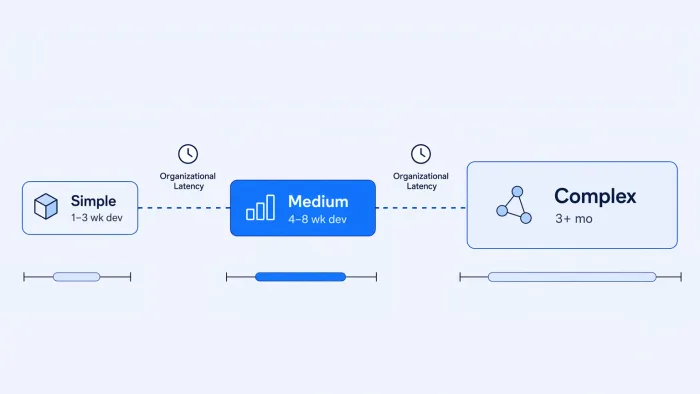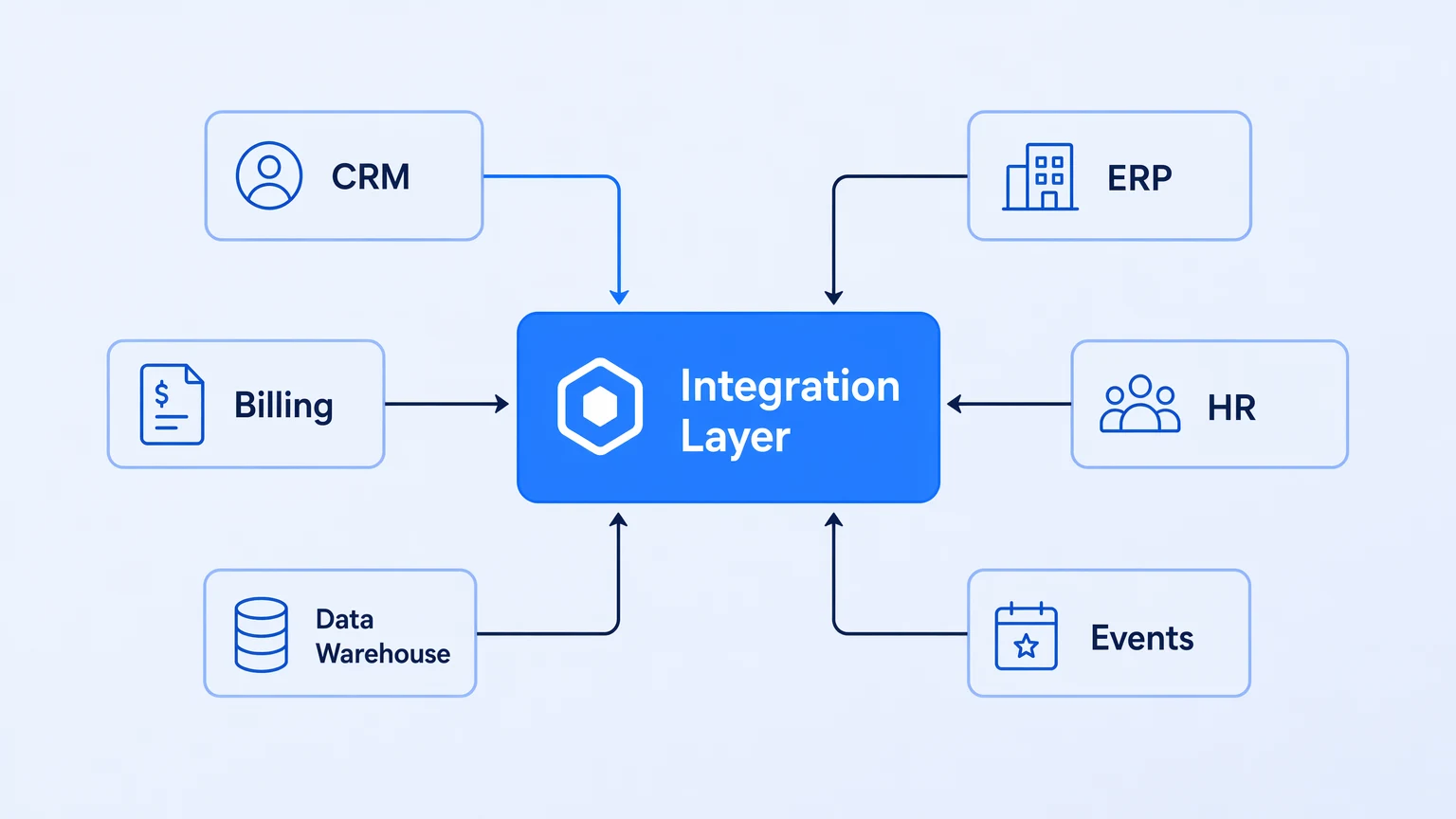
Your team has twenty, maybe thirty integrations in production. Salesforce to the data warehouse, ERP to billing, Greenhouse to BambooHR, a handful of payment webhooks, some event streams to internal consumers. Nobody planned for thirty. You added them one at a time, each reasonable in isolation, over three years. Sprints are slower than they used to be. On-call now includes "integration weirdness" as a rotation category. Two engineers have informal ownership of half the stack — fine, until one takes PTO.
The standard advice is "use a better tool." Pick a platform, centralize, automate. That's not wrong, but it answers the wrong question — the same one the guide to what API integration actually involves argues most teams get wrong at any scale. The bottleneck isn't tooling selection. It's the patterns underneath: who owns what, what's observable, and whether your cost structure punishes you for growing.
How to Manage Multiple API Integrations Efficiently: A 5-Point Framework
- Map the ownership surface, not just the integration count — know who owns each integration before the person who set it up leaves.
- Instrument every integration for observability before you need it — you can't debug a failure across thirty systems from logs that live in thirty different places.
- Choose a pricing model that doesn't punish growth — usage-metered billing on retries and backfills turns scaling into a budget risk.
- Treat integrations as versioned, reviewable artifacts — not tribal knowledge held by whoever built them.
- Fix the organizational pattern, not just the tooling — a better platform doesn't help if ownership and review habits don't change with it.
The multiplier problem: integrations compound in ways that traffic doesn't
A single integration is manageable. It has a clear owner, a known failure mode, some runbook entry somewhere. When you have thirty, you don't have thirty manageable things — you have something qualitatively different, because integrations share dependencies.
One upstream API changes its authentication scheme. Every integration touching that provider needs updating. A downstream schema changes silently. Every integration writing to that destination starts emitting bad records, probably without any alert. A new engineer joins the platform team. She needs to understand not just the workflows, but the mental model of why each one was built the way it was — the decisions made in contexts that no longer exist.
The compounding problem isn't the integrations themselves. It's the hidden surface area between them.
This is why integration count doesn't scale linearly with velocity. Each new integration doesn't add fixed overhead — it adds to a shared pool of dependency risk. The fifteenth isn't fifteen times harder to manage than the first. It's harder in ways that are difficult to articulate in a planning meeting, which is why the problem keeps getting deferred. The longer argument for how this compounds into structural debt lives in why unobservable integration stacks are the real hidden bill, but the operational point here is simpler: at scale, the unit of complexity isn't the individual integration — it's the graph.
Ownership without a map is ownership in name only
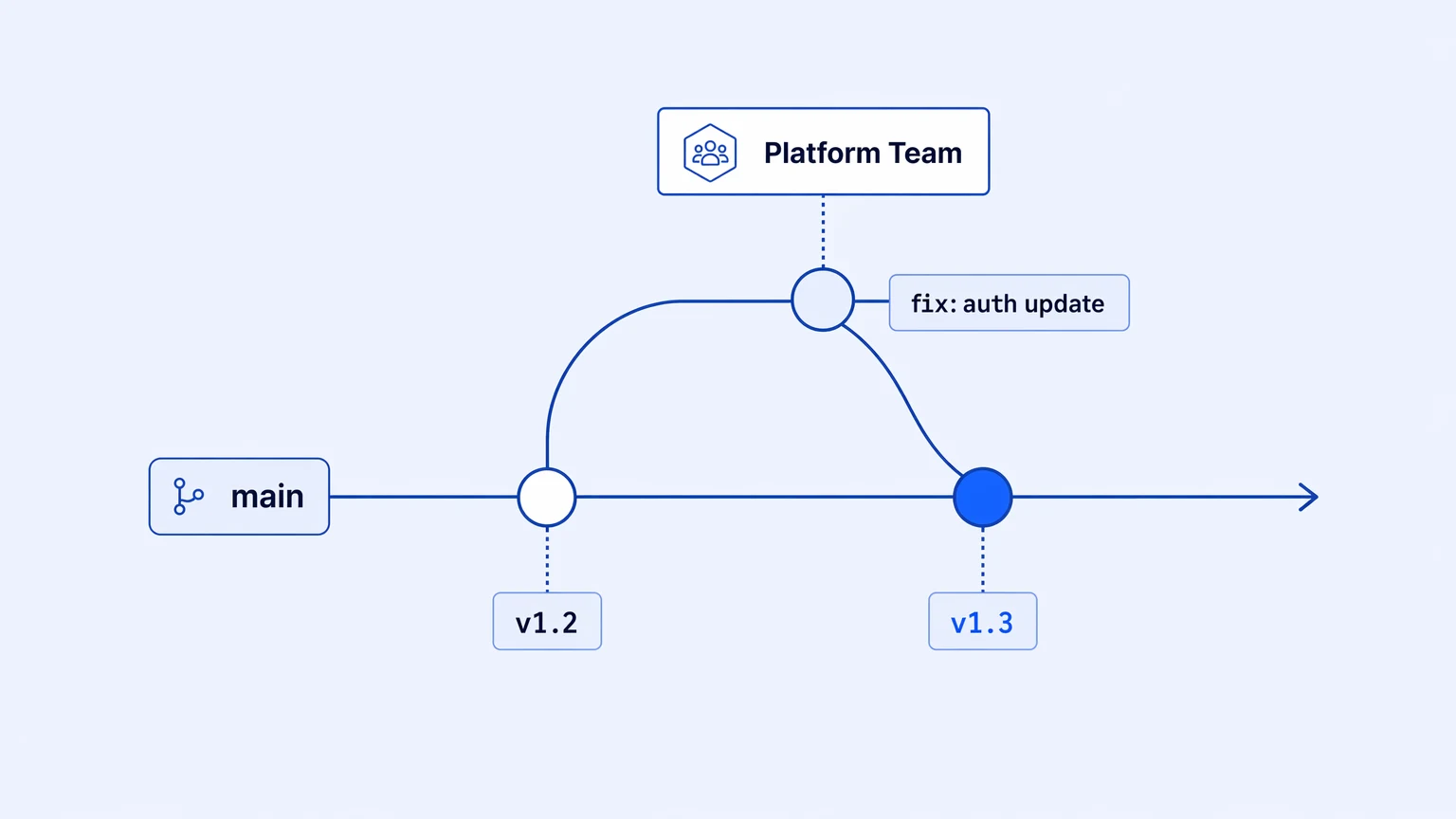
Most multi-integration stacks have owners on paper. In practice, "owner" usually means "the person who set it up." When that person leaves, or changes teams, or simply gets busy, the integration enters a state that's hard to name but easy to recognize: it runs, it occasionally breaks, someone patches it reactively, and nobody knows where the configuration actually lives.
The root cause is almost always the same: the integration was never treated as a software artifact. No version history. No test coverage. No deployment record. The logic lives inside a vendor UI, a JSON config in someone's Downloads folder, or a Lambda function that predates your current CI/CD setup.
The organizations that manage multiple API integrations efficiently — where adding the twenty-fifth integration doesn't meaningfully slow the team down — share a specific pattern. Every integration is versioned in a real Git repo, with branches and a review process. Every change is deployed through an environment sequence. Ownership is tied to a team, not a person, and that ownership is discoverable from the artifact itself, not from institutional memory.
When an integration is a versioned file in your repo, handoffs are engineering problems with engineering solutions. When it's a JSON blob in a vendor UI, handoffs are organizational problems with no solution.
Infrastructure went through this same shift in the early 2010s. Before IaC, "who owns this server" was a tribal knowledge question. Terraform made ownership a file. The integration layer is at the same point now — and the platforms that treat workflows as software artifacts, with real Git versioning and in-platform branching where PRs run through your existing GitHub or GitLab flow, are the ones making the same argument Terraform made: the artifact is the truth, not the memory of the person who built it.
Observability isn't optional at thirty integrations
At five integrations, you can afford to debug reactively. Something breaks, you grep some logs, you find it. At thirty, reactive debugging is a full-time job that competes with your actual roadmap.
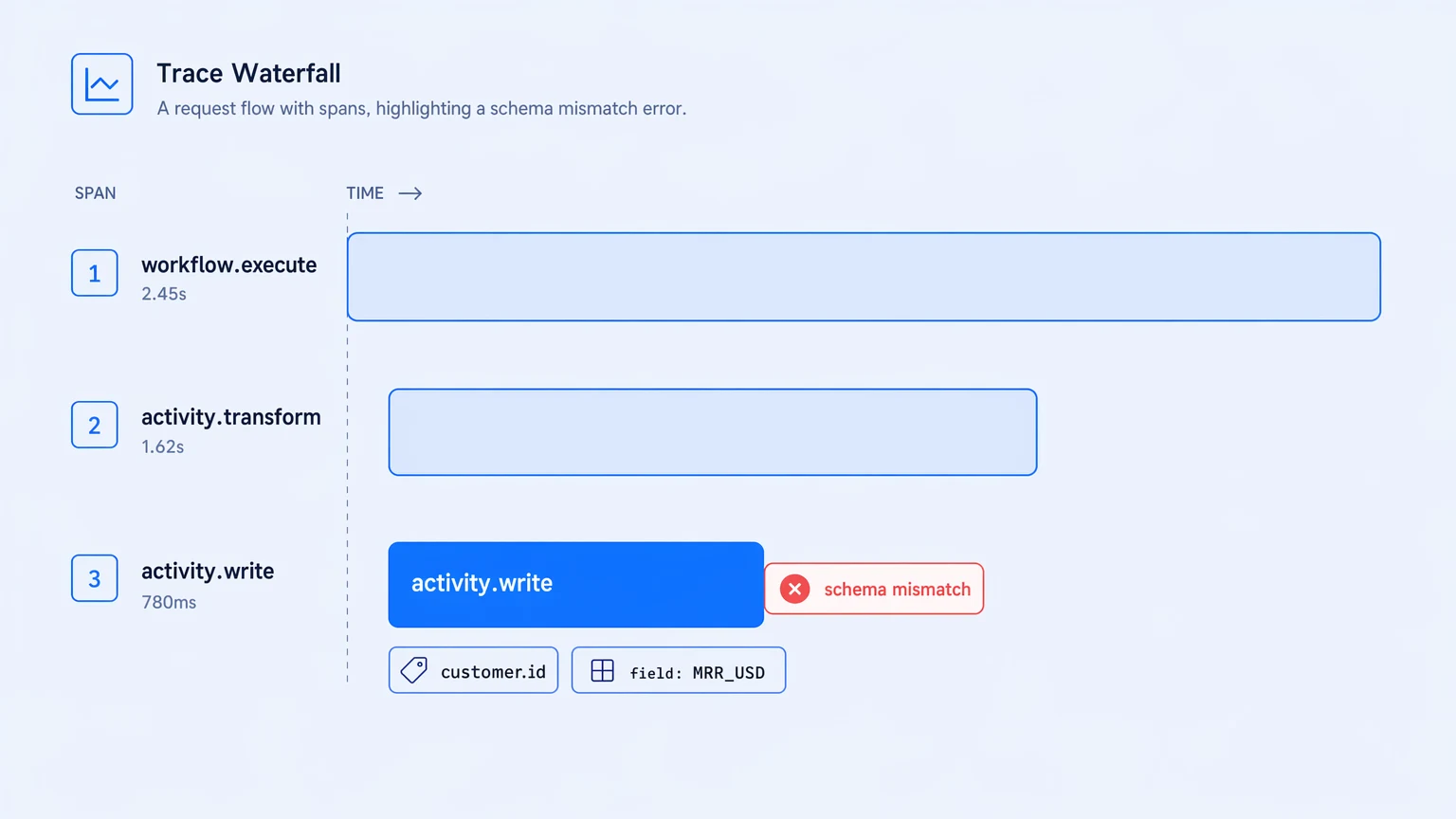
The specific failure mode is silent corruption. An integration doesn't throw an error — it runs successfully, writes a record, and that record is wrong. A field got renamed upstream. A downstream schema evolved. An enrichment step returned null for a subset of inputs. By the time the problem surfaces, the root cause is three layers back and the timestamp on the bad records doesn't help you because your logs rolled off.
The fix isn't faster humans. It's tracing. When every integration emits OpenTelemetry spans — with the workflow version, the input payload, the output schema, the activity-level latency, and any error context — you can answer in two minutes the question that currently takes three hours: what happened, where, on which record, at which step, and what did the data look like going in.
The difference between an observable integration layer and an unobservable one isn't a debugging convenience. It's the difference between a production system you can reason about and one you can only react to.
This is where most integration platforms still fall short. Logging exists; tracing doesn't. You get a task history UI that tells you "the run succeeded" or "the run failed," but you don't get spans that land in Datadog or Honeycomb alongside your application traces. Your SRE team has one pane of glass for the application and a separate UI for the integration layer, and the correlation between them requires manual reconstruction.
Native OpenTelemetry — not a log export, not a vendor-proprietary streaming format, but actual OTLP traces indexed by attribute tags — changes the operational posture for a team managing thirty integrations. You stop asking "did anything break?" and start asking "show me every execution in the last four hours where customer.tier = enterprise had a non-2xx downstream response." That's a different kind of query. It requires a different substrate.
Pricing models that punish growth slow engineering down
The slowdown in multi-integration management often isn't technical at all. It's a cost dynamic that never makes it into engineering planning docs.
Usage-metered integration pricing — where you pay per execution, per task, per action-step — creates a hidden tax on operational hygiene. Retries are good engineering practice; on a metered platform, retries are billed. Idempotency patterns require test executions; test executions count against your quota. When a workflow spikes under load, the bill spikes too — often nonlinearly, because loops and branches multiply step counts.
The result is that engineering teams on metered platforms start making architectural decisions based on cost avoidance rather than correctness. Fewer retries. Less testing. Reluctance to add integrations because each new workflow is a new line item with unpredictable ceiling. The platform that was supposed to accelerate the team ends up introducing a new category of tradeoff into every design conversation.
| Usage-metered | Feature-tiered (no overages) | |
|---|---|---|
| Retry on transient failure | billed per retry | not billed |
| Test run before deploy | billed | not billed |
| Traffic spike in production | bill spikes | flat |
| New integration in Q3 | new execution cost line | no change |
The integration platform's billing model is an invisible architectural constraint. Teams on feature-tiered pricing design for correctness; teams on usage-metered pricing design for cost.
Feature-tiered pricing — where the bill tracks capability adoption rather than execution volume — removes this constraint. No per-execution billing, no overage invoices. Your bill doesn't move when your traffic does. It's not about being cheap. It's about aligning the cost structure with the behavior you actually want from your team: retry on failure, test before deploy, add integrations when the business needs them. None of that should carry a financial penalty.
The organizational pattern, not just the tool
The teams that manage multiple API integrations without slowing down engineering aren't running a smarter platform in isolation. The platform choice matters, but it's downstream of three prior decisions.
Integrations are versioned software. Not recipes in a vendor UI, not JSON snapshots in a backup directory — actual files in a repo, with branches, reviews, and deployment records. Ownership maps to teams, not people.
The integration layer is observable using the same stack as everything else. Traces in Datadog, not a separate vendor UI. Failures are replayable from the platform, not reconstructed from rolling logs.
And the cost structure doesn't punish doing things correctly. Retries don't generate surprise invoices. Test runs don't count against a quota. The bill doesn't spike the month a workflow ships to production.
These aren't exotic requirements. They're the standards the rest of the production stack already holds. The gap is that most integration tooling was built before those standards were expected — and the incumbent platforms can't retrofit them without breaking what their existing buyers need.
If you're evaluating platforms against these three criteria, Koodisi is worth benchmarking. Community tier is $0 — no credit card, OpenTelemetry on every node, real Git-native workflows from day one. Professional is $399/mo, no per-execution billing, no overage invoices, 90-day OTel retention. It's built for the team running thirty integrations the same way they run the rest of their production stack: versioned, observable, predictably priced.
Get the patterns right first. The platform follows.