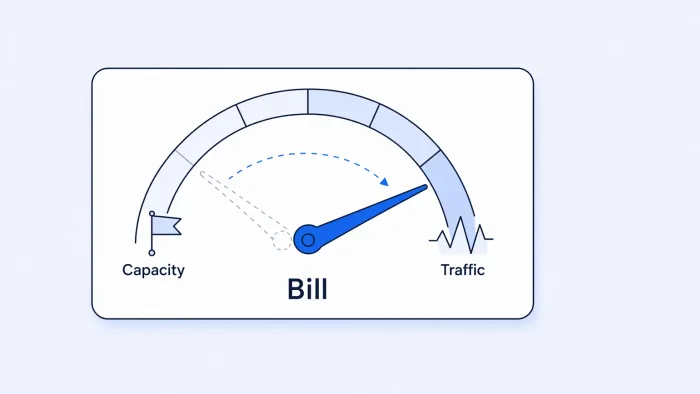
The vendor quoted you $833 a month. The first invoice came in at $3,400.
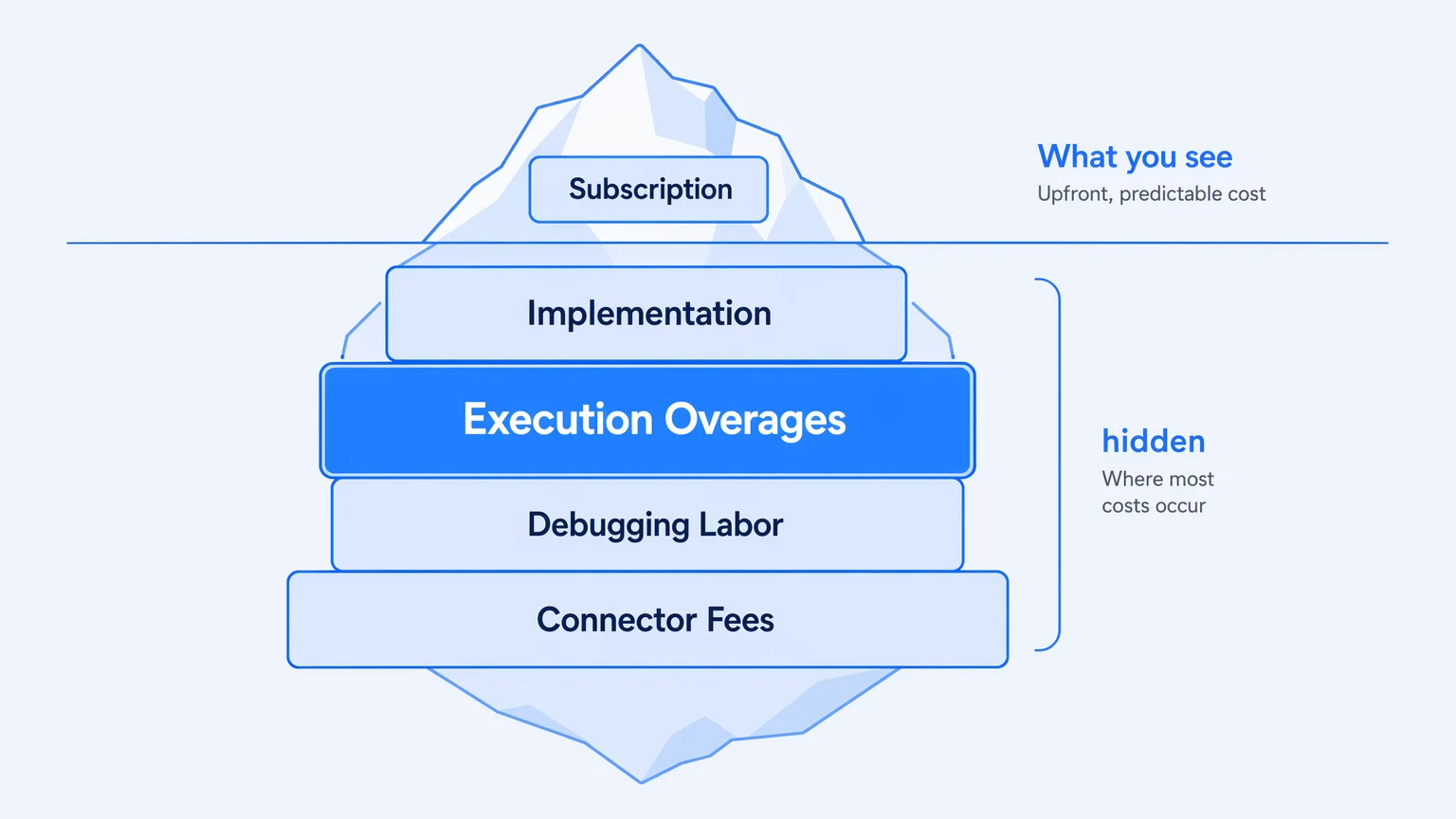
That's not an anomaly. If you've been through a serious integration platform evaluation, you've lived some version of it: the subscription number is real, but it's surrounded by costs the sales deck doesn't mention. Implementation fees. Execution overages. The engineering hours your team burns debugging a system that tells you something failed but not where, or why, or in what state the data was when it did. The platform that looked like a reasonable line item has become a significant portion of infrastructure spend — and nobody can tell the CFO exactly why.
Most teams don't discover the hidden costs of data integration platform implementation until they're committed. At that point the costs aren't hypothetical — they're your budget.
The implementation partner you didn't know was mandatory
The first hidden cost hits before your team runs a single workflow. Enterprise integration platforms have long sold through partner networks — systems integrators who specialize in standing them up. That model made sense when the alternative was hand-rolling point-to-point integrations in Java. It makes less sense when you're charged five figures a year for a platform that still requires a $30,000 engagement to configure for your environment.
The framing you see on pricing pages is "optional professional services." The framing inside the platform's partner community is closer to the truth: most non-trivial deployments require it. Platforms built for enterprise procurement cycles are often built with implementation partners as part of the delivery model — complexity creates recurring demand for the partner ecosystem. Mid-market teams hit this hard. They buy the platform and then discover the learning curve is steep enough that a partner engagement is the only realistic path to a working production deployment in under six months.
Implementation fees aren't optional for most teams — they're deferred first-year costs bundled into a separate line item.
The execution model that punishes your most successful workflows
The second category of hidden cost is less front-loaded but more durable: the billing model.
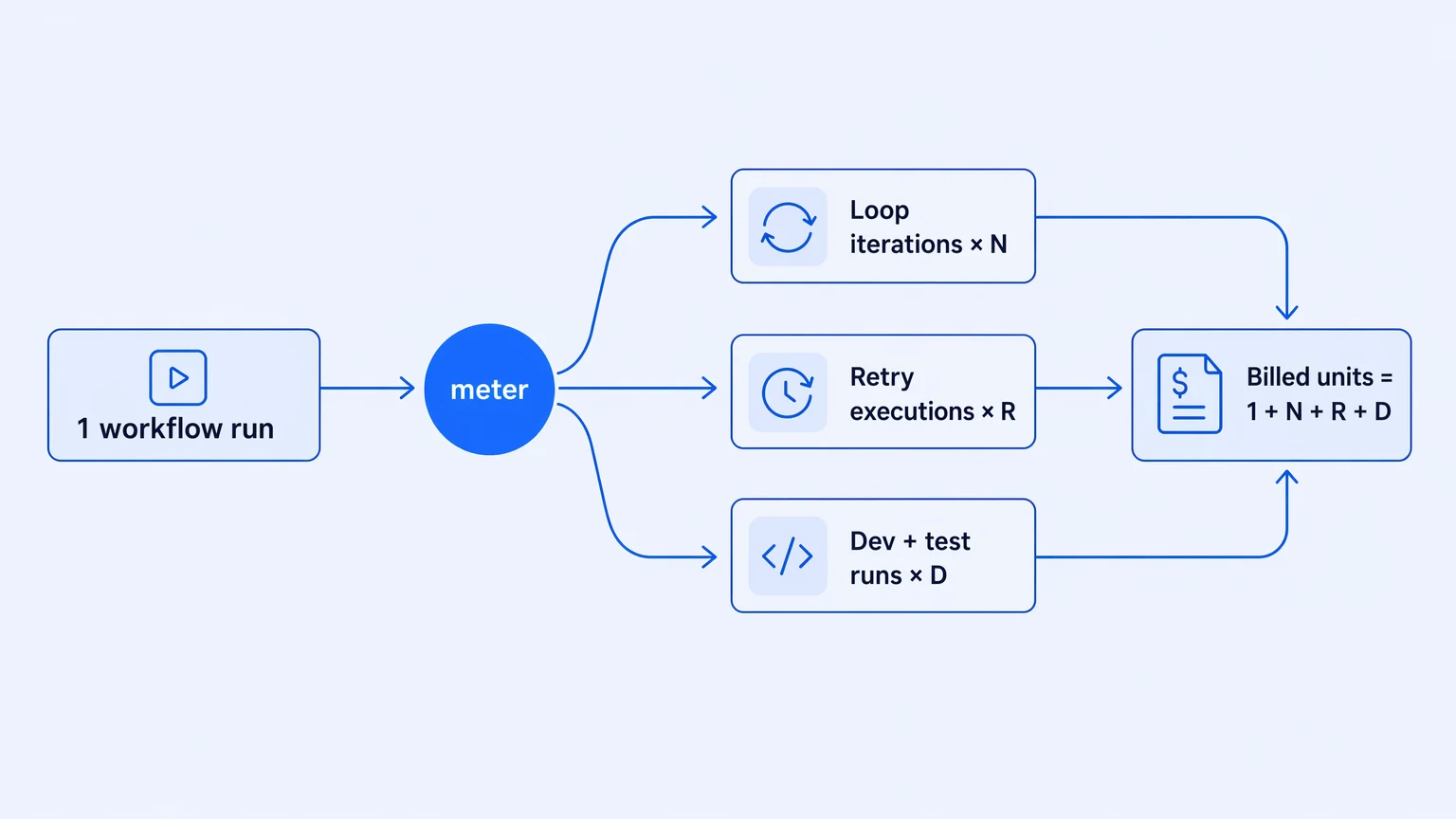
Most integration platforms price on execution volume. Recipes, tasks, steps, transactions — the noun varies, but the structure is the same. The units are cheap during the trial because you're running test workflows against synthetic data. They get expensive precisely when your integrations get good.
The moment a workflow becomes load-bearing — when other systems depend on it, when traffic scales, when retries happen — is the moment usage-metered billing becomes a liability on your balance sheet.
There are at least three ways platforms amplify this beyond the base meter. Loops and fan-out patterns count as multiple task units even when the semantic work is a single batch operation. Retries — healthy engineering behavior — count as new executions on platforms that bill per invocation. Dev and test executions run against the same meter as production, meaning your engineering velocity has a literal dollar cost. None of this appears in the headline pricing; it lives in the documentation under "what counts as a task."
The debugging labor nobody puts on the invoice
The third cost shows up as engineering hours rather than a line item.
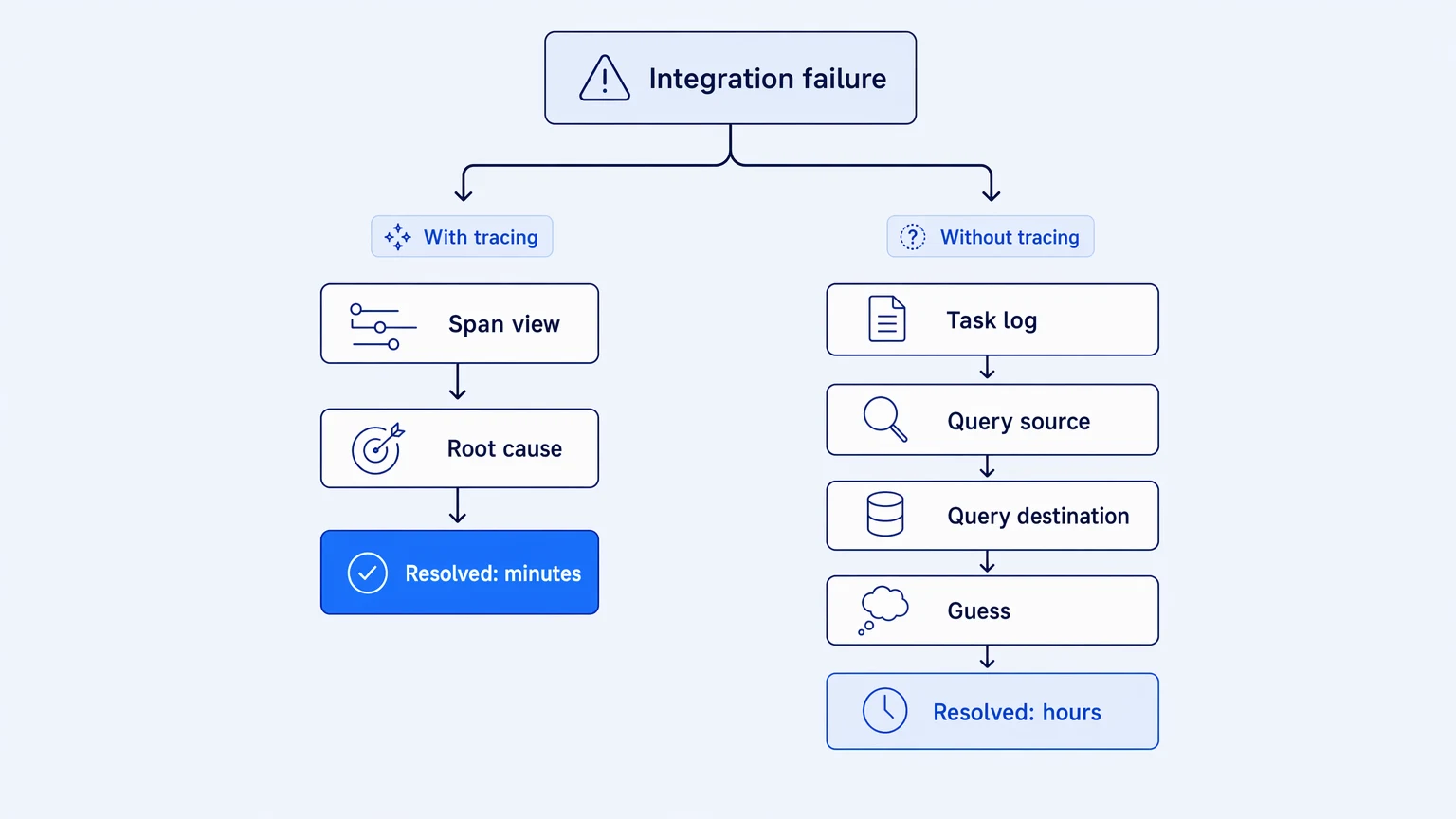
When an integration breaks in production, time to resolution depends almost entirely on observability quality. A platform with distributed tracing lets you pull the exact execution, see the payload at each step, and identify the failure in minutes. A platform whose observability model is "here is a log of tasks that ran or didn't run" leaves you grepping timestamps and querying source and destination systems trying to reconstruct what happened.
Silent failures — where a workflow completes without error but the data is wrong — are endemic to integration. A schema mismatch, a rate-limited API that returned a 200 with an error payload, a transform that silently truncated a field. Without span-level payload capture you're doing archaeology.
This unobservability doesn't just cost debugging time. It makes integrations the part of your stack where nobody's confident they'll catch a problem before a customer does — and that uncertainty compounds: slower shipping, more manual verification, a permanent "we should check this before the release" that never goes away.
Unobservable integrations don't just cost debugging hours — they cost every engineering decision made under uncertainty about what the integration layer is actually doing.
The connector tax
The headline subscription price typically covers a "standard" connector catalog. The applications that matter most to mid-market teams — enterprise ERP, modern SaaS, messaging infrastructure — usually sit in a "premium" tier carrying additional monthly fees or per-transaction pricing. Salesforce costs extra. NetSuite costs extra. Most real deployments require at least a few premium connectors, which means the base price is a filter for the sales conversation, not an estimate of actual spend. Some platforms mark these fees as "subject to change at renewal," which is the mechanism behind annual price increases that arrive not as a rate hike but as a connector schedule adjustment.
The more business-critical your integration footprint becomes, the more expensive the platform gets — and that trajectory was always baked into the model.
What a less-hidden cost structure actually looks like
Feature-tiered pricing — where the bill scales with what you can do, not with how much you run — removes the execution problem entirely. Promoting a workflow to production doesn't move the invoice. Retries don't move the invoice. The longer argument for why this matters lives in why unobservable integration stacks are the real hidden bill. The short version: a billing model that scales with execution volume is a model where your vendor benefits financially from your success.
Platforms that gate distributed tracing to enterprise tiers are making a similar bet — that customers will pay for observability as an upgrade. The cost is carried by every team on a lower tier whose debugging time is the budget line the vendor never counted.
Koodisi ships OpenTelemetry tracing on every tier from the free Community plan, and its Professional tier at $399/month carries no per-execution billing and no overage invoices. There's a fair-use ceiling, but the bill doesn't move with traffic. That's not universal in the category.
The questions to ask before signing any integration platform agreement: What counts as an execution on your meter? What are your premium connector fees and are they locked at renewal? Where do traces and spans live, and at what tier? What does the implementation path look like without an in-house integration architect?
If the answers are vague, that vagueness is part of the product.
Koodisi is the integration platform for engineering teams who treat integrations as software. Try it on the Community tier — 30 workflows, 1,000 executions/month, OpenTelemetry from day one, no credit card required.