You have seven production systems and fourteen people who know how data moves between them. Three of those people are on the same team. One of them is on vacation. When a critical sync fails on a Friday afternoon, you start a Slack thread and wait.
That experience — the fragility, the tribal knowledge, the invisible seam that becomes a five-alarm fire — is what enterprise integration looks like when it's not treated as engineering. Most organizations have the technology. The platforms, the connectors, the recipes. What they're missing is the discipline: an organized, version-controlled, observable surface for how their systems talk to each other.
Enterprise integration is not a technology category. It's an organizational capability — and most engineering teams only discover they don't have it when something goes wrong at the worst possible time.
Why integration accumulates debt faster than anything else
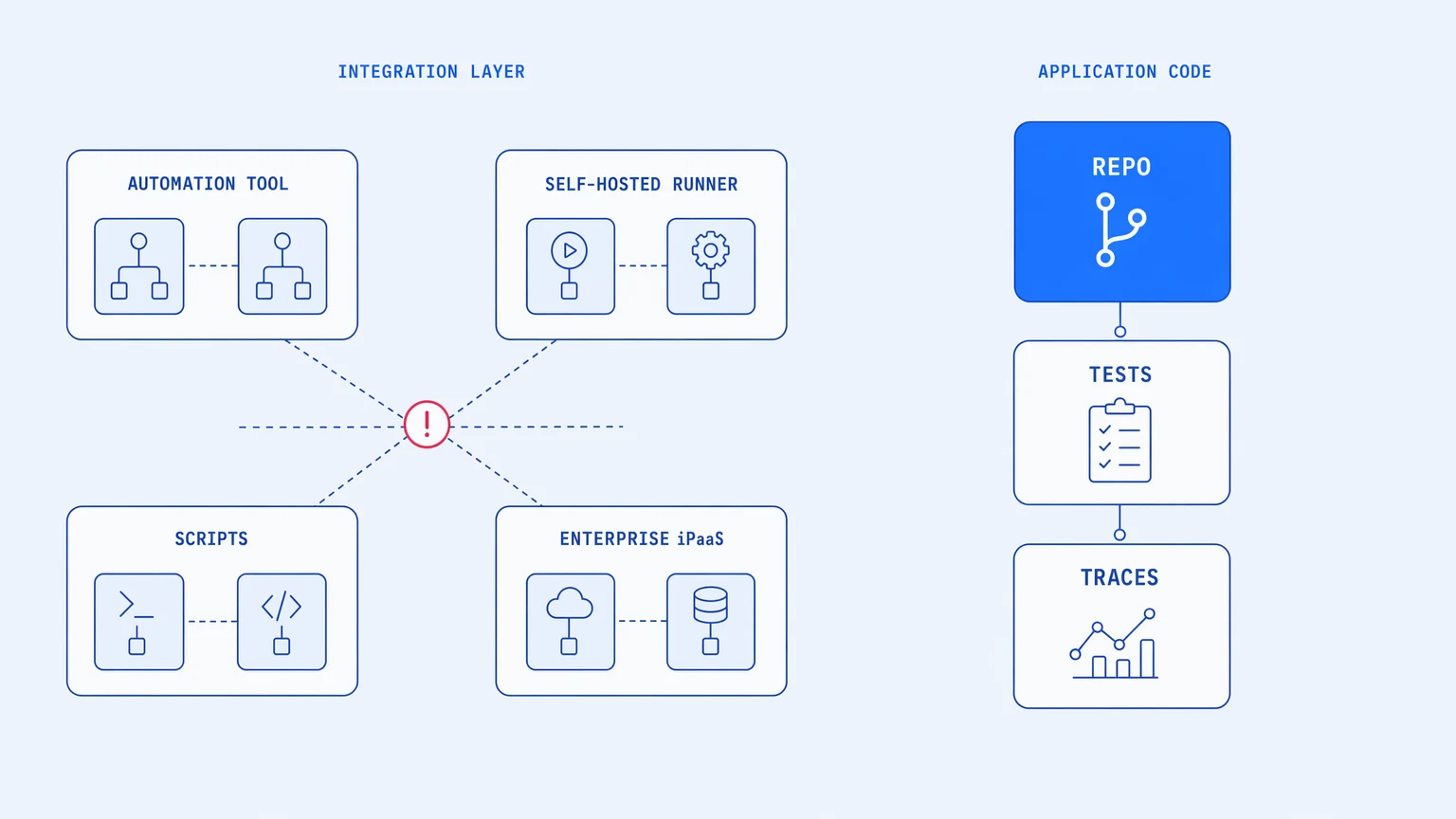
Application code has natural forcing functions against debt. Tests break. Pull requests require reviewers. Deployments are gated. When something is wrong, the development process itself tends to surface it.
Integration logic has none of that pressure by default. The workflow is visual, not textual, so code review doesn't apply in the same way. It lives in a vendor's database, not your repository, so your existing engineering practices don't reach it. It runs on a schedule or a trigger that nobody watches unless something explodes. And it's usually built by one knowledgeable person who is, by definition, the only one who fully understands it.
The result is a layer that grows rapidly and degrades silently. A new integration gets wired up for the CRM migration. Another one for the payroll sync. A third for the customer data platform that marketing insisted on. Each one is built in isolation, in whatever tool was cheapest or most convenient at the time. None of them have tests. None emit traces. None live in version control. And because they work — for a while — nobody goes back to fix them.
The integration layer is where your organization's business logic actually lives. It's also the last place that gets treated like software.
This isn't a tooling failure. It's an organizational one. Most engineering organizations have clear ownership, review processes, and deployment discipline for their application code. They apply almost none of that to the logic connecting their systems. Integration is treated as plumbing — something you run once and forget about — and it becomes load-bearing without anyone quite deciding it should be.
Integration debt accumulates faster than application debt because it lacks the organizational forcing functions that keep application code honest.
What enterprise integration actually means
The phrase gets used three ways, and only one of them is useful.
Vendors use "enterprise integration" to mean their most expensive tier: the one with SLAs, dedicated support, and single-sign-on. Analysts use it to describe a market segment with a Gartner Magic Quadrant and a taxonomy of acronyms. Neither definition helps an engineering leader make a decision.
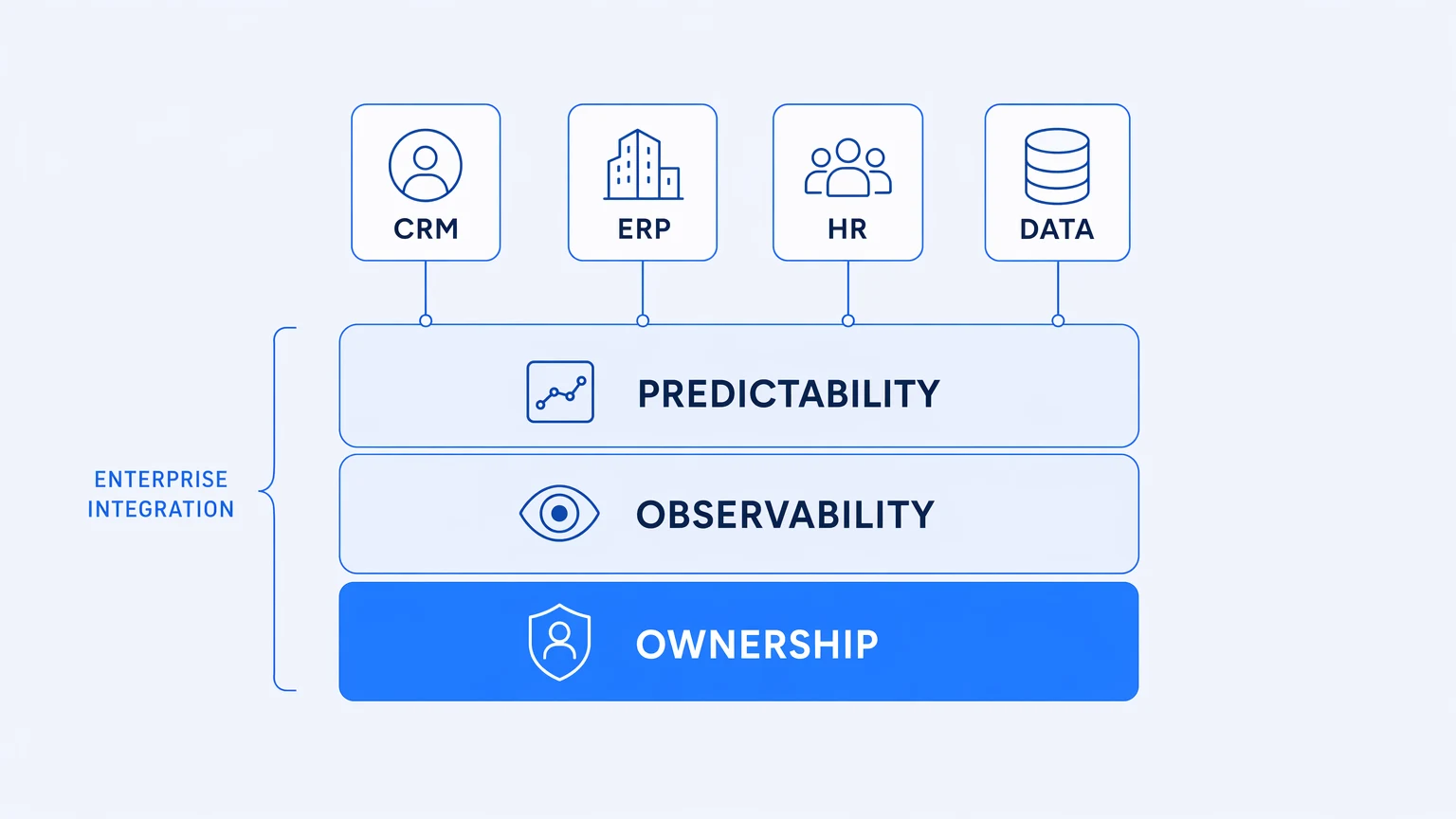
The useful definition is operational. Enterprise integration is the discipline of managing system-to-system communication at a scale and criticality where ad hoc approaches fail. It has three properties that distinguish it from automation tooling or point-to-point scripting:
Ownership. The integration logic is a first-class artifact in your organization — versioned, attributable, reviewable. When something changes, you can see what changed, when, and why. When something breaks, you can trace the failure to its source. When the engineer who built it leaves, the next person can understand it.
Observability. Every integration emits structured telemetry that answers operational questions: Did this run? What did each step do? Where did it slow down? Where did it fail? Crucially, that telemetry lands in the same stack your teams already use to monitor production — not in a proprietary UI you only remember exists when something is on fire.
Predictability. The cost of running the integration layer doesn't change unpredictably based on volume. When a workflow runs more because your business grew, or because an upstream system started retrying, the bill should reflect a platform decision you made, not an execution event that happened while you were asleep.
Most mid-market engineering teams have none of these three properties today. The tooling they're running — lightweight automation tools, a self-hosted runner, some cloud scripts — was never designed to provide them. Enterprise platforms that do provide them have historically come with contracts that required a procurement event to justify, which meant teams only got there after the pain was already severe.
Most teams build integration infrastructure the same way they build technical debt: incrementally, without quite deciding to, until it becomes the thing that wakes them up.
The architecture question nobody asks until it's too late
Most conversations about enterprise integration architecture start with a taxonomy: ESBs versus message queues versus iPaaS versus event streaming. The taxonomy is real, and the distinctions matter for specific use cases. But it's not the architecture question that will define whether your integration layer is manageable in two years.
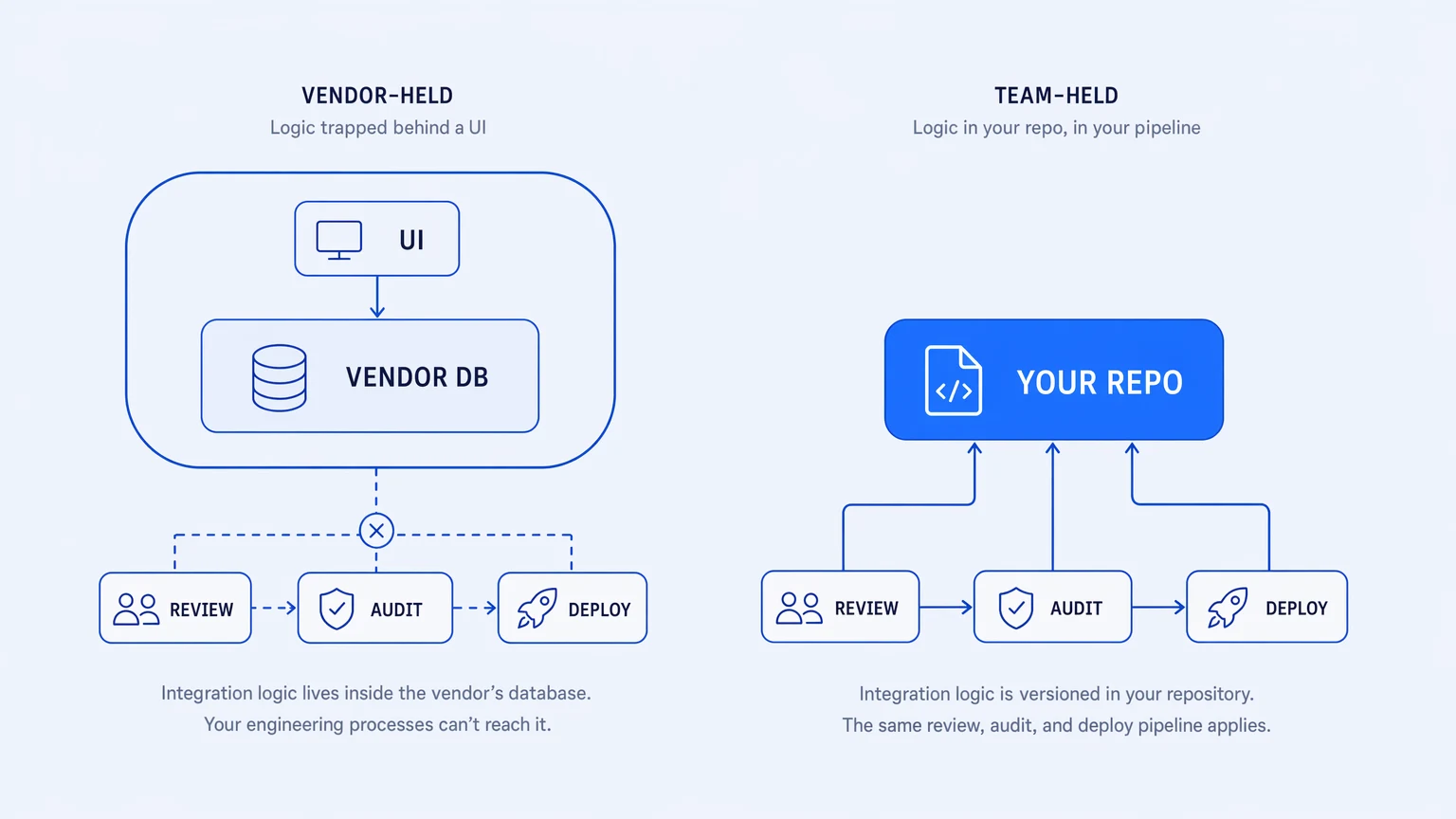
The question that matters is simpler: where does the logic live, and who controls it?
There are two answers. In one model, the integration logic lives in your systems — in version control, deployed through your processes, emitting telemetry into your stack. In the other model, it lives in a vendor's database — in a UI that your engineers access, but that your engineering processes don't govern.
The distinction sounds abstract until you try to do something concrete. Roll back a change that broke a production flow at midnight. Audit every modification made to a payroll integration over the past six months. Bring a new engineer up to speed on a workflow that's been running for two years. Migrate off a platform because the pricing changed in a way that broke your budget.
Every one of those scenarios is straightforward if the logic is yours. Every one is complicated — sometimes severely — if it isn't.
Architecture for enterprise integration isn't a question about topology. It's a question about ownership. Who holds the logic, and under what terms?
The standard advice — "use whatever integrates best with your existing stack" — optimizes for the happy path. It ignores the operational reality that integration is not a one-time decision. It's a continuously evolving surface that will need to be debugged, audited, transferred, and migrated. The architecture that minimizes friction for those operations is the one worth building toward.
For a thorough treatment of what integration ownership actually requires in practice — the code, observability, and billing properties that make it real — the full argument is in why unobservable integration stacks are the real hidden bill.
The patterns that scale and the ones that don't
Enterprise integration has a small set of durable architectural patterns. Not all of them survive contact with production at scale, and knowing which ones don't saves real engineering time.
Point-to-point connections are where every integration starts. Service A calls Service B directly. This works for two services. It becomes unmanageable at a dozen, because every connection is bespoke and every change requires coordination between exactly two teams. The dependencies accumulate invisibly until they make the system fragile at the seams nobody watches.
Message-based routing — using a queue or topic as the intermediary between producers and consumers — decouples the timing and makes the dependency explicit. Producers don't need to know who's consuming; consumers don't need to know when the producer runs. The downside is operational: you've traded the point-to-point fragility for a message infrastructure you now have to run, monitor, and scale.
Orchestrated workflows sit above both. Instead of services calling each other or publishing to shared topics, a workflow layer explicitly models the end-to-end process — the sequence, the error handling, the retry logic, the compensation if a step fails. This is where enterprise integration platforms sit. The benefit is visibility and control: the entire integration is a legible artifact, not a set of implicit contracts. The cost is that the orchestration layer becomes load-bearing, which means it needs to be treated like production infrastructure.
A well-operated orchestrated workflow beats a sophisticated architecture that nobody fully understands. Operability isn't a soft concern — it's the one property that makes everything else possible.
The integration pattern that scales isn't the most technically sophisticated one — it's the one you can operate, debug, and hand off without a two-week context-transfer.
What to actually evaluate
When an engineering team is choosing how to handle enterprise integration — whether consolidating a fragmented stack, evaluating platforms, or redesigning what they have — the questions that matter are mostly not on the feature comparison sheet.
Does the integration logic live in version control, or in the vendor's database? When a workflow fails in production, do traces land in your existing observability stack, or in a proprietary UI? Does the billing model reflect platform capability you've chosen, or execution volume you can't predict? If you needed to migrate off this platform in eighteen months, what would that require?
These questions are harder to answer from a demo than connector counts or workflow builder screenshots. But they're the ones that determine whether your integration layer is an asset that gets easier to operate over time, or a liability that extracts cost — in money, in engineering time, in on-call incidents — on a recurring basis.
Koodisi is built for the teams that have started asking these questions. OpenTelemetry on every tier, including the free Community tier. Real Git versioning with in-platform branching, so integration logic lives in your repo and follows the same review process as the rest of your code. No per-execution billing, no overage invoices — the bill reflects which capability tier you're on, not how often your workflows ran. Start on Community (1,000 executions per month, 30 workflows, no credit card) and run a real flow before you decide anything.
Enterprise integration done well isn't invisible infrastructure. It's a legible, debuggable, cost-predictable layer that your team can actually own.