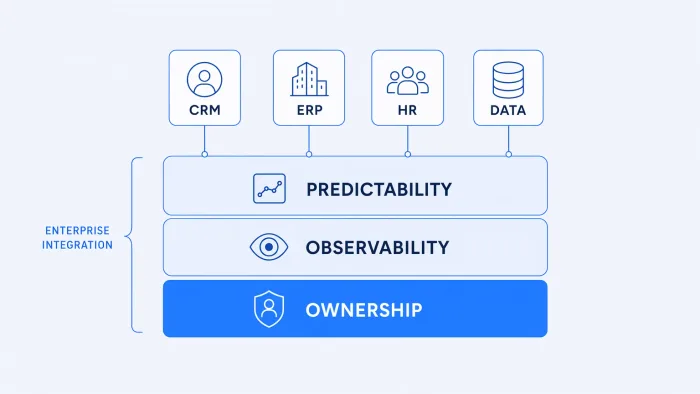
The integration project is closed. The ticket says "done." The Confluence page has a green checkmark and a diagram with boxes and arrows. Three months later, a finance lead pings you on a Friday afternoon: the customer invoice system isn't matching the CRM, accounts receivable is a spreadsheet again, and nobody is sure when it broke.
You dig into it. The integration ran fine for twelve weeks, then a schema change upstream happened, and whatever was supposed to catch that didn't. The log is in a vendor UI. The trace, if one exists, is buried under filters you've never used. The person who built the flow left two months ago.
That gap — between "the integration works" and "we can operate the integration like a production system" — is what this guide is about.
Most articles about system integration give you the taxonomy: point-to-point, hub-and-spoke, ESB, iPaaS, event-driven. The definitions are correct. They just describe the wiring diagram, not the operational discipline you need once that wiring is live and load-bearing. Business leaders don't fail at the diagram phase. They fail at month four.
System integration is a runtime commitment, not a project deliverable
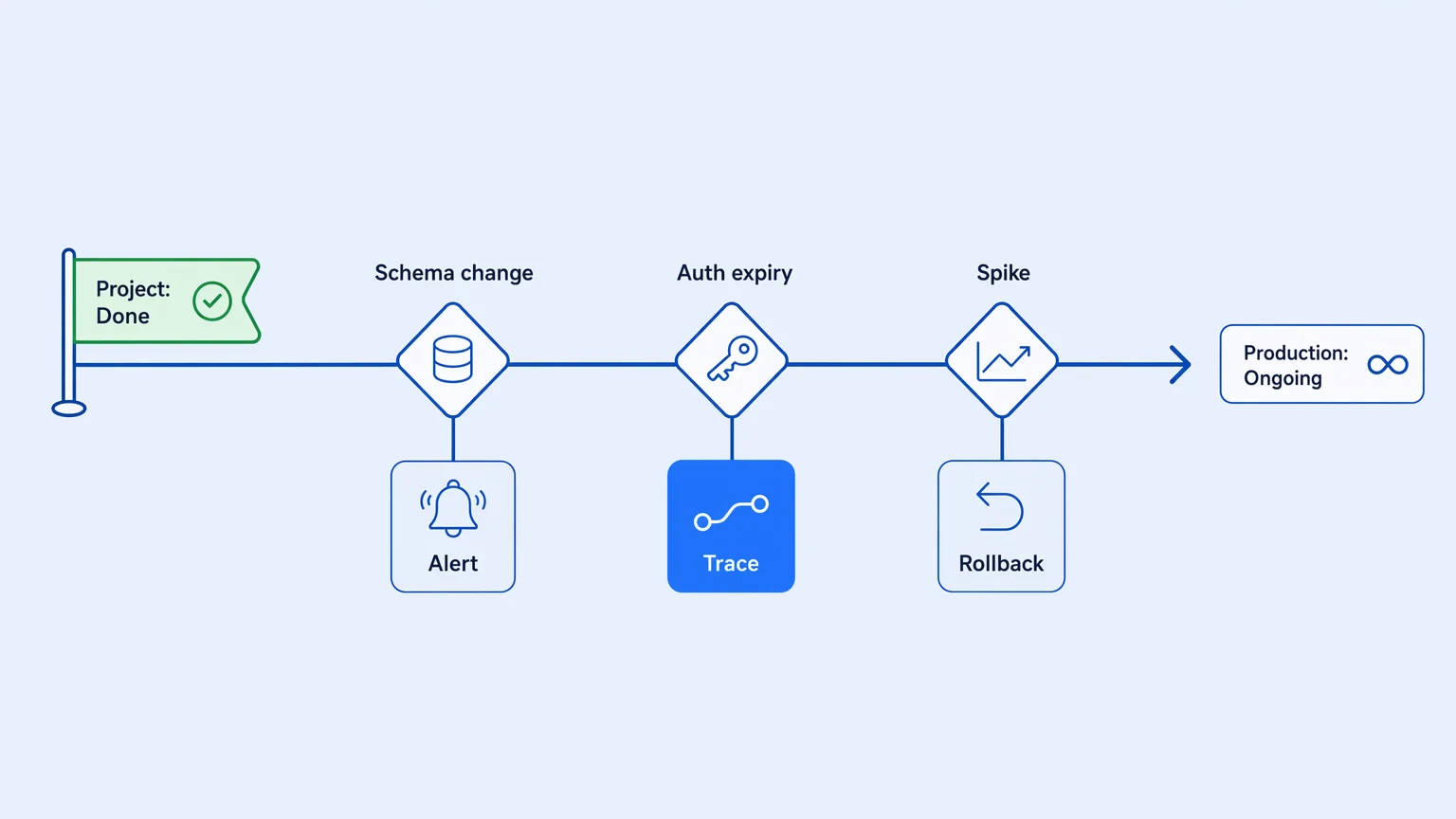
Here is a definition that holds up in production: system integration is the discipline of making distinct software systems share data, trigger actions across each other, and fail in a way you can detect and recover from — continuously, over a system's operational life.
Note the "continuously." That word is doing a lot of work and most vendors quietly drop it.
An integration between your HRMS and your payroll processor is not finished when the first sync runs correctly. It is a production system. It will encounter upstream API changes, schema drift, auth token expiry, network timeouts, vendor outages, and data anomalies. Whether your organization treats that integration as a production system — with the same operational care as your web application — determines whether it runs quietly for years or quietly breaks and gets discovered the hard way.
The integration that nobody owns is the one that fails at 2 AM with no alert, no trace, and no on-call owner.
This is not a niche failure mode. It is the dominant failure mode for mid-market integration stacks. The wiring is done. The ownership is not.
The actual problem is not choosing the right pattern
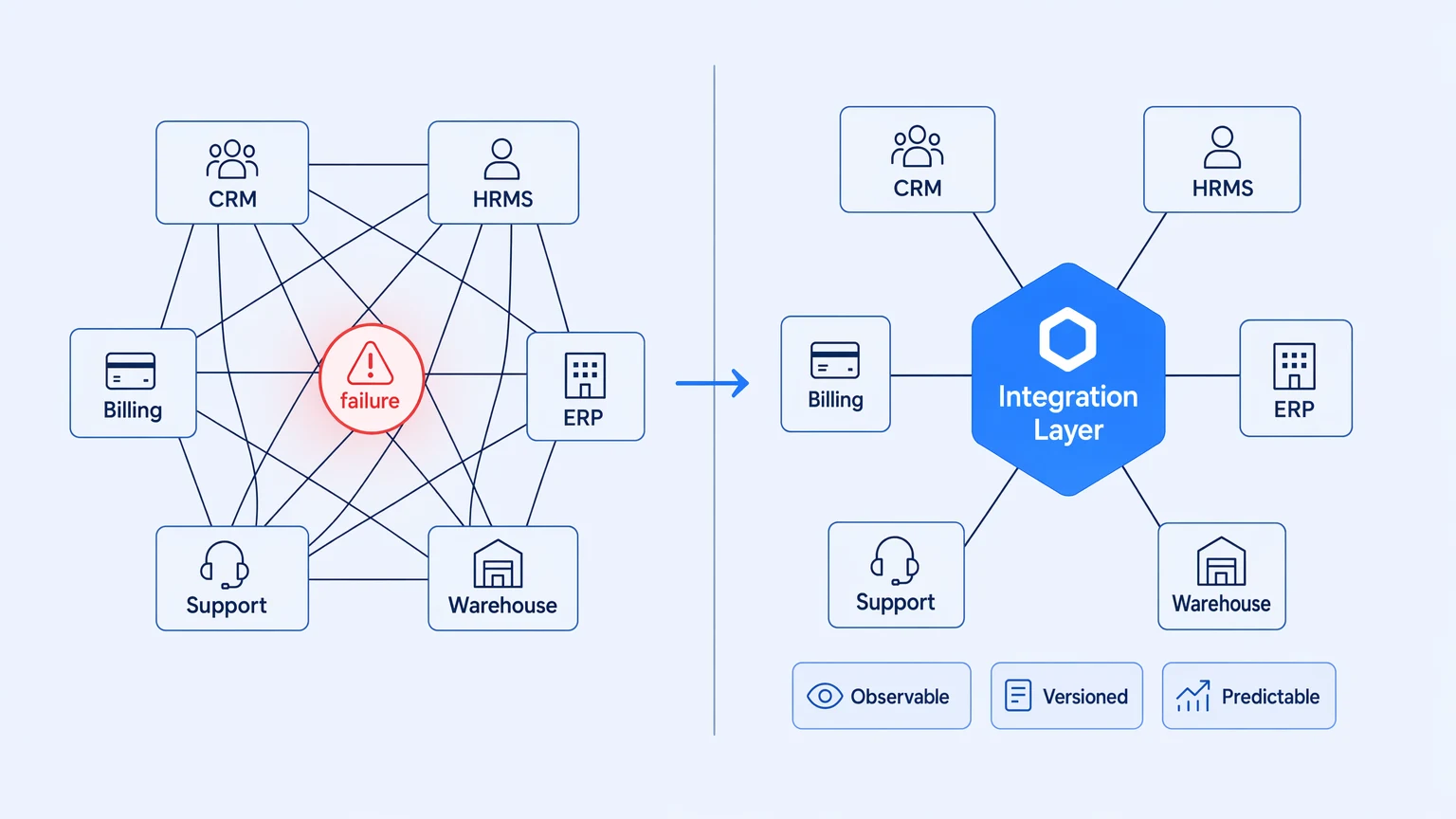
The taxonomy articles — types and methods and examples — exist because the decision of how to integrate two systems is real. Point-to-point wiring is fine for three systems and becomes unmanageable at twenty. Hub-and-spoke centralizes routing but creates a single failure point. Event-driven architectures decouple producers and consumers but introduce ordering guarantees and replay logic as operational concerns. These trade-offs are real, and making the wrong one creates work.
But the taxonomy is not what business leaders get wrong most often. Most organizations make a reasonable architectural choice for their size and context. The patterns are well-understood. What they consistently underestimate is the operational surface that lives below the architectural choice.
Consider what the integration between your CRM and billing system actually requires once it ships:
Visibility into every execution. Not "did it run?" but "what did each step receive, what did it send, and at which step did the error occur?" That's the difference between a five-minute diagnosis and a three-hour grep.
A version record. When a schema change breaks the integration, can you see what the integration logic looked like before the change? Can you roll back? Or is the current state of the workflow the only state you have access to?
Cost behavior you can predict. If that integration runs ten times more than expected next month — because a campaign fires, because a sales event triggers a bulk sync — does your bill stay flat or does it scale with execution count? This is not a hypothetical. Usage-metered platforms turn normal production load into finance escalations.
Most organizations cannot answer all three of those questions confidently. The integration shipped. The operational discipline is on backorder.
The pattern you chose doesn't matter as much as whether you can see, version, and own the thing after it ships.
Three properties that separate durable integrations from fragile ones
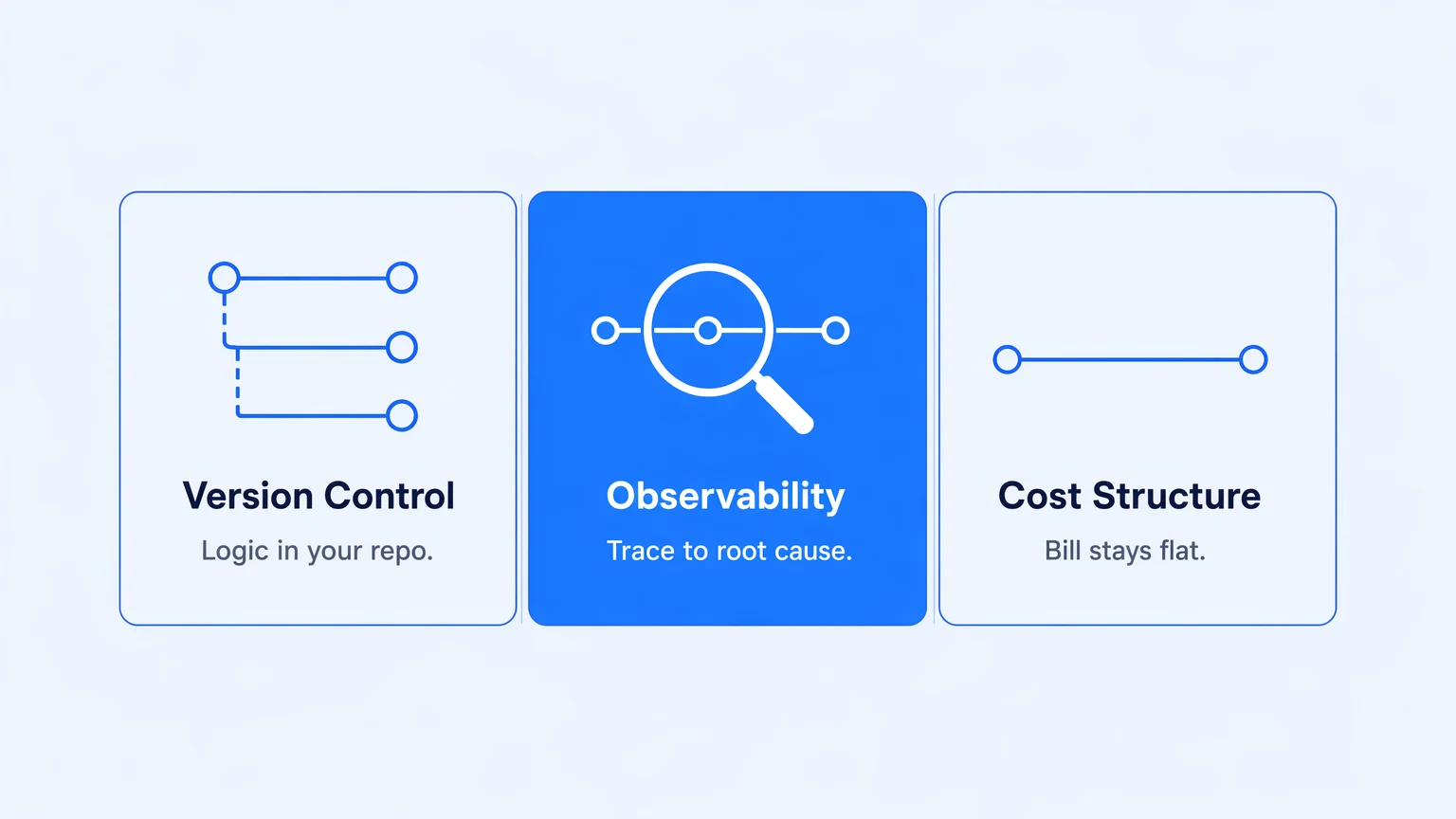
Rather than evaluating integration by the pattern (hub-and-spoke, event-driven) or the technology (ESB, iPaaS, hand-rolled Lambda), evaluate it against three operational properties. These properties predict whether an integration will compound quietly in the background or accumulate operational debt that eventually surfaces as an incident.
Observability. Every integration step should emit structured telemetry — not a UI log that lives in the vendor's console, but queryable distributed traces in an open format your existing tooling can consume. OpenTelemetry has become the standard here because it lets integration telemetry land in the same observability stack your application engineers already use. When an integration fails, the engineer on call should be able to navigate from alert to root cause through a trace, not through a support ticket to the integration vendor. Organizations that don't get this right end up routing around their integration layer — keeping critical workflows small and on-call-free because they can't see into them.
Version control. Integration logic is software. It should be treated the way you treat the rest of your software: versioned, attributable, and reversible. A workflow that lives only in a vendor's database — exported as a JSON snapshot when you need a "backup" — is not version-controlled. It cannot be branched, reviewed, or rolled back in any meaningful operational sense. Real version control means the integration logic lives in your repository, under the same review process as your application code. Changes are diffable. Rollback is a revert, not a manual undo through a vendor UI.
Cost structure. Usage-metered pricing is a trap that reveals itself at the worst time — when production load increases. Retries count. Failed executions count. A runaway loop counts. The integration platform that seemed affordable at prototype volume generates an invoice at production volume that requires a CFO conversation. Feature-tiered pricing, where the bill reflects capability adoption rather than execution count, removes this unpredictability. The cost question to ask any platform vendor is not "what's the starting price?" but "what happens to our bill if this integration runs ten times more next month than it did this month?"
These three properties are observable before the integration ships, which means they're checkable during platform selection — not discoverable after a production incident.
What "system integration strategy" actually means for an engineering leader
A system integration strategy is not a diagram on a whiteboard. It is not a choice between ESB and iPaaS. It is the set of organizational decisions that answer three questions operationally:
Who owns each integration, and what does ownership include? Integration ownership is not the same as authorship. The person who built a workflow is the author. The team that responds to alerts, reviews changes, and handles upstream API changes is the owner. In many organizations, these are the same person and ownership is implicit. That is fine until that person leaves. The integration becomes an orphan, and nobody knows until a Friday afternoon Slack message.
What is the standard for shipping an integration to production? For application code, most engineering organizations have a standard: tests, review, a staging environment, a deployment process. For integrations, the standard is often "it ran once and worked." That gap in rigor is where fragile integrations are born.
How does a new engineer understand what the integration does, and where it runs? If the answer requires logging into a vendor console, navigating a UI, and reverse-engineering a flow diagram, the integration is owned by whoever built it and nobody else. Integrations that live in version control, with tests and deployment history, transfer ownership the same way application code does.
These are governance questions, not architectural ones. The architecture determines whether the wiring is correct. The governance determines whether the wiring is operable.
The honest tradeoff
None of this is free. Treating integrations as production software — with version control, observability, review process, and ownership structure — requires investment. It requires that engineering culture extend to the integration layer, which means platform engineers can't be handed a recipe builder and told to "just wire it up." It means your integration tooling needs to support Git-based workflows and OpenTelemetry export, not just a point-and-click designer.
For organizations whose integrations are genuinely simple and genuinely few, the overhead is not worth it. A handful of low-stakes automations that don't touch financial data or customer-facing workflows can live in lighter tooling. The calculus changes the moment integrations become load-bearing: touching billing, affecting customers, feeding dashboards that inform decisions.
If you're at the point where integration failures become incidents — where a broken sync means an engineering response, not a click to reconnect — you've crossed the line where the operational discipline pays for itself.
If you're evaluating where your integration layer sits against these properties, Koodisi's Community tier is a good place to start — you get OpenTelemetry traces and Git-enabled workflows from the free tier, with no execution overages from Professional ($399/mo) upward. The broader ownership argument — what it means to hold your integration layer rather than rent it — lives in why unobservable integration stacks are the real hidden bill.