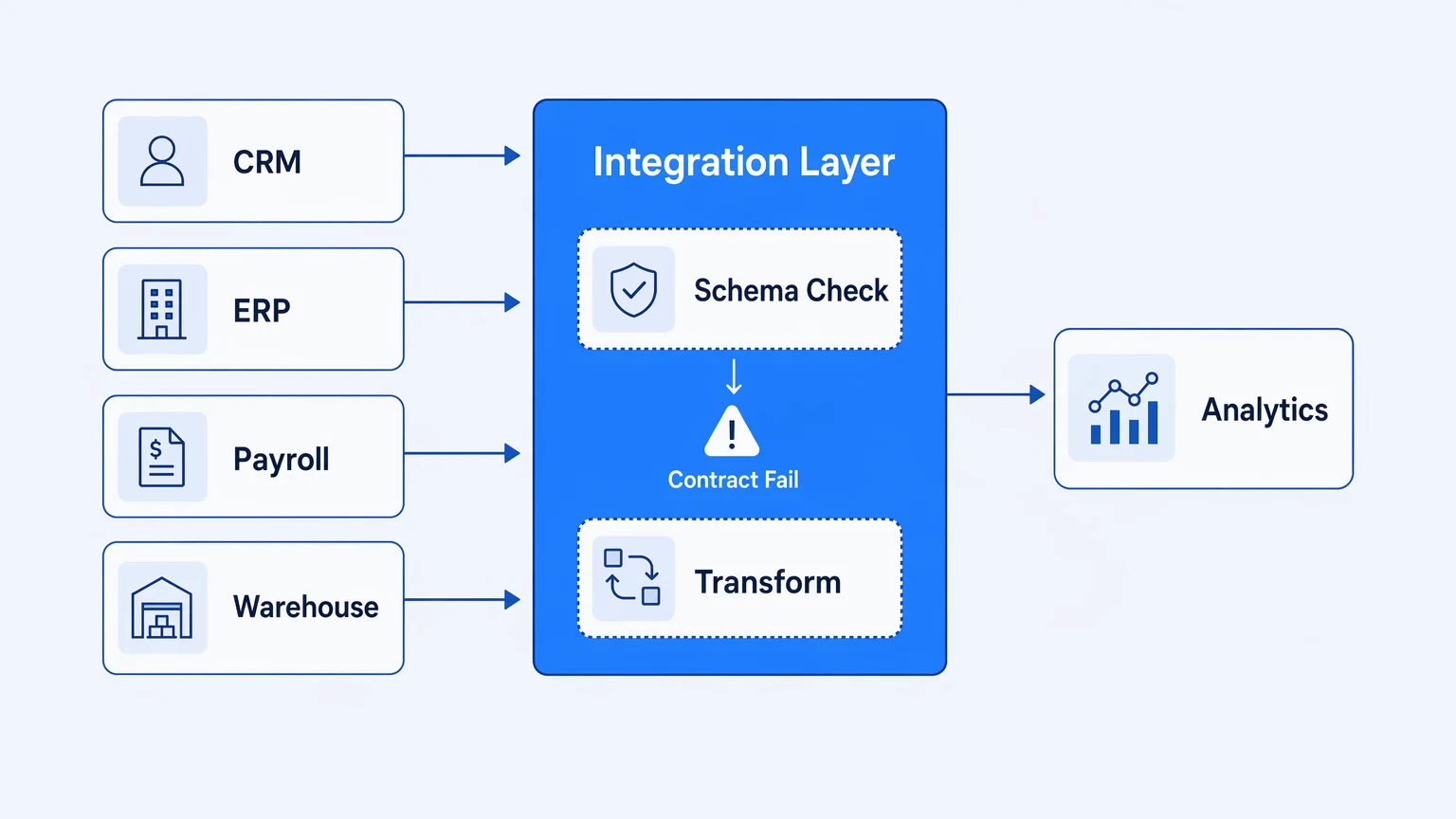
You've connected the CRM to the data warehouse. The ERP syncs on a schedule. Payroll feeds HR. It works, and then one afternoon a field gets renamed upstream and nobody finds out for eleven days.
That's the real shape of multi-source data integration at mid-market scale: not the connection problem, which is mostly solved, but the invisible contract problem. Systems change without ceremony. APIs evolve without versioning discipline. The custom Lambda you wrote to bridge two platforms that didn't quite speak the same language becomes the load-bearing thing nobody on the team can modify without a full day of spelunking.
The vendors selling you on "no-code integration" are mostly selling the connection step. They're quieter about what happens after.
The part that custom code actually solves
When engineers reach for custom code to integrate data sources, it's rarely because they enjoy writing glue. It's because no tool they evaluated handled the messy middle: partial schema conformance, conditional routing, stateful error recovery.
A visual drag-and-drop tool will move a record from System A to System B. What it won't do without custom code eventually sneaking back in: validate that the record's shape is what the destination expects before it writes, roll back cleanly when one leg of a multi-step sync fails, or give you a structured trace you can search when something goes wrong three weeks later and a stakeholder is asking why 400 records are missing.
The custom code tax appears not when you build the integration, but when the upstream system changes and you discover you have no schema contract to catch it.
This is why teams describe integration projects as "done" and then spend three to four hours per week in low-grade firefighting. The connection is live; the governance isn't.
Schema contracts are the thing vendors gloss over
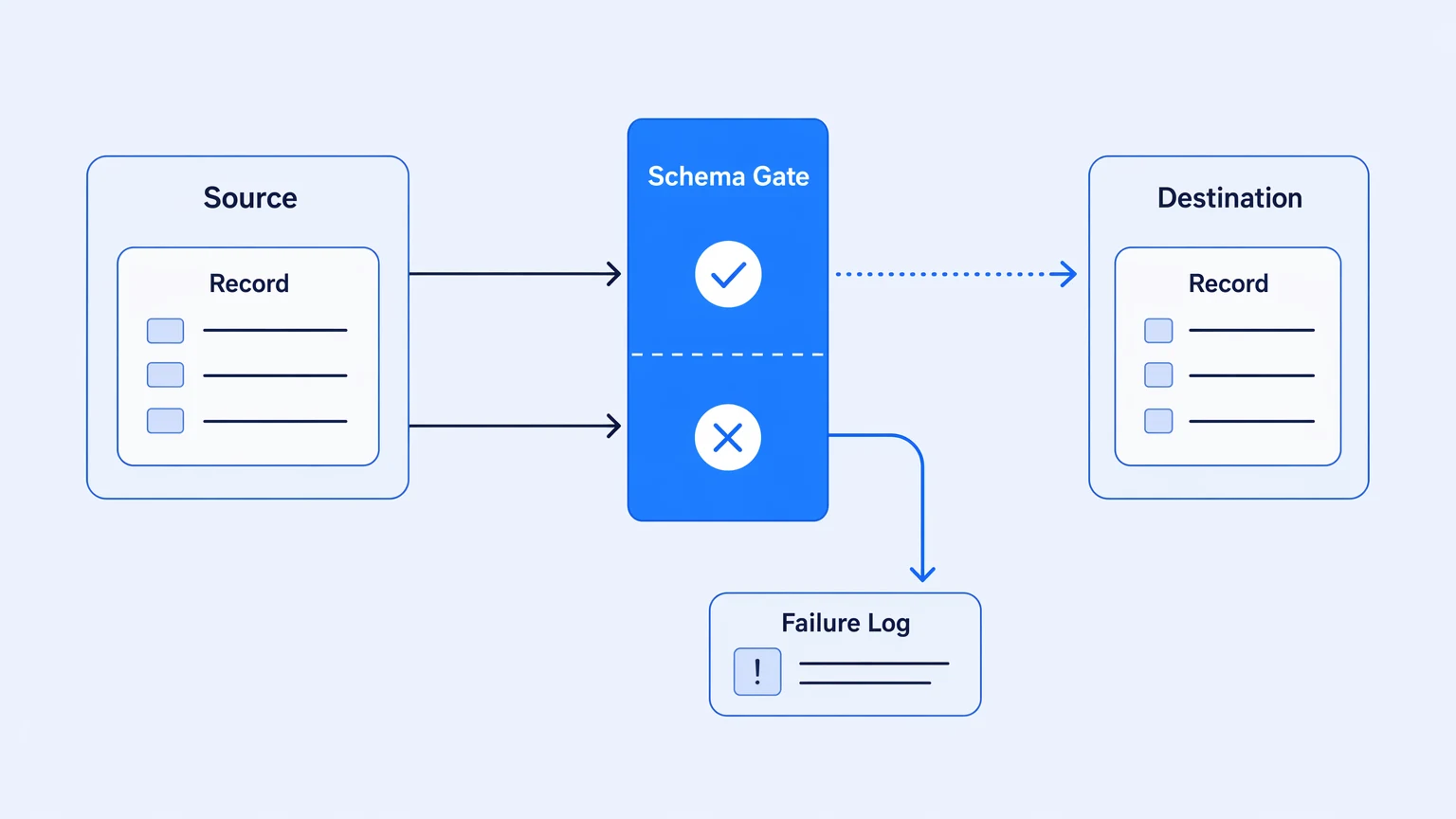
Every integration between two systems is implicitly a claim: "the data coming out of System A has this shape, and System B can process it." That claim is almost never formalized. It lives in the head of the engineer who wired it up, or in a Slack thread, or nowhere.
When the claim holds, nobody notices. When it breaks — a field type changes, a required field is dropped, an enum gains a new value — the failure propagates silently. The integration keeps running. It just runs wrong. Records land in the destination in a state that looks plausible but isn't accurate. Detection requires either a downstream alert built by someone who was thinking ahead, or a human noticing something is off.
The pattern that actually works: express the contract explicitly, as close to the integration logic as possible. JSON Schema definitions at the input and output of each workflow step, validated before the record moves, with a failure captured and surfaced rather than swallowed. Not a documentation artifact — a runtime check.
This is applying the same discipline to integration that you'd apply to any API your team publishes. You wouldn't ship a service endpoint without defining its input and output shape. There's no good reason your Salesforce-to-Warehouse sync should be any different.
The integration layer became load-bearing while nobody was looking. The tooling didn't move with the work.
What breaks when you integrate data from different sources at scale
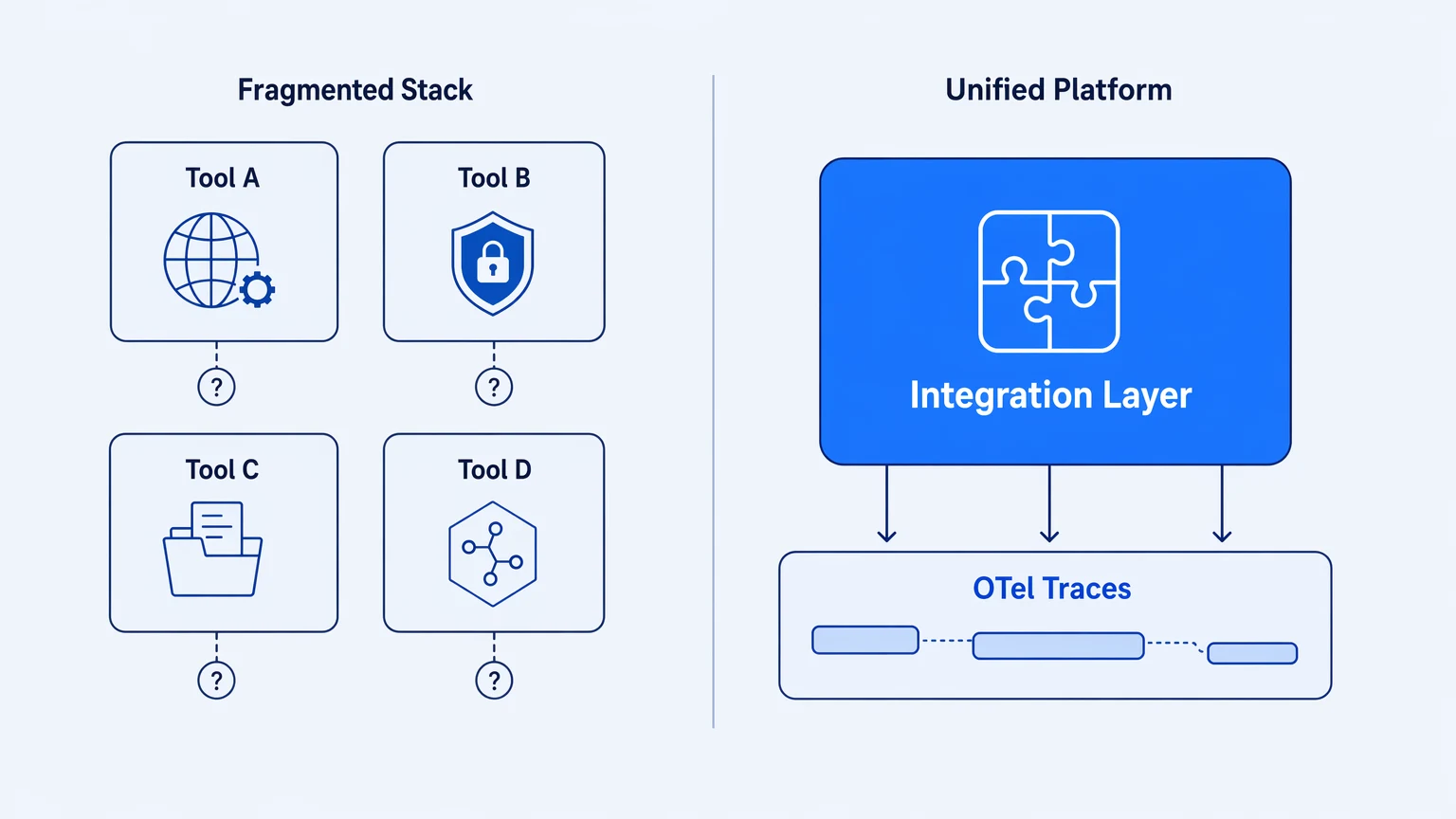
The other failure mode that shows up predictably around the 15-workflow mark is the four-tool stack.
A lightweight automation tool handles the simple HTTP syncs. A self-hosted workflow runner handles the batch jobs and database writes. A few Lambda functions handle the cases that neither tool can express cleanly. And one seat of an enterprise iPaaS holds the critical-path connection — the one touching payroll, or billing, or the customer identity graph — because nothing else was production-grade enough.
Four tools. Four billing models. Four places where "what did this do at 3 a.m. Tuesday" is answered differently, or not answered at all.
The coordination tax is real and mostly invisible. It shows up as the engineer who knows where everything lives and is now a single point of failure, the incident that requires checking four dashboards before you can triangulate root cause, the new team member who spends their first two weeks just mapping the topology of the integration layer before they can safely touch any of it.
Fragmentation isn't a sign your team made bad choices — it's what rational procurement looks like when no single tool covers the full range.
The self-hosted runner was the right call when you needed version control and the lightweight tool couldn't provide it. The Lambda was the right call when you needed conditional logic the visual tool couldn't express. Each decision made sense locally. The aggregate is the problem.
The design choice that changes the consolidation math
Most attempts to consolidate a fragmented integration stack fail at one of two points: the tool that can handle the complex cases is too expensive for the straightforward ones, or the tool cheap enough for everything is too limited for the cases that actually matter.
Usage-metered pricing makes this worse. If the bill moves when traffic moves, you have to budget not for capability but for volume. A retry loop, a test run, a spike from a batch job — these aren't feature usage, they're operational reality. Paying per execution means paying for your own production behavior.
The model that changes the math is feature-tiered pricing: the bill reflects what capabilities you've activated, not how much your workflows ran. You can run the complex batch job and the simple CRM sync on the same platform, at the same tier, without the batch job's execution volume appearing as a line item. The consolidation decision stops being "which tool should I tolerate" and becomes "which platform handles all of this cleanly."
How to integrate data from different sources without custom code isn't primarily a connector question. It's a governance and predictability question. Can you define schemas and have them enforced at runtime? Can you observe failures in a consistent telemetry layer? Can you deploy changes through the same review process your application code uses? Can you predict what the platform costs when traffic is unpredictable?
The connector catalog is table stakes. The checklist above is the real evaluation.
For teams evaluating a consolidation path, the ownership argument goes deeper — the case for treating integration logic as a versioned software artifact rather than a vendor-hosted configuration is laid out in why unobservable integration stacks are the real hidden bill.
The honest tradeoff
A platform-first approach to multi-source data integration introduces its own constraint: you're making a bet on a vendor's connector coverage matching your stack. Pre-built connectors cover the common surface — Salesforce, HubSpot, SAP, Workday, the cloud databases. For genuinely novel sources, you're either writing a custom activity or using HTTP generics and absorbing some of the work you were trying to avoid.
The math still works for most mid-market stacks, because most mid-market stacks are standard enough that the platform's library covers 80-90% of the connections. The remaining 10-20% is usually better expressed as a versioned, tested, observable platform activity than as a Lambda nobody knows about.
Starting without custom code
The practical path: start with one source pair — CRM to warehouse, or ERP to analytics — and build it in a platform that enforces schema contracts by default and gives you OpenTelemetry traces from day one, not as an add-on. Validate that failures surface rather than propagate silently. Then expand.
Koodisi's Community tier covers 30 active workflows and 1,000 executions per month, free, with no credit card required. OpenTelemetry observability is on every tier. Schema validation, JSONata-based mapping, and Git versioning are available from the first workflow you build. The professional tier starts at $399/month with no per-execution billing and no overage invoices — the bill doesn't move when your traffic does.
The goal isn't to eliminate custom code from integration forever. It's to stop writing custom code for the problems a platform should already solve, so the code you do write is load-bearing in a way you can see, version, and hand off.