The payroll run is queued for midnight. The HRIS pushed the change event at 11:47 PM — a new comp adjustment for someone in Singapore. The mapping layer translated the fields. The payroll API returned 200. In the morning, three employees in the Singapore entity were paid at the wrong gross because the comp adjustment carried a currency field that the mapping silently coerced from SGD to USD and nobody wrote a schema constraint that would have caught it.
The integration ran. The integration also failed. These are not mutually exclusive.
This sits one layer down from the broader question of connecting your HRMS to the rest of your stack — global payroll is the hardest of those downstream syncs to get right. Integrating global payroll with HR systems is an architecture problem, not a steps problem. Most "how to integrate" guides treat it as configuration: pick a vendor, map your fields, test in staging, go live. That framing is correct at the level of a single-country Workday-to-payroll connection and basically wrong the moment you add a second jurisdiction, a second legal entity, or a second payroll provider. The engineering surface that breaks — schema divergence, event sequencing, jurisdiction-specific compliance data, multi-entity fan-out — is not fixed by following steps more carefully. It requires deliberate architectural choices that the vendor guides almost never discuss.
Why global payroll-HRIS integration is different from what you've done before
A domestic payroll integration is a data pipe with a known shape on each end. The HRIS owns employee data. The payroll system owns pay calculations. You write a mapping between their schemas, validate it, and watch the runs. Schema drift happens, but slowly. The compliance surface is one jurisdiction.
Global payroll adds orthogonal complexity on three axes simultaneously.
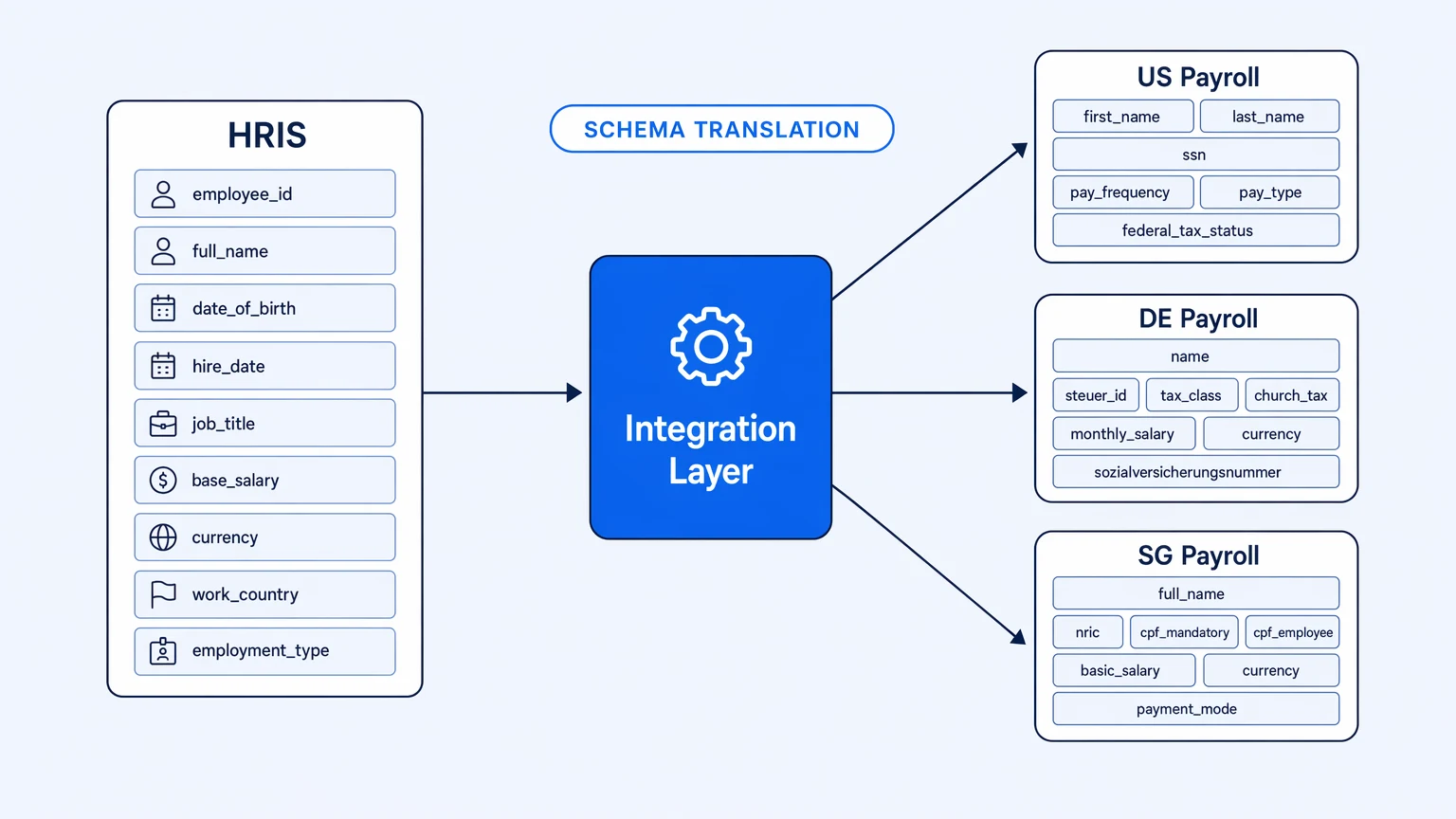
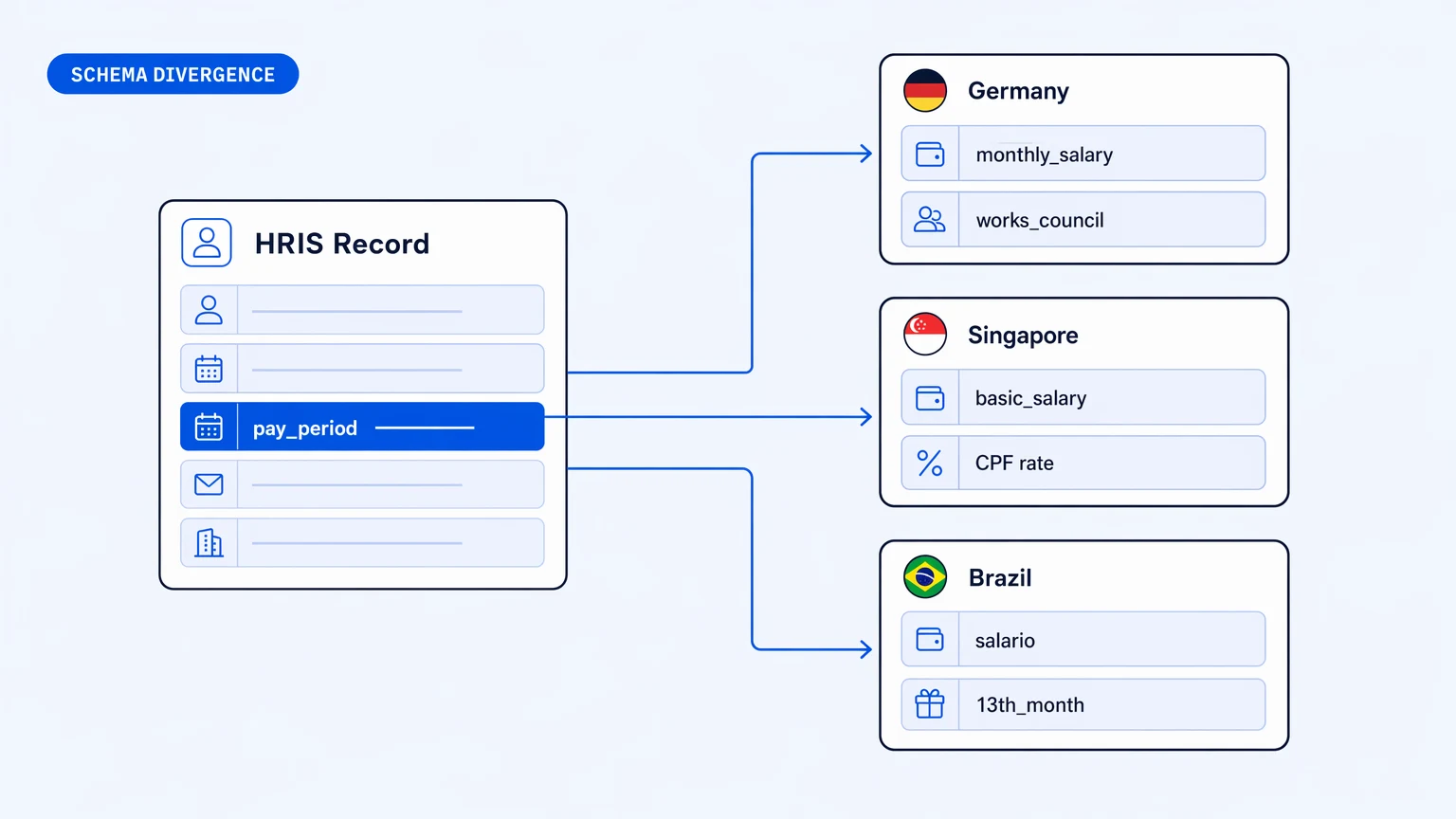
Schema divergence per jurisdiction. A "pay period" is not a universal concept. Germany uses monthly salary with works-council-approved deductions. Singapore uses monthly with mandatory CPF employer and employee components. Brazil uses variable with dissídio adjustments and thirteenth-month rights. Each of those maps to a different set of required fields in the local payroll engine, and none of those engines use the same schema. Your HRIS stores a normalized representation of the employee record. What the local payroll system needs is a denormalized, jurisdiction-specific projection of it — and there is no standard for how those projections should look.
The gap between the HRIS schema and the local payroll schema is not a one-time mapping problem. It is a continuously maintained translation layer, because both sides change independently. When Workday adds a new field for German Kurzarbeit benefits, and the German payroll provider adds a field with a different name for the same concept, and nobody updates the mapping, the next sync writes the field as null and the payroll calculates as if the benefit doesn't exist.
Event sequencing and the effective-date problem. Payroll systems are not stateless APIs. They are ledgers. Changes carry effective dates, retroactive periods, and booking windows. When a comp change, a role change, and a termination all land in the same payroll period for the same employee in different legal entities, the order in which those events are applied matters. A role change applied before a comp change in the same period is fine. A termination applied before a comp change generates a final settlement calculation. A comp change applied after a termination generates an error in some systems and silently wrong data in others.
HRIS systems emit events as they happen. They do not sequence those events by payroll-cycle order. If your integration pipe treats every event as independent and pushes them in arrival order, you will occasionally get the sequencing wrong for employees with overlapping changes — which is exactly the employees who are most likely to notice, because they're being promoted, terminated, or moved across entities.
The HRIS knows what changed. The payroll system cares about the order. The integration layer is where that mismatch lives.
Compliance data that your HRIS doesn't own. The HRIS is the system of record for the employee. It is not the system of record for jurisdiction-specific compliance data. Brazilian CPF numbers, Singapore NRIC, German Sozialversicherungsnummer, UK National Insurance — these may be in your HRIS, or they may be in a local HR system, a spreadsheet, or a compliance vendor. The payroll system needs them. If your integration assumes the HRIS has them and tries to pass nulls when it doesn't, the payroll provider will reject the run or, worse, accept it and calculate incorrectly.
The naive approach is to fill compliance gaps with manual overrides. This scales to approximately two countries before it becomes unmanageable, and it creates a class of data that lives outside both systems, is not version-controlled, and surfaces in audits as "we had a spreadsheet for that."
Multi-entity fan-out with different providers. Few global organizations use one payroll provider in every country. The US might be on ADP. Germany on a local DATEV reseller. Singapore on a regional provider. Each has a different API, a different schema, a different run cadence, and different error handling. When the integration layer is a single workflow that pushes everything to one endpoint, adding a second country means either forking the workflow or adding conditional branches until it's unreadable.
Schema divergence compounds across jurisdictions, events arrive out of payroll-cycle order, compliance data has gaps, and every country adds a new endpoint shape. None of those problems are solved by configuring a sync. They're solved by the architecture choices you make for the integration layer itself.
The architectural decisions that actually matter
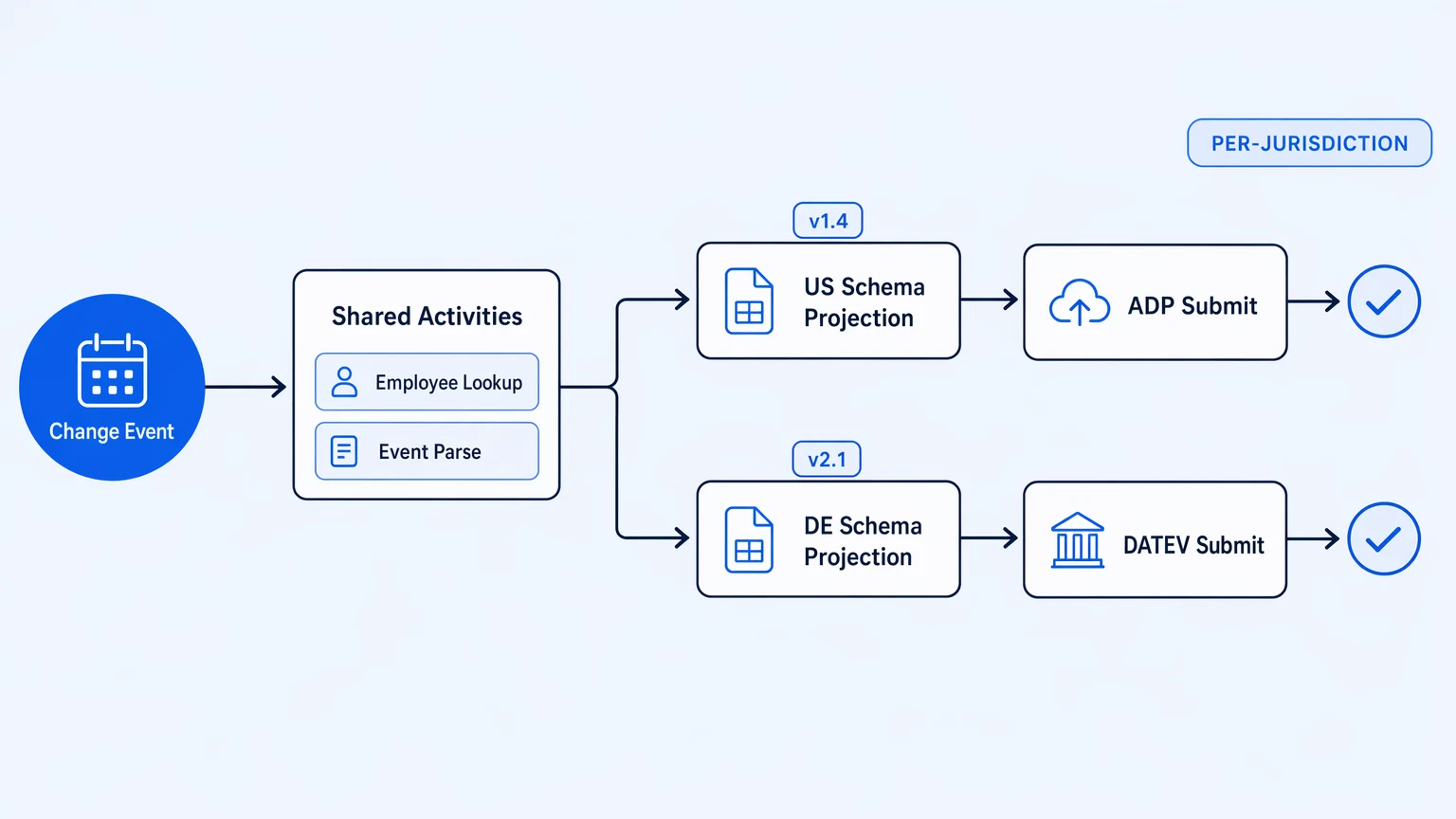
Most of the guide content on this topic covers the operations of integration: test in staging, pilot in one country, train your HR staff. That's real advice and it's not wrong. It's also downstream of the architectural choices that determine whether your integration is maintainable at all.
The choices that matter:
Schema translation as a versioned artifact, not a configuration screen. The mapping between your HRIS schema and each jurisdiction's payroll schema is software. It should be in version control, it should be reviewable when it changes, and it should be testable against known inputs. A mapping that lives inside a vendor's UI — drag-and-drop field connections, stored in the vendor's database — is a mapping you can't diff, can't test independently, and can't roll back without manual reconstruction. When the German payroll provider changes their API schema in February and your HRIS changes their employee model in April and a payroll failure surfaces in June, you need to be able to see exactly what the mapping looked like on those three dates. That's a git log away if you've made the right choice, and an impossibility if you haven't.
Idempotent, ordered event processing. The sequencing problem is solved by treating payroll sync events as an ordered log rather than a fire-and-forget queue. Events should carry effective dates. The integration layer should process them in effective-date order for each entity, not in arrival order. Retries should be idempotent — applying the same comp change event twice should produce the same result as applying it once. These are standard distributed-systems patterns; they're not standard in integration tooling, because most integration tools were built for web-hook style event-driven flows where order and idempotency are someone else's problem.
Explicit nullability contracts for compliance fields. Every compliance field that the payroll system requires and the HRIS might not have should be modeled explicitly — as a required field with a validation step that fails loudly, not as an optional field that passes nulls silently. JSON Schema or similar schema validation at the integration boundary is the mechanism. A run that fails to validate because a Singapore NRIC is missing is a recoverable error that HR can fix in ten minutes. A run that passes validation with a null NRIC and generates an incorrect statutory calculation is an audit finding.
Per-jurisdiction workflow branches, not one workflow with conditionals. The fan-out problem is addressed by treating each jurisdiction as a first-class concern in the workflow model. One workflow for Workday-to-ADP-US. One workflow for Workday-to-DE-payroll. Shared activities for the common parts (employee lookup, change-event parsing), jurisdiction-specific activities for the schema projection and submission. This makes each workflow independently deployable, independently testable, and independently debuggable. The alternative — a single workflow with a growing if-Germany-else-Singapore-else-Brazil branch tree — looks manageable at two countries and is a maintenance tax at ten.
Observability by employee record, not by run status. The cover-up problem described at the top of this post — the integration ran, the data was wrong — is a monitoring problem. Run-level success metrics don't catch partial writes, field coercions, or effective-date misapplications. The integration layer needs traces at the field level, not the run level, indexed in a way that lets you ask: for this employee, on this payroll cycle, what value did we send for gross_salary, and where did it come from? That's a different observability question than "did the run succeed," and it requires distributed traces, not a success/failure counter. (The longer treatment of this specific failure mode walks through tracing a payroll sync down to the exact dropped field.)
The integration layer isn't a connector — it's the place where compliance is made concrete. Every piece of jurisdiction-specific logic that translates between your normalized HRIS record and a local payroll requirement lives in the integration layer. That makes it load-bearing infrastructure, not plumbing, and it should be built like it.
The honest tradeoff
This architectural approach requires more upfront investment than configuring a vendor's pre-built connector. If you're running payroll in two countries with a stable team and a low rate of compensation changes, the patterns above may be more overhead than the problem they solve.
The calculus changes when you're adding jurisdictions at a rate of two or three per year, when you have frequent mid-cycle changes, or when a payroll error carries compliance exposure rather than just an awkward correction. At that point, the operational simplicity of "we just configured a connector" becomes the technical debt you're paying to debug every quarter.
Where to start
Pick the country that worries you most and map the gap between your HRIS schema and that jurisdiction's payroll schema explicitly — in a document or a JSON Schema file, not in a vendor's UI. That exercise will surface the compliance fields you don't have, the sequencing assumptions you're making implicitly, and the effective-date logic that's probably hiding in someone's head. The gap you find is the integration you actually need to build.
If you want to test what observable, versioned global payroll integration looks like in practice, the Community tier gives you 30 workflows and 1,000 executions at $0 — enough to model the Workday-to-payroll path for one jurisdiction with real schema validation and OTel traces, and see where the gaps actually live before you commit to an architecture.