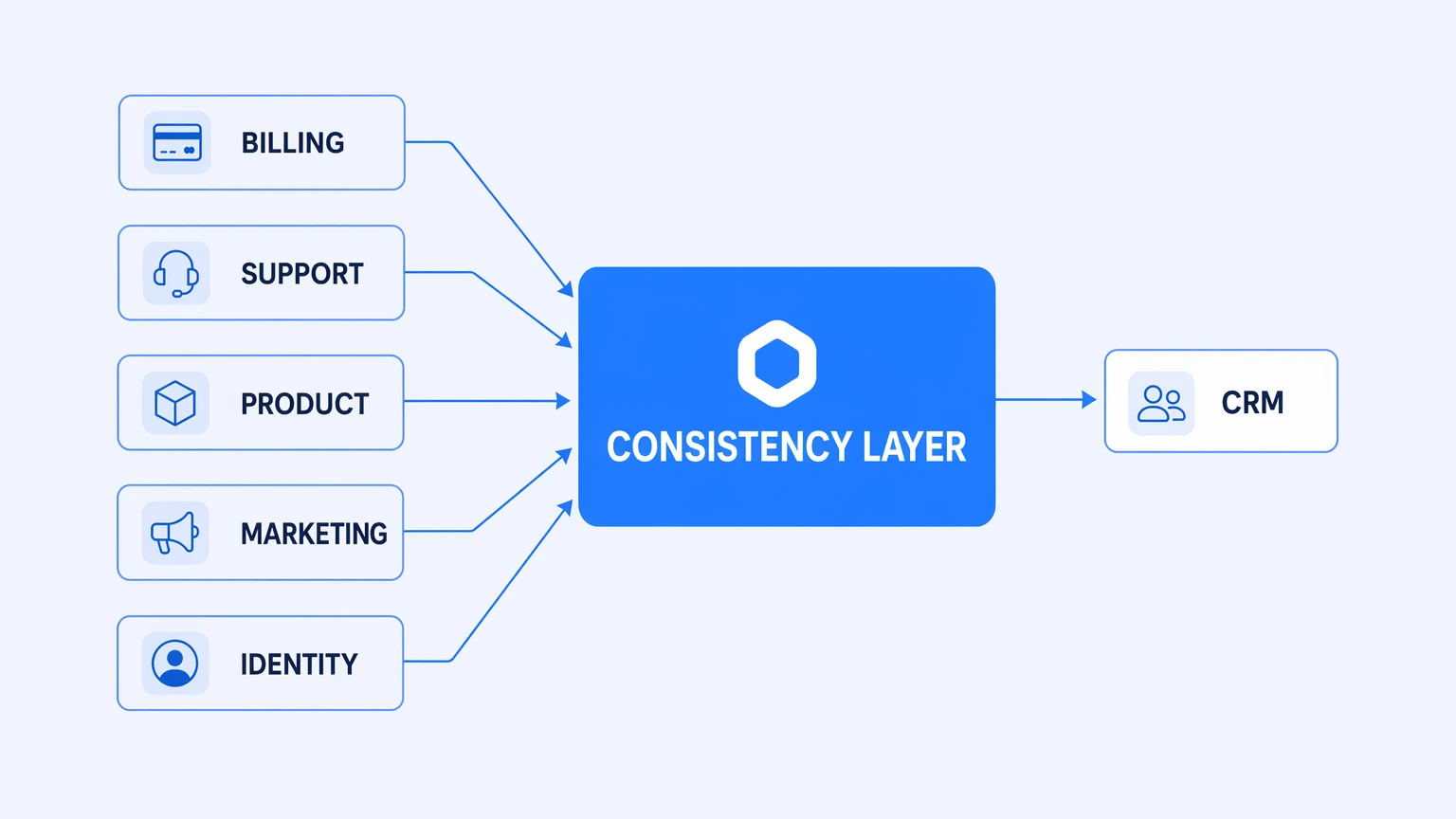
The sales team files a ticket: the CRM is wrong again. A customer who churned six months ago is still showing as active. Another has an address from two offices ago. A third has three duplicate records, each with a different phone number, none of them current.
You trace it back to the data pipeline — the one that was supposed to keep the CRM in sync with the billing system, the support desk, the product database. And you find what you always find: the pipeline is running fine, by its own definition of fine. It's pushing records. It's logging successes. What it isn't doing is keeping the data consistent, because consistent is a property the pipeline was never designed to hold.
That gap between "the pipeline ran" and "the CRM is correct" is what customer data integration is actually about, and it's the same gap the broader definition of data integration argues most guides skip. It is not a sync job. It is a consistency guarantee — and most engineering setups treat it like the former while expecting it to behave like the latter.
Customer data integration is a consistency problem, not a movement problem
The standard framing of customer data integration — move data from system A to system B on a schedule — gets teams into trouble at exactly the moment it seems to be working.
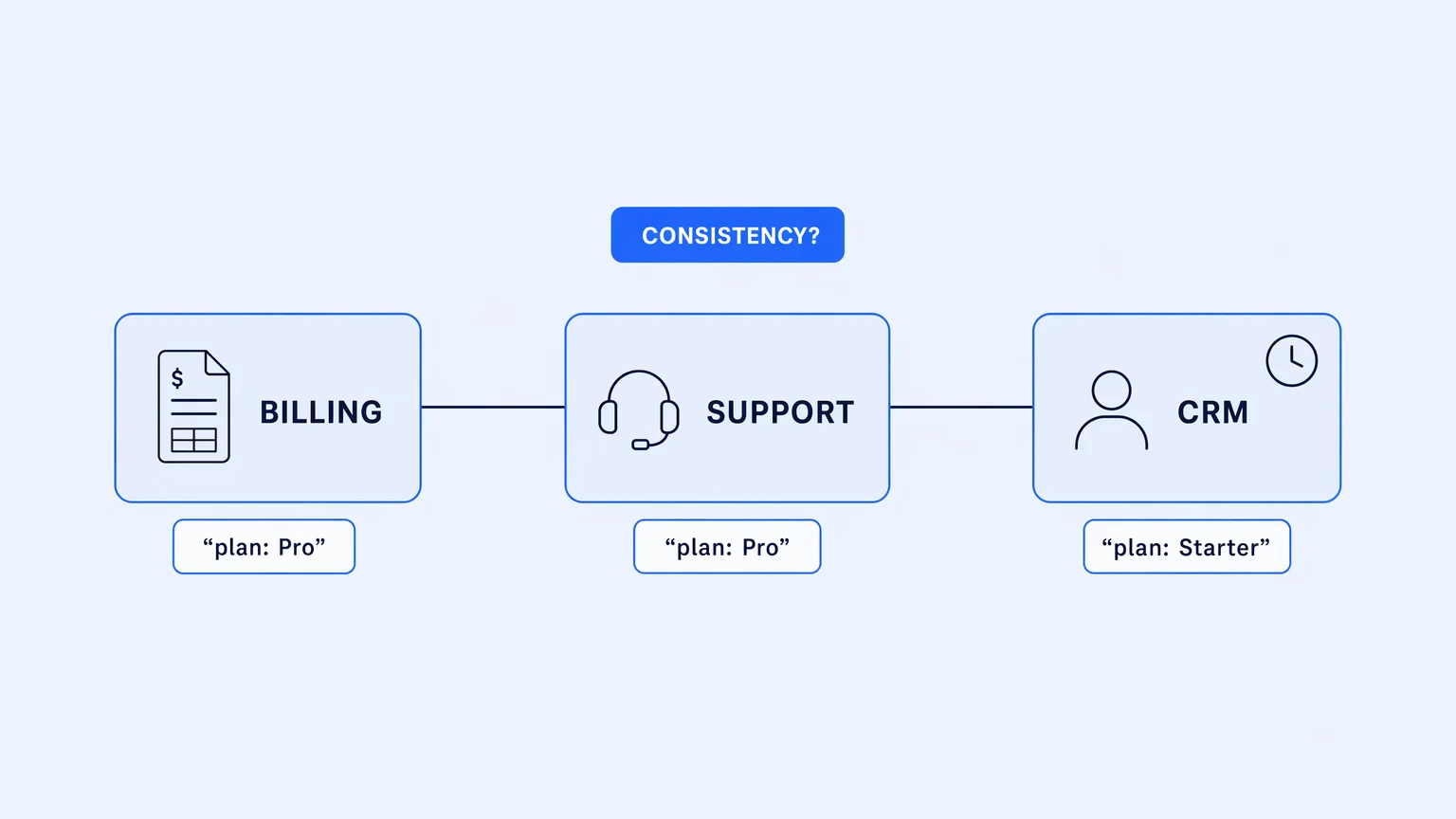
A nightly batch sync from your billing system to your CRM is customer data integration by most definitions. It runs. Records arrive. The dashboard shows green. Then a customer calls support with a billing dispute, and the support rep's CRM shows a plan that was changed three days ago. The batch hasn't run yet. The rep is working off stale state. The customer is frustrated. Nobody in that call is looking at the same version of reality.
Customer data integration solves for consistency across systems, not just presence of data. Those are different engineering problems.
Presence is easy to measure: did the record arrive? Consistency is harder: does every system that holds a version of this customer's record agree, and if they disagree, which one wins? That question involves conflict resolution, event ordering, schema alignment, and latency tolerances. It also involves an architectural decision most teams make implicitly, by accident, and then spend years fixing.
Every customer data integration setup makes an implicit consistency model choice. Eventual consistency, where systems catch up but may diverge in the window. Read-your-writes consistency, where a customer who just updated their email sees the update immediately. Strong consistency, where every system agrees before any write is acknowledged — expensive and mostly overkill for this use case. Most teams running a nightly batch are accidentally choosing "eventual consistency with a 24-hour lag," and then surprised that their CRM is stale.
Why CRMs are the hardest system to keep consistent
A CRM is not a database. It is an aggregation point. It pulls customer state from billing, support, product usage, marketing engagement, and sometimes a half-dozen other systems. Every one of those systems is the authoritative source for its own slice of the customer record. None of them cares about the CRM's version of the truth.
This creates what engineers who've lived through a CRM migration tend to call the canonical record problem: there is no single authoritative source for the complete customer record, only a patchwork of authoritative sources for each field, each with its own update frequency, its own schema conventions, and its own tolerance for latency.
The canonical record problem isn't a data quality issue. It's an architectural one — you've distributed authority across systems that were never designed to agree with each other.
When you add a new data source to the CRM (a new SaaS tool, a new product line, a new support channel), you're not just adding more data — you're adding a new authority that can contradict every existing authority. The nightly batch sync is now arbitrating between competing versions of the truth with no conflict resolution logic, no schema validation, and no observability into which version won and why.
This is why CRMs go stale in specific, predictable patterns: the most recently integrated system tends to win, regardless of whether it should. A support desk record updates the customer's name and overwrites a billing system correction. A marketing platform creates a new contact record instead of matching the existing one. A product database pushes usage events with a customer ID that hasn't been normalized to match the CRM's ID scheme, so they land in a parallel universe and never enrich the record they were meant to.
CRM data quality is usually an integration architecture problem wearing a data quality disguise.
What production-grade customer data integration actually requires
Most of the guides on this topic end at step-by-step implementation — map your fields, test your sync, monitor your error rate. That's necessary but not sufficient for a CRM that carries any operational weight.
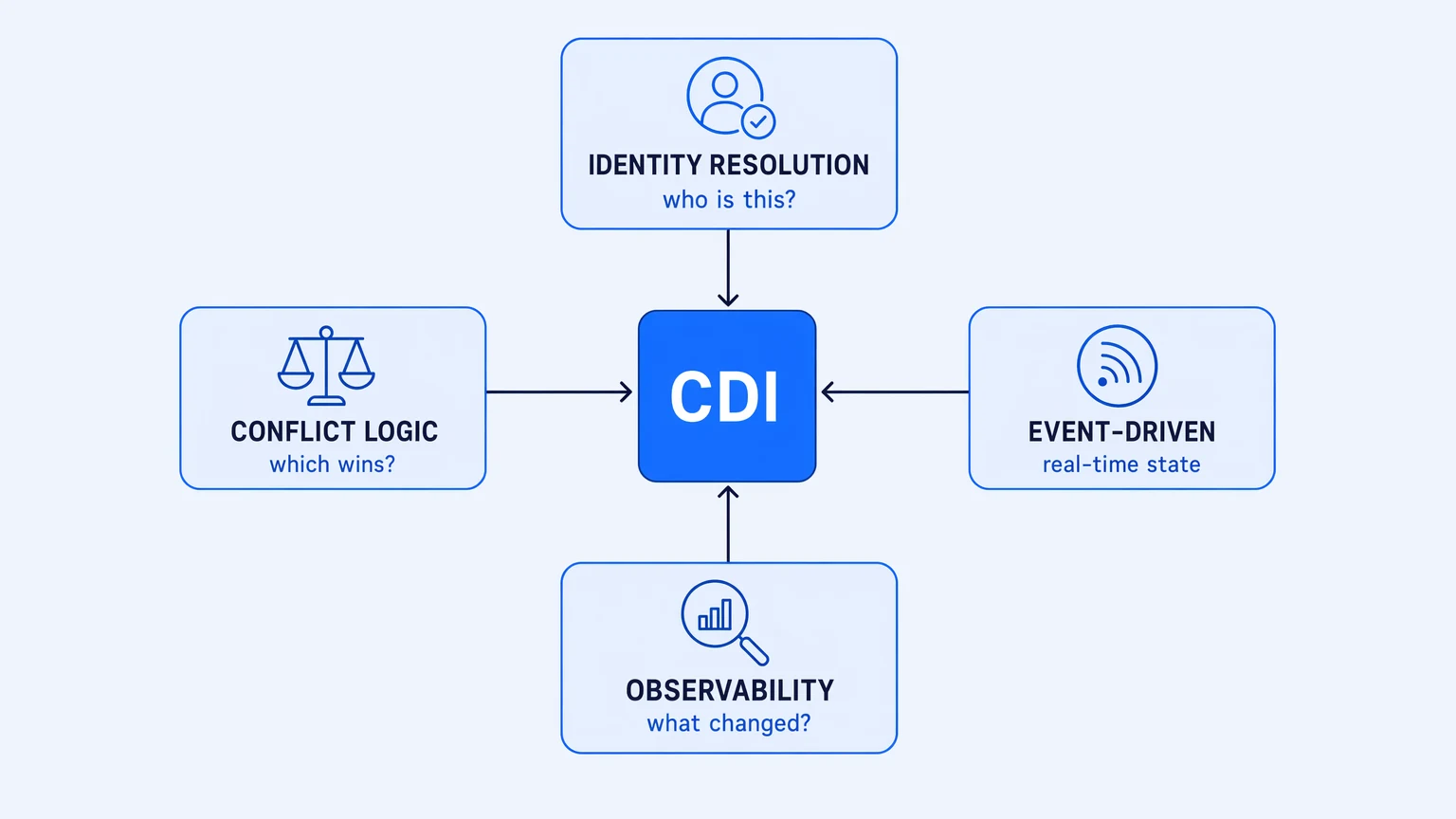
What separates an integration setup that holds up from one that quietly degrades comes down to four things.
Identity resolution at the seam. Every system that feeds the CRM has its own customer identifier. Billing has an account ID. Support has a ticket-owner ID. Product has a user ID. Unless you've built the mapping between these identifiers — and maintained it as they drift — your integration is merging records by coincidence, not by design. A customer who creates a second account, or whose email changes, or who's represented differently in two legacy systems, can silently become two or three people in your CRM.
Conflict resolution logic that's explicit, not inherited. When billing says a customer's address is X and the support desk says it's Y, which one wins? Most integration setups have an answer to this — it's just implicit, buried in the order sync jobs run. Making that logic explicit, testable, and changeable without redeploying pipelines is the difference between a CRM you can trust and one that correct-answers-its-way-through-demos.
Event-driven updates for state that can't wait for batch. A customer who churns, cancels, or escalates to a critical support case cannot wait for the next nightly run. Those events need to propagate immediately, which means the integration layer needs to support real-time event streams alongside batch jobs. A hybrid architecture that runs batch for enrichment and events for state changes is almost always the right shape — and also the shape that's hardest to operationalize without a platform that handles both natively.
Observability into the data in flight. When a CRM record is wrong, the investigation should answer: which system last wrote this field, when, and what did it write? That requires the integration layer to emit structured traces — not just "the job ran successfully," but field X on record Y was updated by system Z at timestamp T with value V, replacing prior value W. Most integration setups can't answer those questions. The data moved; the evidence of how didn't.
The observability gap is where CRM trust actually dies
Engineering teams often treat CRM data quality as a data problem. Clean the records, run deduplication, let the CRM admin manage it. But the pattern repeats: you clean the records, the pipelines keep running, and six months later the CRM is dirty again.
It repeats because cleaning records without fixing the pipeline is treating symptoms. The pipeline is still making the same decisions — same conflict resolution logic, same schema mismatches, same implicit identity resolution — it's just making them with clean source data for a few weeks before the drift accumulates again.
The only sustainable fix is visibility into what the integration layer is doing as it does it. What ran, what it changed, which conflict resolution path it took, which records it couldn't match. When that visibility exists, you can catch the pattern before it becomes a CRM full of stale records. When it doesn't, you're cleaning up after the fact and hoping the cycle is slower this time.
OpenTelemetry-format traces from the integration layer — the kind that export into whatever observability stack the team already runs — change the investigation from "why is this wrong" to "here is what happened and when." Distributed traces across every step of a customer data sync make a CRM record an auditable artifact instead of an undifferentiated pile of writes.
When the integration layer is observable, CRM trust is an engineering property you can measure. When it isn't, it's a feeling the sales team has.
The longer argument about what owning your integration layer — including telemetry, code, and predictable billing — actually looks like lives in why unobservable integration stacks are the real hidden bill.
The CRM is a symptom
Your CRM's data quality is a reliable indicator of your customer data integration architecture's maturity. A CRM that stays accurate under operational load — new data sources, new product lines, churn, account changes — is one fed by an integration layer with explicit identity resolution, event-driven propagation for time-sensitive state, conflict resolution logic the team can inspect and change, and traces the team can query.
A CRM that has to be "cleaned" periodically is one fed by pipelines that were designed to move data, not to guarantee consistency.
Customer data integration is building the latter: integration logic versioned and reviewable, observability into every write, and conflict resolution that's an explicit architectural decision rather than an accident of scheduling order.
If you're building or consolidating that layer and want a platform that treats it as engineering work — versioned workflows in real Git, OpenTelemetry traces from the Community tier at no cost, no per-execution billing on Professional — Koodisi is worth running through your actual flows. Start on Community; the 1,000 executions/month limit is there to let you validate the model before committing.