
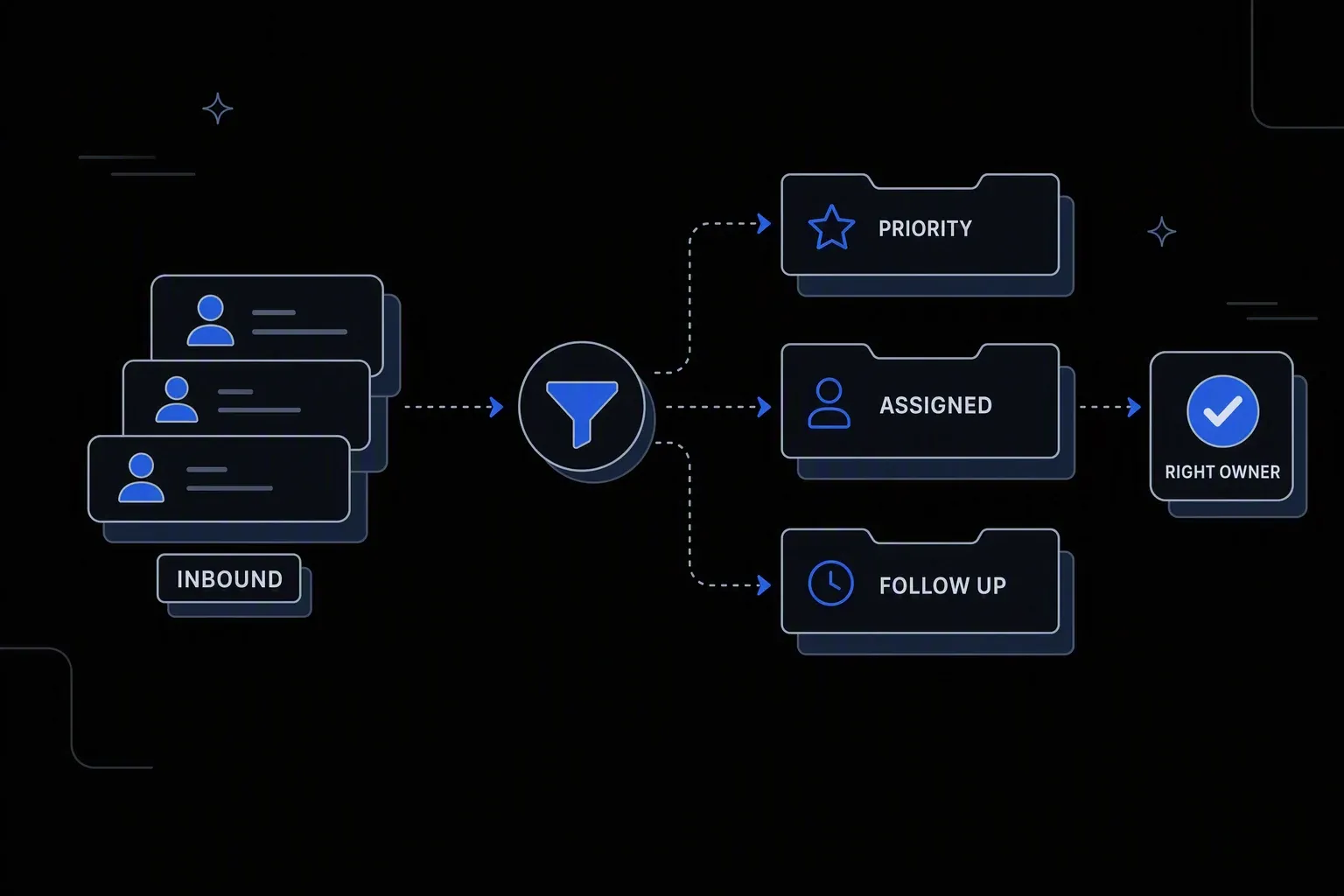
Automate Lead Routing
Route the right leads to the right reps — instantly and automatically.
Minutes to first touch
Faster response
A lead reaches the right rep as it arrives rather than after the next queue review.
Rules, not claims
Fair distribution
Territory, segment, and capacity decide ownership instead of who checks the queue first.
No lead unassigned
Complete coverage
Every lead has an owner and a timestamp, so nothing sits unclaimed and unnoticed.
One governed workflow across systems that never talked.
- Who it's for
- Sales and revenue operations teams distributing inbound leads across territories, segments, and reps.
- What it does
- A workflow that enriches, scores, and assigns every inbound lead by rule, then confirms the assignment landed.
- Systems involved
- Your CRM, marketing automation, and enrichment sources — connected through the REST Client, with dedicated activities built on request.
- How it stays governed
- Assignment rules in decision tables, scoped permissions on routing logic, and a record of every assignment.
What this looks like today
The friction that makes this workflow expensive to run by hand.
Delay
Leads cool while they wait
Inbound interest arrives faster than anyone reviews the queue, and the value of a lead falls sharply with every hour it sits.
Fairness
Routing depends on who is watching
Without enforced rules, distribution favours whoever is most attentive, which distorts territory coverage and quota fairness.
Gaps
Some leads have no owner
Records that do not match a rule fall through silently, and nobody notices until a pipeline review comes up short.
The workflow
How Koodisi runs it
Koodisi automates lead routing based on territory, company size, industry, score, or any custom rule — ensuring every lead reaches the right rep in real time without manual assignment.
Capture leads as they arrive
Form submissions, marketing platform events, and imported lists enter one process, so routing does not depend on the source.
Webhook and scheduled triggers over the REST Client.
Enrich and normalise
Company, size, and geography are filled in and standardised, so routing rules evaluate consistent values rather than whatever the form captured.
Enrichment sources connect through the REST Client.
Resolve the owner by rule
Territory, segment, product interest, and current capacity are evaluated in a decision table that produces one owner, consistently.
Routing rules live where revenue operations can change them.
Assign and notify
The CRM record is assigned and the rep told, with the context to act, then confirmed so an assignment cannot silently fail.
Retry policies cover transient failures; unconfirmed writes raise a failed run.
Catch what did not match
Leads that fit no rule route to a named fallback owner rather than sitting unassigned, so coverage is complete by construction.
Fallback handling defined in the same decision table.
Record the assignment
Each lead carries why it was routed where it was, and when — the basis for tuning rules and settling disputes.
Execution logging with before and after state.
Connectivity
The systems in this workflow
Koodisi orchestrates the platforms this workflow touches — through the REST Client today, and through a dedicated activity whenever you need one.





The capability underneath
Every workflow above is assembled from the same governed building blocks — which is why connecting one more system is a day of work, not a project.
Connect to anything
- REST and webhook connectivity with managed authentication (4 activities)
- Secure file transfer over SFTP (5 activities)
- Direct database reads and writes (4 activities)
Move and reshape data
- Translate between CSV, JSON, XML, and fixed-width formats (6 activities)
- Field-level mapping between systems that model data differently
- High-volume batch processing with per-record tracking (7 activities)
Decide and protect
- Decision tables for approval and routing rules your team can read
- Encryption, hashing, and signature verification on sensitive fields
- Retry policies, error handling, and full execution logging
Business systems connect through Koodisi’s REST Client, and our team builds dedicated activities for the ones you depend on — typically within a day of you asking.
Request a system →Governance
Automated, but still under control
Every run is authorised, recorded, and observable — the part that decides whether automation survives an audit.
Routing rules in the open
Territory and segment logic lives in a decision table revenue operations can review and change without engineering.
Every assignment recorded
Each lead logs the values evaluated, the rule matched, and the resulting owner with a timestamp.
Scoped control of routing
Permission scopes separate who can run the workflow from who can change the rules that allocate revenue opportunity.
Contact data masked
Personal contact details are masked in logs so routing records can be reviewed without exposing prospects.
Credentials in Key Vault
CRM and enrichment credentials are stored in Key Vault and referenced at run time.
Visible when it backs up
Traces show routing latency, so a slowdown is caught before it shows up as missed follow-up.
Yes. Territory, segment, and capacity rules are expressed in a decision table, so the workflow enforces the model you already run rather than replacing it.
They route to a named fallback owner rather than sitting unassigned. Unmatched volume is also visible in the run record, which usually points to a rule that needs adding.
Yes, where your CRM exposes the relevant counts. Capacity is just another input the decision table evaluates alongside territory and segment.
Where your form or marketing platform can emit an event, assignment happens as the lead arrives. Where it cannot, scheduled cycles run as frequently as the platform allows.
Tools used in this workflow
Ship integrations faster. Operate them without chaos.
Less time on auth, retries, and deployment scripts. More time on the integrations your customers are asking for.
Contact Sales