
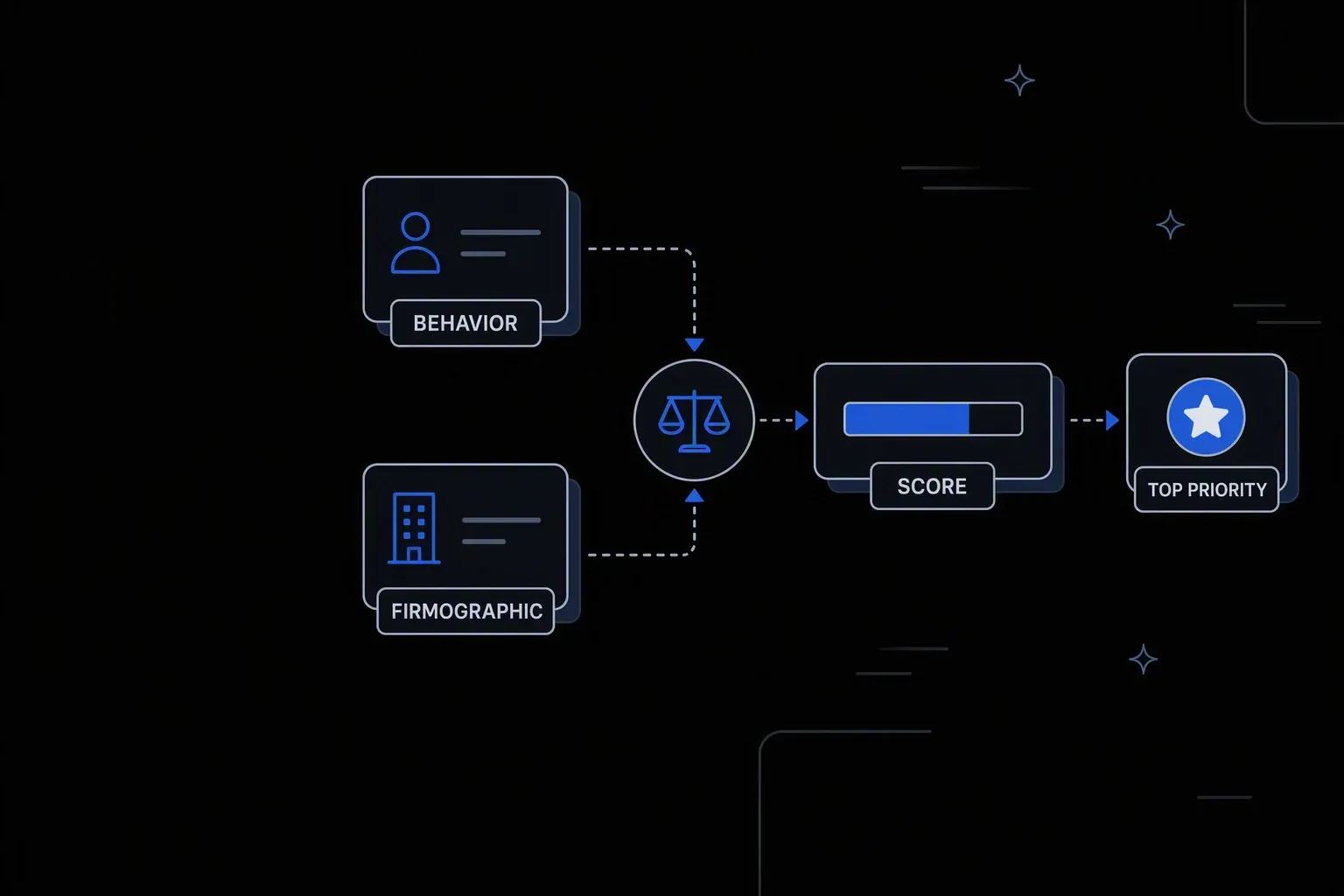
Automate Lead Scoring
Score and prioritize leads automatically based on behavior and firmographic data.
One agreed definition
Sales and marketing alignment
Scoring criteria live in one reviewable place instead of being argued over each quarter.
Scores that keep up
Current signal
Behaviour and firmographic changes update the score as they happen, not on a monthly recalculation.
Explainable rankings
Trust in the model
Every score can be traced to the signals that produced it, so reps know why a lead is ranked where it is.
One governed workflow across systems that never talked.
- Who it's for
- Marketing and revenue operations teams deciding which leads deserve sales attention and needing sales to agree.
- What it does
- A workflow that combines behavioural and firmographic signals into a maintained score, with the reasoning recorded.
- Systems involved
- Your marketing automation, CRM, product analytics, and enrichment sources — connected through the REST Client, with dedicated activities built on request.
- How it stays governed
- Scoring criteria in decision tables, scoped rights to change weightings, and a full record per scored record.
What this looks like today
The friction that makes this workflow expensive to run by hand.
Disagreement
Nobody agrees what qualified means
Marketing passes leads sales does not act on, because the definition lives in different places for each team.
Staleness
Scores describe last month
Recalculation happens on a cycle, so a lead that became interesting yesterday is still ranked as it was weeks ago.
Opacity
Reps cannot see why
A number with no explanation gets ignored. Without the reasoning, scoring becomes something sales works around.
The workflow
How Koodisi runs it
Koodisi automates lead scoring by pulling behavioral signals from marketing tools, product analytics, and CRM — and updating lead scores in real time without manual intervention.
Gather the signals
Engagement, product usage, and firmographic data are read from the systems that hold them, so the score reflects more than form fills.
Reading through the REST Client on schedules or change events.
Normalise so signals compare
Values are standardised into consistent bands, so a score is not distorted by how a given system happens to record something.
Field mapping and format conversion before evaluation.
Apply the agreed model
A decision table holds the criteria and weightings both teams signed up to, so the definition of qualified is one artefact rather than an argument.
Criteria are readable and changeable without engineering.
Write the score and the reasoning
The CRM receives the score alongside the signals that produced it, so a rep can see why before deciding whether to act.
Retry policies cover transient failures; writes are confirmed.
Trigger on threshold crossings
When a lead crosses into a qualified band, routing and notification happen at that moment rather than at the next review.
Threshold rules live alongside the scoring criteria.
Keep a record for tuning
Each scoring run records inputs and outputs, so the model can be evaluated against outcomes rather than adjusted on instinct.
Execution logging with before and after state.
Connectivity
The systems in this workflow
Koodisi orchestrates the platforms this workflow touches — through the REST Client today, and through a dedicated activity whenever you need one.





The capability underneath
Every workflow above is assembled from the same governed building blocks — which is why connecting one more system is a day of work, not a project.
Connect to anything
- REST and webhook connectivity with managed authentication (4 activities)
- Secure file transfer over SFTP (5 activities)
- Direct database reads and writes (4 activities)
Move and reshape data
- Translate between CSV, JSON, XML, and fixed-width formats (6 activities)
- Field-level mapping between systems that model data differently
- High-volume batch processing with per-record tracking (7 activities)
Decide and protect
- Decision tables for approval and routing rules your team can read
- Encryption, hashing, and signature verification on sensitive fields
- Retry policies, error handling, and full execution logging
Business systems connect through Koodisi’s REST Client, and our team builds dedicated activities for the ones you depend on — typically within a day of you asking.
Request a system →Governance
Automated, but still under control
Every run is authorised, recorded, and observable — the part that decides whether automation survives an audit.
The model is a readable table
Criteria and weightings live where marketing and sales can both review them, which is what makes agreement possible.
Every score explainable
Each run records the signals evaluated and the resulting score, so any ranking can be justified.
Scoped rights to change weightings
Permission scopes control who can alter the model, so scoring cannot be quietly tuned to favour a particular pipeline.
Behavioural data masked
Personal and behavioural details are masked in logs so scoring records stay operational.
Credentials in Key Vault
Marketing, CRM, and analytics credentials are stored in Key Vault and referenced at run time.
Traced per run
Traces show which signal source is failing, so a silently degraded score is caught early.
The model lives in a decision table both teams can read, and permission scopes control who can change it. In practice that is what turns scoring from an argument into an agreement.
Where source systems emit events, scores update as signals change. Where they do not, scheduled cycles run as frequently as needed. Threshold crossings trigger routing at the moment they happen.
Yes. The score is written alongside the signals that produced it, which is usually the difference between a score reps act on and one they ignore.
No. It applies the criteria and weightings your teams define. That keeps the model explainable and adjustable, which matters more than sophistication for most scoring.
Tools used in this workflow
Ship integrations faster. Operate them without chaos.
Less time on auth, retries, and deployment scripts. More time on the integrations your customers are asking for.
Contact Sales