
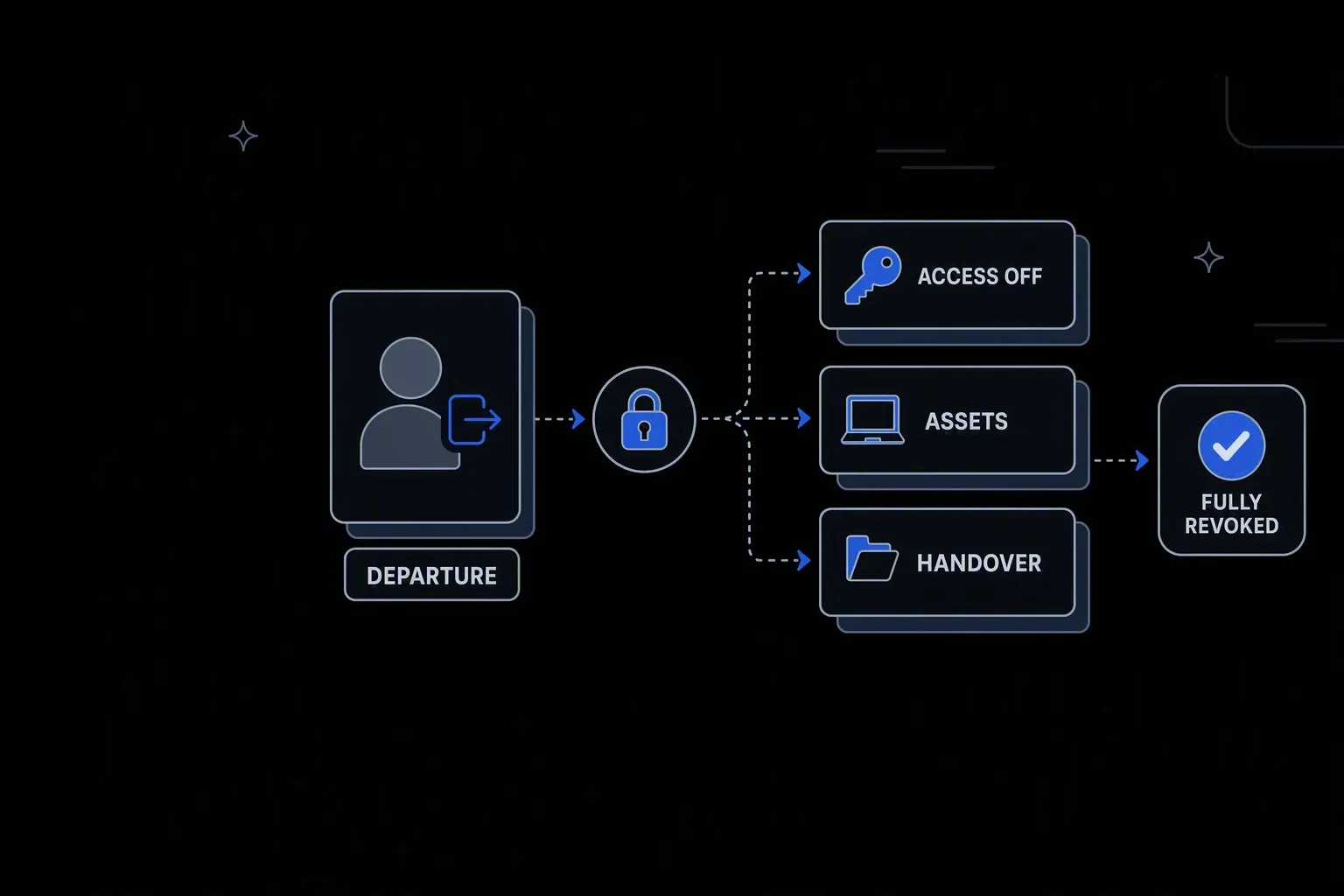
Automate Employee Offboarding
Secure, consistent offboarding in minutes — not days.
Access gone the same day
Closed risk window
Accounts are revoked on the leave date rather than whenever the request works its way through a queue.
Nothing quietly missed
Complete revocation
Every system the leaver had access to is covered from one checklist, including the ones nobody remembers.
Proof for the access review
Audit readiness
Each departure leaves a record showing what was revoked, when, and by whose authority.
One governed workflow across systems that never talked.
- Who it's for
- IT security, HR, and compliance teams accountable for removing access when someone leaves — and for proving it happened.
- What it does
- A governed workflow that revokes access, reassigns ownership, and preserves the evidence when an employee departs.
- Systems involved
- Your HRMS, identity provider, and every system holding accounts or data ownership — connected through the REST Client, with dedicated activities built on request.
- How it stays governed
- Role-scoped permissions, approval routing for data handling, and a complete revocation record per departure.
What this looks like today
The friction that makes this workflow expensive to run by hand.
Exposure
Access outlives employment
Accounts stay live for days or weeks after someone leaves because revocation depends on tickets clearing in sequence.
Coverage
The forgotten systems
Core tools get revoked; the peripheral ones do not. Nobody has a reliable list of everywhere a given person had access.
Continuity
Work disappears with the person
Files, approvals, and integrations owned by the leaver break silently after departure because ownership was never reassigned.
The workflow
How Koodisi runs it
Koodisi automates the complete employee offboarding workflow — from HRMS termination event to access revocation, equipment recovery, and final pay processing.
Start from the confirmed leave date
The HRMS termination record triggers the process, so revocation is driven by an authoritative date rather than a remembered one.
Webhook or scheduled checks over the REST Client.
Resolve everywhere this person had access
Entitlements are resolved from role and identity records rather than recollection, producing the full list of systems to act on.
Decision tables map role and access to the required revocation set.
Preserve before you revoke
Mailboxes, files, and owned records are archived or reassigned to a named successor first, so removing access does not destroy work.
Reassignment targets are resolved from the org structure.
Revoke across every system
Accounts are disabled and sessions terminated everywhere at once, rather than in a sequence that leaves gaps open for days.
Retry policies ensure a transient failure is not mistaken for completion.
Verify the revocation held
Each system is checked back to confirm the account is actually disabled — the difference between believing access is gone and knowing it.
Confirmed results are logged; anything unconfirmed raises a failed run.
Produce the departure record
One record shows what was revoked, what was reassigned, when, and under whose authority — the evidence an access review asks for.
Execution logging with per-system status.
Connectivity
The systems in this workflow
Koodisi orchestrates the platforms this workflow touches — through the REST Client today, and through a dedicated activity whenever you need one.





The capability underneath
Every workflow above is assembled from the same governed building blocks — which is why connecting one more system is a day of work, not a project.
Connect to anything
- REST and webhook connectivity with managed authentication (4 activities)
- Secure file transfer over SFTP (5 activities)
- Direct database reads and writes (4 activities)
Move and reshape data
- Translate between CSV, JSON, XML, and fixed-width formats (6 activities)
- Field-level mapping between systems that model data differently
- High-volume batch processing with per-record tracking (7 activities)
Decide and protect
- Decision tables for approval and routing rules your team can read
- Encryption, hashing, and signature verification on sensitive fields
- Retry policies, error handling, and full execution logging
Business systems connect through Koodisi’s REST Client, and our team builds dedicated activities for the ones you depend on — typically within a day of you asking.
Request a system →Governance
Automated, but still under control
Every run is authorised, recorded, and observable — the part that decides whether automation survives an audit.
Evidence per departure
Each offboarding produces a single record of every revocation and reassignment with timestamps and before and after state.
Authority is scoped
Permission scopes control who can trigger, approve, or alter an offboarding run, so revocation cannot be quietly bypassed.
Handling rules in the open
What gets archived, what gets reassigned, and what needs approval is defined in decision tables rather than individual judgement.
Credentials in Key Vault
Identity and system credentials are stored in Key Vault and referenced at run time, never held in a step.
Personal data masked
Contact details and identifiers are masked in logs so the record can be reviewed without exposing the individual.
Verified, not assumed
Traces show each revocation confirming, so an incomplete run is visible immediately rather than at the next audit.
The workflow runs on the confirmed leave date from the HRMS and revokes across systems in one pass, rather than depending on tickets clearing in sequence. Each revocation is verified before the run is marked complete.
Preservation happens before revocation. Owned records are archived or reassigned to a named successor first, so removing access does not orphan work that other people depend on.
Yes. Decision tables can route sensitive cases — executives, disputes, legal holds — to a named approver, and the workflow waits for that decision and records it.
Every departure produces one record showing each system, the revocation timestamp, and the confirming check. That is the evidence reviewers ask for, without assembling it from tickets and inboxes.
Tools used in this workflow
Ship integrations faster. Operate them without chaos.
Less time on auth, retries, and deployment scripts. More time on the integrations your customers are asking for.
Contact Sales