
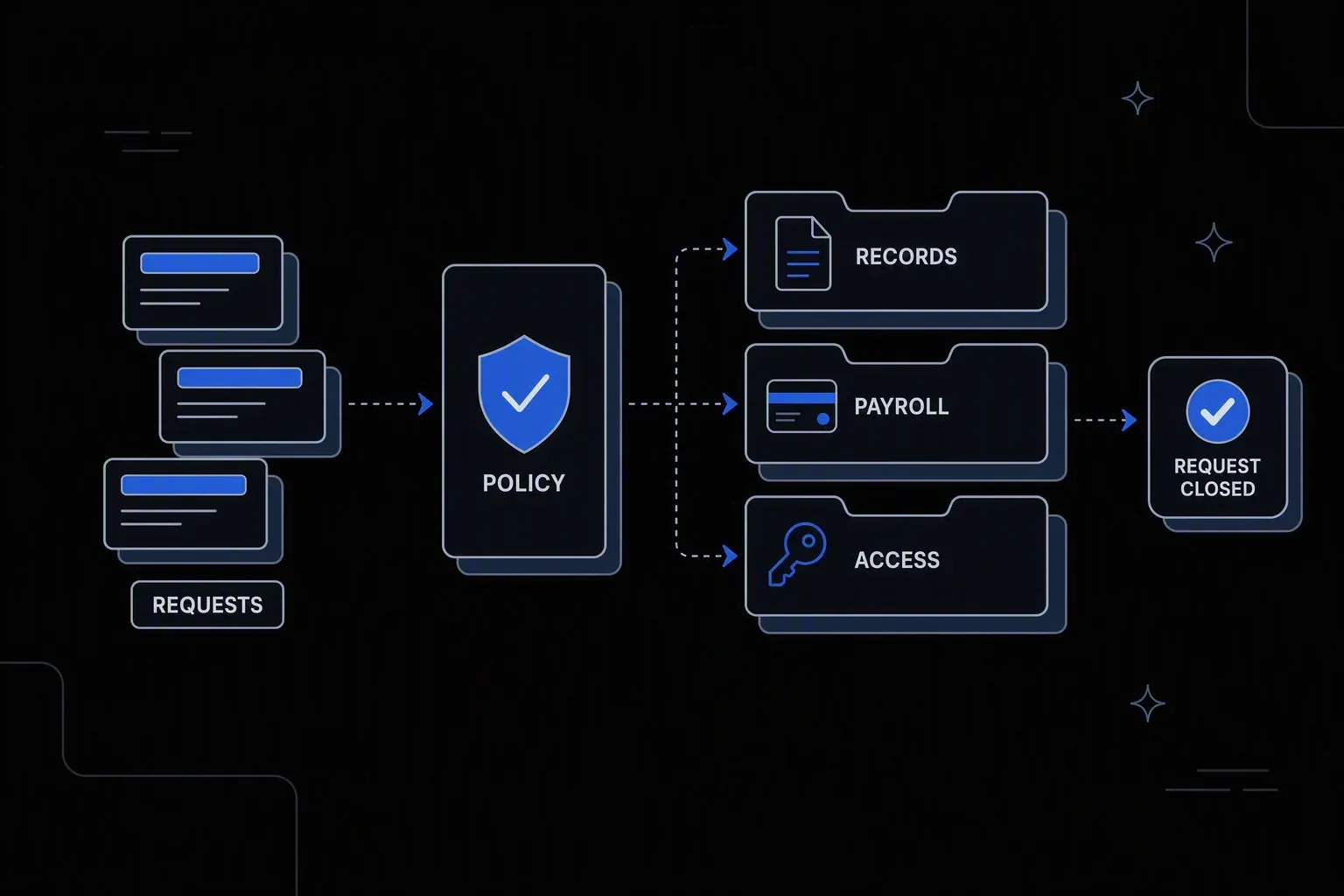
HR Process Automation
Automate repetitive HR workflows across your entire people stack.
One process, not twelve
Consistency
Every HR request follows the same governed path regardless of which team raised it or which system it lands in.
Requests that close themselves
Throughput
Routine changes complete without a person shepherding them between systems and inboxes.
Evidence on every change
Audit readiness
Who requested, who approved, what changed, and when — captured as one record per run.
One governed workflow across systems that never talked.
- Who it's for
- HR operations teams running joiner, mover, and leaver processes across an HRMS that does not reach every downstream system.
- What it does
- A governed workflow layer that turns HR requests into completed changes across payroll, identity, and finance systems.
- Systems involved
- Your HRMS, payroll, identity provider, and finance platforms — connected through the REST Client, with dedicated activities built on request.
- How it stays governed
- Approval routing in decision tables, role-scoped permissions, and a complete execution record for every change.
What this looks like today
The friction that makes this workflow expensive to run by hand.
Repetition
The same change, entered four times
A promotion means edits in the HRMS, payroll, the org chart, and access groups. Each one is manual, and each one can be missed.
Waiting
Progress depends on someone remembering
Requests sit in inboxes between steps. Nobody can say where a case is without asking the person who last touched it.
Exceptions
Policy lives in people's heads
Which changes need approval, and from whom, is tribal knowledge. It gets applied inconsistently and cannot be evidenced later.
The workflow
How Koodisi runs it
Koodisi automates core HR processes — from new hire provisioning to offboarding — connecting HRMS, payroll, identity, and communication tools in one platform.
Take the request from wherever it starts
A form submission, an HRMS status change, or a scheduled review kicks the process off, so employees and managers use whatever they already use.
Webhook and scheduled triggers, reading through the REST Client.
Apply policy before anything changes
A decision table resolves what this request type requires — approvals, effective dates, eligibility — so policy is applied the same way every time.
Decision tables keep the rules readable and changeable without editing the workflow.
Route approvals to the right person
Anything needing sign-off goes to the named approver with the context to decide, and the workflow waits rather than proceeding on assumption.
The approver and their decision are both recorded.
Make the change everywhere at once
Payroll, identity, org structure, and finance records are updated from one approved source, then read back so a partial failure cannot pass as success.
Retry policies cover transient failures; mismatches surface as failed runs.
Confirm and close
The requester and manager are told the change is complete, with the record of what actually changed attached.
Execution logging produces the audit trail.
Connectivity
The systems in this workflow
Koodisi orchestrates the platforms this workflow touches — through the REST Client today, and through a dedicated activity whenever you need one.




The capability underneath
Every workflow above is assembled from the same governed building blocks — which is why connecting one more system is a day of work, not a project.
Connect to anything
- REST and webhook connectivity with managed authentication (4 activities)
- Secure file transfer over SFTP (5 activities)
- Direct database reads and writes (4 activities)
Move and reshape data
- Translate between CSV, JSON, XML, and fixed-width formats (6 activities)
- Field-level mapping between systems that model data differently
- High-volume batch processing with per-record tracking (7 activities)
Decide and protect
- Decision tables for approval and routing rules your team can read
- Encryption, hashing, and signature verification on sensitive fields
- Retry policies, error handling, and full execution logging
Business systems connect through Koodisi’s REST Client, and our team builds dedicated activities for the ones you depend on — typically within a day of you asking.
Request a system →Governance
Automated, but still under control
Every run is authorised, recorded, and observable — the part that decides whether automation survives an audit.
Policy in a readable table
Approval thresholds and eligibility rules live where HR and compliance can review them, not buried inside workflow logic.
Role-scoped permissions
Designing, running, and approving a process are separate rights, so no single person can quietly change how policy is applied.
One record per change
Each run captures the request, the decision, the approver, and the resulting system writes with before and after state.
Personal data masked in logs
Salary, identifiers, and contact details are masked so the audit trail never becomes an exposure of its own.
Credentials in Key Vault
System credentials are stored in Key Vault and referenced at run time, never pasted into a step.
Visible when it stalls
OpenTelemetry traces show exactly where a request slowed or failed, on every plan.
No. Your HRMS stays the system of record. Koodisi handles what has to happen in other systems once a change is approved there — the part the HRMS does not reach.
Yes. Decision tables route whatever you define as sensitive to a named approver, and the workflow waits for that decision. Both the approver and the outcome are recorded.
Approval thresholds and eligibility rules live in decision tables, so they can be updated without editing the workflow itself or involving engineering.
The run fails with the exact step and payload rather than silently completing. Retry policies handle transient errors, and anything that exhausts them surfaces for a human.
Tools used in this workflow
Ship integrations faster. Operate them without chaos.
Less time on auth, retries, and deployment scripts. More time on the integrations your customers are asking for.
Contact Sales