
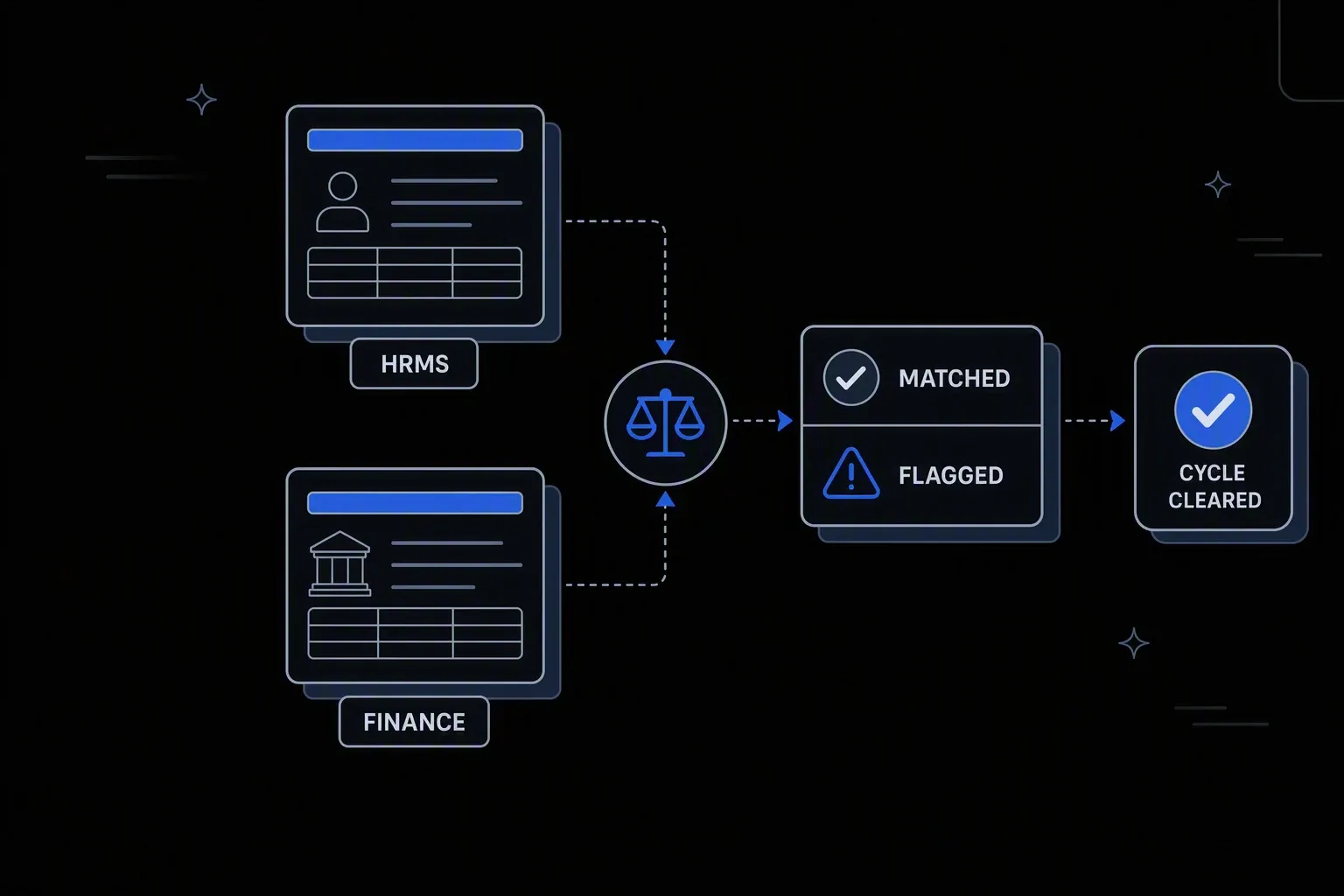
Automate Payroll Sync
Keep payroll data in sync across HRMS and finance systems automatically.
Reconciled before it runs
Fewer pay errors
Discrepancies between HR and payroll surface before the pay run, not in a correction cycle afterwards.
Every cycle evidenced
Provable accuracy
Each run records what was transferred and what changed, so finance can show how a figure was reached.
Hours back each cycle
Effort saved
The manual export, reformat, and re-key that consumes payroll teams before each deadline is handled by the workflow.
One governed workflow across systems that never talked.
- Who it's for
- Payroll and HR operations teams reconciling employee, time, and compensation data between systems before every pay run.
- What it does
- A scheduled workflow that moves and reconciles payroll-relevant data, flagging discrepancies before they reach a payment.
- Systems involved
- Your HRMS, time and attendance, and payroll platforms — connected through the REST Client, with dedicated activities built on request.
- How it stays governed
- Masking on compensation data, approval routing for exceptions, and a complete record of every cycle.
What this looks like today
The friction that makes this workflow expensive to run by hand.
Deadline
The cycle is a manual scramble
Exports, spreadsheets, and re-keying compress into the days before each deadline, when there is least time to catch a mistake.
Accuracy
Discrepancies surface after payment
A mismatch between HR and payroll becomes visible when someone is paid wrongly — the most expensive and least private moment to find it.
Evidence
Hard to show how a figure was reached
When a number is questioned, the trail runs through spreadsheets and inboxes rather than a system anyone can audit.
The workflow
How Koodisi runs it
Koodisi automates payroll data synchronization between HRMS and payroll processors — ensuring employee compensation, tax, and benefit data is always current without manual intervention.
Collect on the payroll calendar
The workflow runs on the cycle you already work to, pulling employee, time, and compensation changes since the last run.
Scheduled triggers reading through the REST Client.
Normalise the formats
Payroll platforms expect specific layouts. Data is translated into what the platform requires rather than being hand-shaped each cycle.
Conversion across CSV, JSON, XML, and fixed-width formats.
Reconcile before anything is submitted
Records are compared across systems and anything that disagrees — a missing starter, a changed rate, an unexpected variance — is flagged rather than passed through.
Decision tables define which variances are material.
Route exceptions to a person
Flagged records go to payroll for a decision, with the conflicting values shown side by side. Clean records continue without waiting.
The workflow waits on the decision and records it.
Submit and confirm
Approved data is written to payroll and read back to confirm acceptance, so a rejected batch is never mistaken for a completed one.
Retry policies for transient failures; confirmed results are logged.
Produce the cycle record
Each run leaves a record of what moved, what was flagged, who decided, and what was submitted.
Execution logging with per-record status.
Connectivity
The systems in this workflow
Koodisi orchestrates the platforms this workflow touches — through the REST Client today, and through a dedicated activity whenever you need one.





The capability underneath
Every workflow above is assembled from the same governed building blocks — which is why connecting one more system is a day of work, not a project.
Connect to anything
- REST and webhook connectivity with managed authentication (4 activities)
- Secure file transfer over SFTP (5 activities)
- Direct database reads and writes (4 activities)
Move and reshape data
- Translate between CSV, JSON, XML, and fixed-width formats (6 activities)
- Field-level mapping between systems that model data differently
- High-volume batch processing with per-record tracking (7 activities)
Decide and protect
- Decision tables for approval and routing rules your team can read
- Encryption, hashing, and signature verification on sensitive fields
- Retry policies, error handling, and full execution logging
Business systems connect through Koodisi’s REST Client, and our team builds dedicated activities for the ones you depend on — typically within a day of you asking.
Request a system →Governance
Automated, but still under control
Every run is authorised, recorded, and observable — the part that decides whether automation survives an audit.
Compensation masked in logs
Salary and bank details are masked so the run record can be reviewed without exposing pay data.
Variance rules you can read
What counts as a material discrepancy is defined in a decision table finance can review and adjust.
Separated duties
Permission scopes keep the people who design the workflow distinct from those who approve exceptions and release runs.
Every cycle recorded
Each run captures inputs, flagged records, decisions, and submissions with before and after state.
Credentials in Key Vault
Payroll and HRMS credentials are stored in Key Vault and referenced at run time.
Watchable against the deadline
OpenTelemetry traces show progress and failures while there is still time to act.
Only if you want it to. The common pattern is that the workflow prepares and reconciles the data and a person approves the submission — automation removes the re-keying, not the accountability.
The record is flagged rather than transferred. Decision tables define which variances are material, and flagged records go to payroll with both values shown for a decision.
Yes. Different groups can run on different schedules with their own mappings and variance rules, while sharing the same governed workflow structure.
Credentials live in Key Vault, compensation fields are masked in logs, and permission scopes control who can run or change the workflow. Every run is recorded.
Tools used in this workflow
Ship integrations faster. Operate them without chaos.
Less time on auth, retries, and deployment scripts. More time on the integrations your customers are asking for.
Contact Sales