
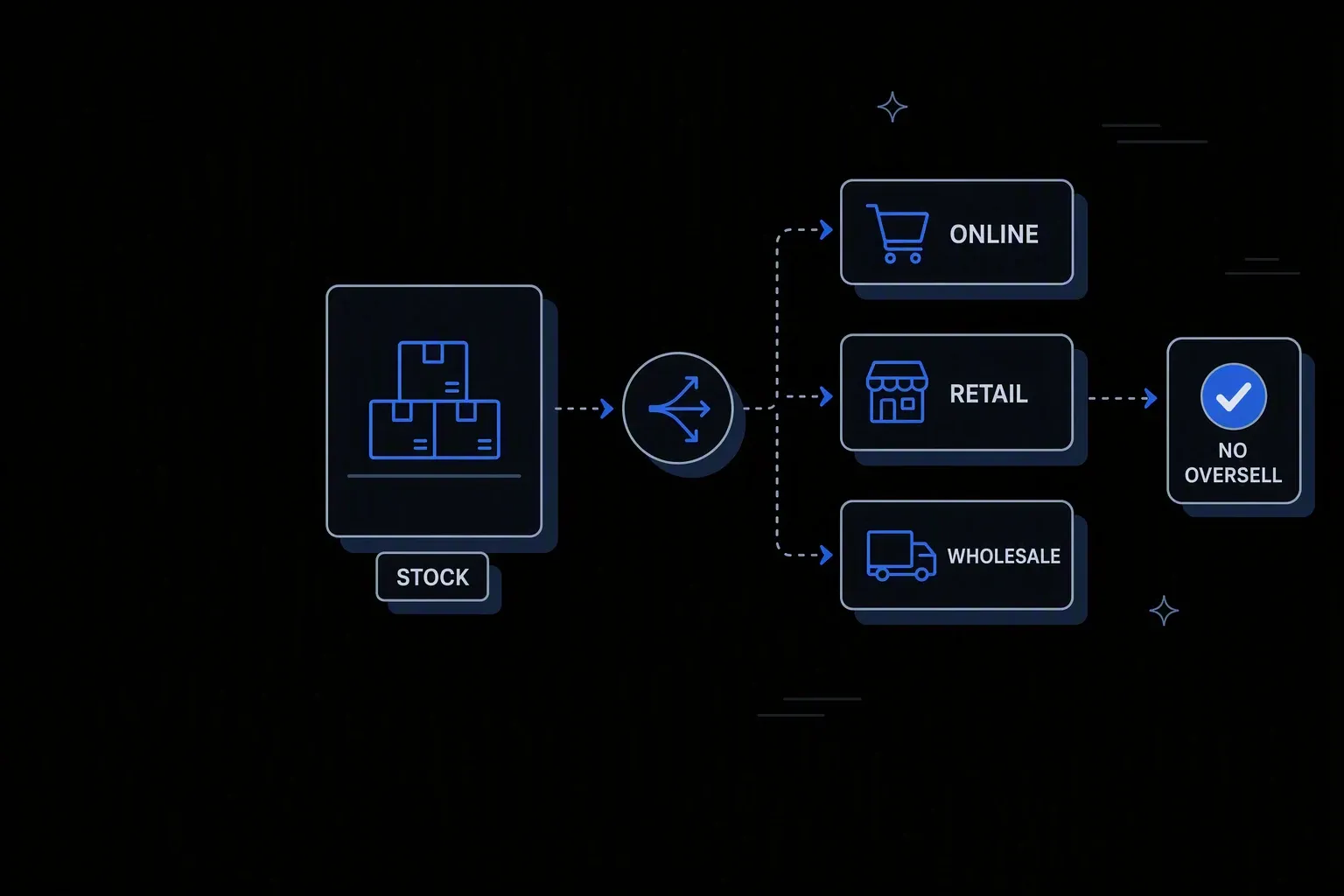
Inventory Management Automation
Real-time inventory sync across all channels — no more stockouts or oversells.
One stock figure
Consistency
Every channel and system reads the same availability instead of each holding its own lagging copy.
Oversells caught early
Fewer cancellations
Stock movements propagate as they happen, so a channel stops selling what the warehouse no longer has.
Rules, not reflexes
Predictable decisions
Reorder points, allocation, and conflict handling follow written rules rather than whoever is watching the dashboard.
One governed workflow across systems that never talked.
- Who it's for
- Supply chain and eCommerce operations teams holding stock across warehouses, channels, and an ERP that disagree with each other.
- What it does
- A governed workflow that keeps inventory levels consistent across systems and applies allocation rules automatically.
- Systems involved
- Your ERP, warehouse management, and sales channels — connected through the REST Client, with dedicated activities built on request.
- How it stays governed
- Conflict rules in decision tables, approval routing for adjustments, and a full record of every stock movement applied.
What this looks like today
The friction that makes this workflow expensive to run by hand.
Lag
Channels sell what is already gone
Stock updates arrive on a batch cycle, so a product keeps selling for hours after the last unit shipped.
Conflict
Two systems, two truths
The ERP and the warehouse disagree on counts and nothing decides which wins, so staff reconcile by hand and trust neither.
Reaction
Replenishment depends on noticing
Reorder points exist in a document rather than in a system, so restocking happens when someone spots the problem.
The workflow
How Koodisi runs it
Koodisi automates inventory management by syncing stock levels across eCommerce platforms, ERP, and warehouse systems in real time — eliminating manual updates and data delays.
Pick up movements as they happen
Receipts, shipments, returns, and adjustments are captured from the systems that record them rather than waiting for a nightly export.
Webhook and scheduled triggers over the REST Client.
Resolve the authoritative figure
When systems disagree, a decision table decides which source wins for that product and location — consistently, and in a rule you can read.
Conflict rules live in decision tables, not in code.
Apply thresholds and allocation
Reorder points, safety stock, and channel allocation are evaluated on every movement, so decisions happen at the moment they matter.
Thresholds are defined per product and location.
Push the update everywhere
Channels, the ERP, and the warehouse system receive the resolved figure, then are read back to confirm it applied.
Retry policies cover transient failures; mismatches raise a failed run.
Escalate what needs a person
Large adjustments, negative stock, and repeated conflicts route to an operator with the context rather than being written through silently.
The decision and the decider are both recorded.
Leave a movement record
Each run records what changed, which source won, and what was pushed where — the trail a stock audit needs.
Execution logging with per-record status.
Connectivity
The systems in this workflow
Koodisi orchestrates the platforms this workflow touches — through the REST Client today, and through a dedicated activity whenever you need one.





The capability underneath
Every workflow above is assembled from the same governed building blocks — which is why connecting one more system is a day of work, not a project.
Connect to anything
- REST and webhook connectivity with managed authentication (4 activities)
- Secure file transfer over SFTP (5 activities)
- Direct database reads and writes (4 activities)
Move and reshape data
- Translate between CSV, JSON, XML, and fixed-width formats (6 activities)
- Field-level mapping between systems that model data differently
- High-volume batch processing with per-record tracking (7 activities)
Decide and protect
- Decision tables for approval and routing rules your team can read
- Encryption, hashing, and signature verification on sensitive fields
- Retry policies, error handling, and full execution logging
Business systems connect through Koodisi’s REST Client, and our team builds dedicated activities for the ones you depend on — typically within a day of you asking.
Request a system →Governance
Automated, but still under control
Every run is authorised, recorded, and observable — the part that decides whether automation survives an audit.
Conflict rules in the open
Which system wins a disagreement is written in a decision table your operations team can review and change.
Every movement recorded
Each adjustment logs its source, the resolved value, and the systems written, with before and after state.
Scoped authority
Permission scopes separate who can run the workflow from who can change allocation rules or approve large adjustments.
Traced across channels
OpenTelemetry traces show where an update stalled, so a channel falling behind is visible before customers find it.
Credentials in Key Vault
ERP, warehouse, and channel credentials are stored in Key Vault and referenced at run time.
Commercial terms masked
Cost and margin fields are masked in logs so operational records do not expose commercial data.
Where a system can emit change events, updates flow as movements happen. Where it cannot, scheduled cycles run as frequently as the platform allows. Both use the same conflict and allocation rules.
A decision table resolves it — you define which source is authoritative for a given product or location. The resolution and the losing value are both recorded, so recurring conflicts are visible rather than buried.
Yes. Thresholds route unusual adjustments to an operator with both values shown, and the workflow waits for that decision rather than writing it through.
Warehouse and ERP platforms connect through Koodisi's REST Client, which handles authentication, pagination, and retries against any documented API. Where you depend on a specific platform, our team builds a dedicated activity — typically within a day.
Tools used in this workflow
Ship integrations faster. Operate them without chaos.
Less time on auth, retries, and deployment scripts. More time on the integrations your customers are asking for.
Contact Sales