
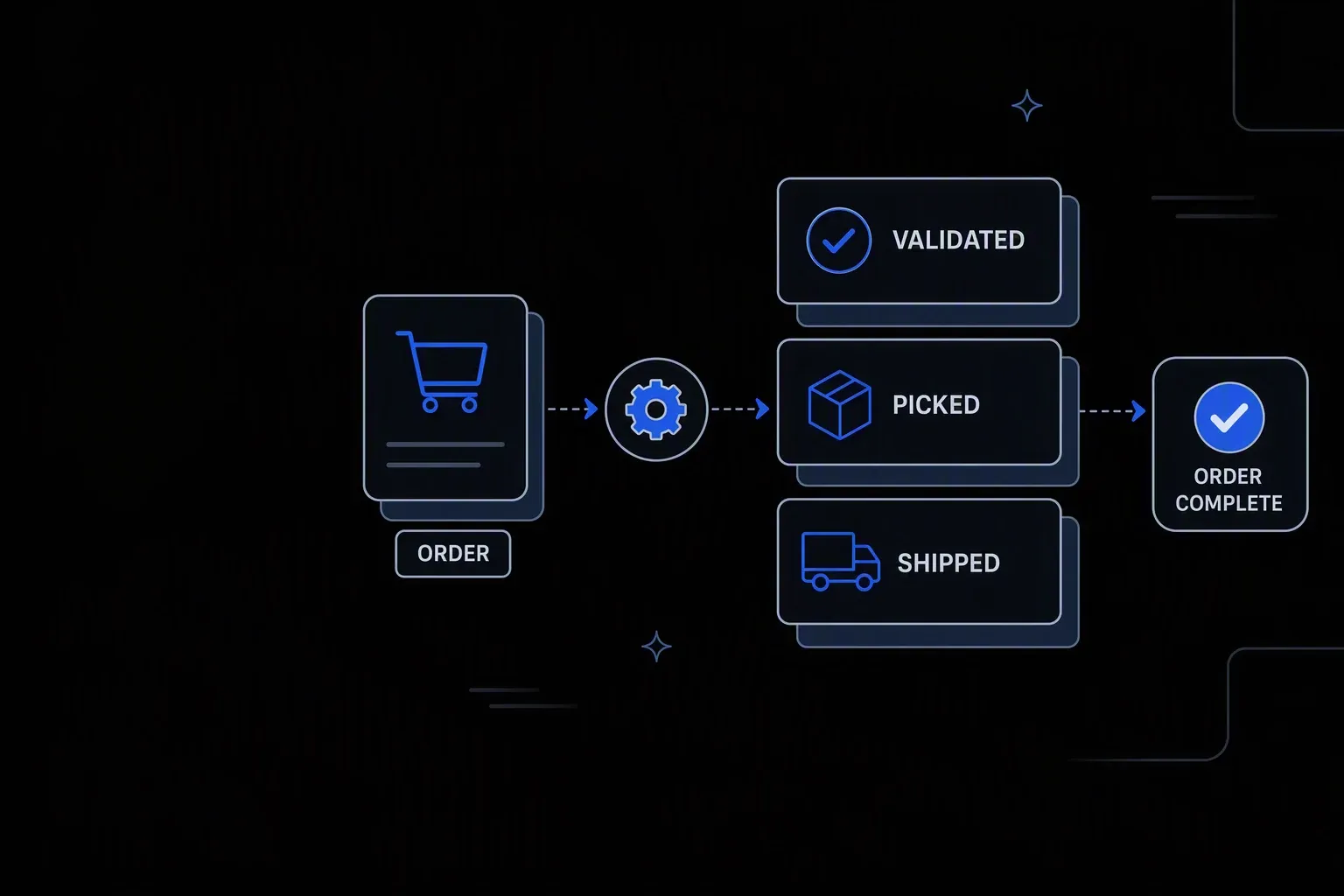
Order Management Automation
Automate the order lifecycle from placement to fulfillment — zero manual steps.
Order to fulfilment, untouched
Straight-through processing
Standard orders flow from channel to warehouse to finance without anyone re-entering them.
Exceptions surface early
Fewer escalations
Payment, stock, and address problems are caught at intake rather than discovered at the packing bench.
One status everyone trusts
Shared visibility
Support, finance, and the warehouse read the same order state instead of three partial views.
One governed workflow across systems that never talked.
- Who it's for
- eCommerce and supply chain teams moving orders between sales channels, fulfilment, and finance systems that were never designed together.
- What it does
- A governed workflow that validates, routes, and tracks orders from capture through fulfilment and financial posting.
- Systems involved
- Your sales channels, ERP, warehouse, and payment platforms — connected through the REST Client, with dedicated activities built on request.
- How it stays governed
- Validation and routing rules in decision tables, approval routing for exceptions, and a complete record per order.
What this looks like today
The friction that makes this workflow expensive to run by hand.
Re-entry
Orders are typed in twice
An order captured in the channel gets re-entered into the ERP and again into fulfilment, adding delay and a chance to get it wrong each time.
Exceptions
Problems found too late
Failed payments, insufficient stock, and bad addresses surface during picking, when correcting them costs the most.
Visibility
Nobody can say where an order is
Status lives in whichever system last touched it, so answering a customer means checking several and reconciling them.
The workflow
How Koodisi runs it
Koodisi automates the full order management workflow — from order capture in eCommerce to fulfillment in ERP, shipping, and customer communication — eliminating manual order processing.
Capture from every channel
Orders arrive from each sales channel into one process, so downstream systems see a consistent shape regardless of origin.
Webhook and scheduled triggers over the REST Client.
Validate before committing
Payment status, stock availability, address quality, and credit terms are checked at intake, so problems are caught while they are still cheap.
Validation rules are defined in decision tables.
Route by rules, not habit
Fulfilment location, shipping method, and handling are resolved from order attributes rather than decided case by case.
Routing logic lives in readable decision tables.
Hold what needs judgement
High-value orders, credit holds, and flagged addresses go to a named approver with the context to decide, while clean orders continue.
The approval and approver are recorded.
Post to fulfilment and finance
The warehouse and the ERP are updated from the same validated record and read back to confirm, so an order cannot be shipped but unbilled.
Retry policies cover transient failures; mismatches raise a failed run.
Keep one status
Each transition is recorded against the order so support, finance, and operations read the same state.
Execution logging per order with before and after state.
Connectivity
The systems in this workflow
Koodisi orchestrates the platforms this workflow touches — through the REST Client today, and through a dedicated activity whenever you need one.





The capability underneath
Every workflow above is assembled from the same governed building blocks — which is why connecting one more system is a day of work, not a project.
Connect to anything
- REST and webhook connectivity with managed authentication (4 activities)
- Secure file transfer over SFTP (5 activities)
- Direct database reads and writes (4 activities)
Move and reshape data
- Translate between CSV, JSON, XML, and fixed-width formats (6 activities)
- Field-level mapping between systems that model data differently
- High-volume batch processing with per-record tracking (7 activities)
Decide and protect
- Decision tables for approval and routing rules your team can read
- Encryption, hashing, and signature verification on sensitive fields
- Retry policies, error handling, and full execution logging
Business systems connect through Koodisi’s REST Client, and our team builds dedicated activities for the ones you depend on — typically within a day of you asking.
Request a system →Governance
Automated, but still under control
Every run is authorised, recorded, and observable — the part that decides whether automation survives an audit.
Routing rules in the open
Fulfilment and handling logic lives in decision tables operations can review, not inside workflow code.
Every order traceable
Each order carries a record of validations, decisions, approvals, and system writes with before and after state.
Approval authority scoped
Permission scopes control who can release held orders, so value thresholds mean something.
Customer and payment data masked
Payment identifiers and personal details are masked in logs so order records can be reviewed safely.
Credentials in Key Vault
Channel, ERP, and payment credentials are stored in Key Vault and referenced at run time.
Traced end to end
OpenTelemetry traces follow an order across systems, so a stuck order is found by looking rather than asking.
Yes. Decision tables define what needs judgement — value thresholds, credit holds, flagged addresses — and those orders wait for a named approver while everything else flows through.
Availability is checked at intake, so the problem surfaces before picking. If it changes later, the run fails with the order and reason identified rather than shipping an order that cannot be fulfilled.
Fulfilment and financial posting are driven from the same validated record and both confirmed, so an order cannot be shipped without a corresponding financial entry.
ERP platforms connect through Koodisi's REST Client against any documented API. Where you depend on a specific one, our team builds a dedicated activity — typically within a day.
Tools used in this workflow
Ship integrations faster. Operate them without chaos.
Less time on auth, retries, and deployment scripts. More time on the integrations your customers are asking for.
Contact Sales